
Unified model API
AI SDK standardizes common language-model integration patterns across supported providers, reducing the need to implement provider-specific request and response handling.

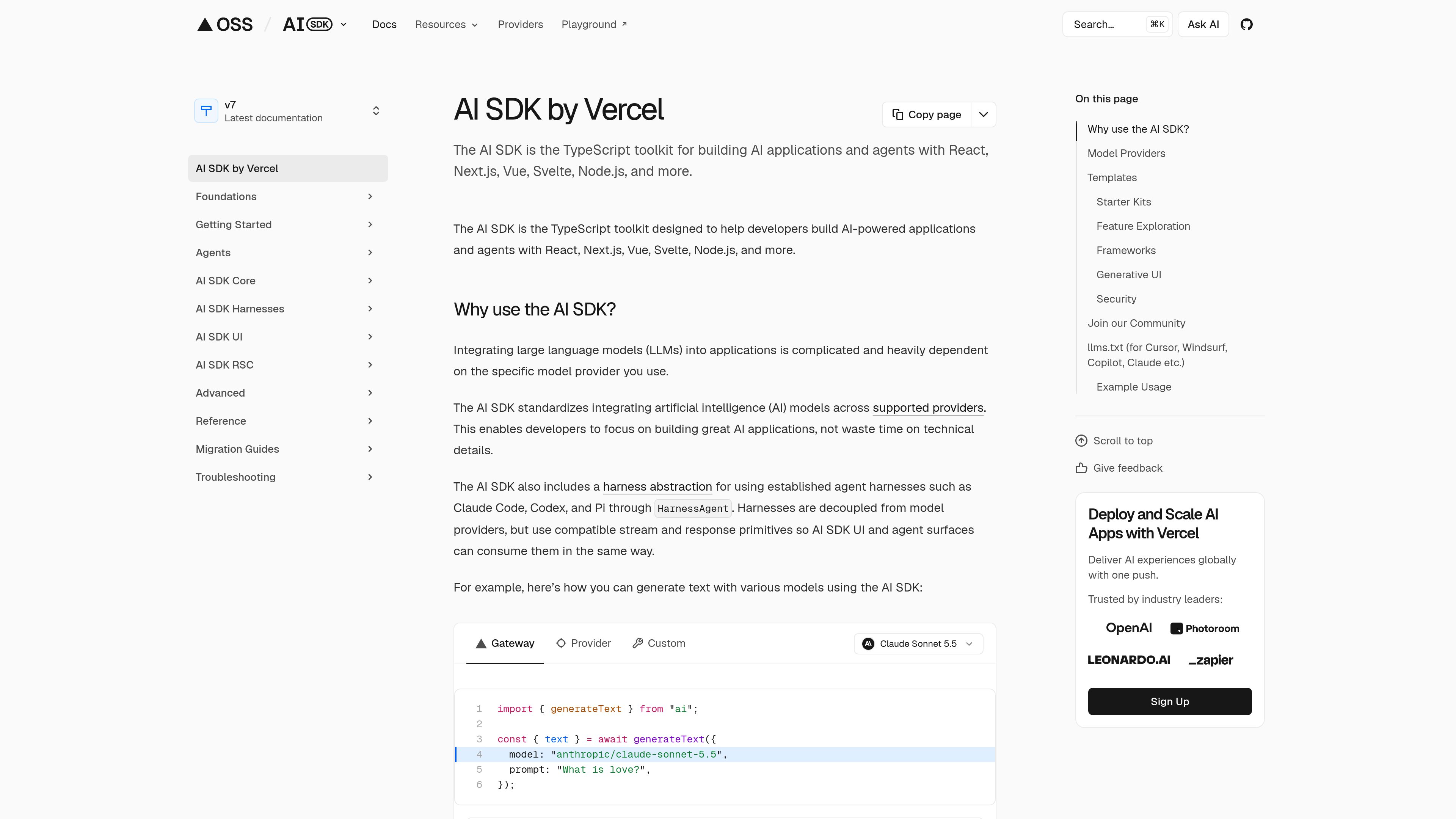
AI SDK is a TypeScript toolkit for building AI-powered applications and agents across supported model providers and web frameworks. It provides shared APIs for model generation, tool use, streaming, structured output, and AI user interfaces.
AI SDK is a TypeScript toolkit from Vercel for building AI-powered applications and agents. It standardizes integration with supported language model providers and offers APIs for text generation, tool calls, streaming, structured output, and AI-driven interfaces.
Its main surfaces are AI SDK Core, AI SDK UI, and AI SDK Harnesses. Core handles model generation and agent-oriented workflows; UI provides framework-agnostic hooks for chat, completions, and streamed JSON; and HarnessAgent offers a uniform API for running established agent harnesses such as Claude Code, Codex, and Pi. The documentation includes framework examples for frontend and backend applications.
AI SDK standardizes common language-model integration patterns across supported providers, reducing the need to implement provider-specific request and response handling.
AI SDK Core provides `generateText` for non-interactive generation and tool-using agents, plus `streamText` for interactive responses and streamed content.
Core generation functions support structured output through options such as `Output.object()` and `Output.array()`, useful for information extraction, classification, synthetic data, and generated UI data.
AI SDK UI includes `useChat`, `useCompletion`, and `useObject` for streaming chat messages, text completions, and JSON objects while managing relevant frontend updates and state.
The UI layer is documented for React, Vue.js, Svelte, Angular, and SolidJS, with framework-specific packages and examples such as Next.js, Nuxt, SvelteKit, and Angular.
AI SDK Harnesses provide a uniform API through `HarnessAgent` for established harnesses including Claude Code, Codex, and Pi, using compatible stream and response primitives for AI SDK surfaces.
Use `streamText` with AI SDK UI’s `useChat` hook to deliver streamed responses and manage message, loading, error, and input state in a chat interface.
Use `generateText` for non-interactive workflows such as drafting email or summarizing web pages, where a response can be generated without a live conversational UI.
Generate typed, schema-validated objects or arrays for information extraction, classification, and other workflows that need data rather than free-form text.
Build agent workflows that call tools with AI SDK Core, or connect established agent harnesses through `HarnessAgent` and consume their compatible streams and responses.
Use streamed JSON with `useObject` and AI SDK Core structured output to render data-driven or generative UI experiences; the site also provides templates for multi-step tools and streamed structured objects.
It is used to build AI-powered applications and agents with TypeScript, including chat interfaces, text generation workflows, tool-using agents, structured data generation, and streamed or generative UI.
The documentation lists React, Vue.js, Svelte, Angular, and SolidJS. It also provides framework examples for Next.js, Nuxt, SvelteKit, and Angular.
`generateText` is intended for non-interactive generation, automation, and tool-using agents. `streamText` streams text and tool calls for interactive use cases such as chatbots and content streaming.
Yes. AI SDK Core supports structured output through the `output` property, including `Output.object()` and `Output.array()`, for typed and schema-validated data workflows.
AI SDK standardizes integration across supported providers rather than being a single model. The site lists providers including OpenAI, Anthropic, Google Generative AI, xAI, Azure, Amazon Bedrock, and others; available capabilities differ by provider.

www.agentops.ai
AgentOps is a developer platform for building, tracing, debugging, and deploying AI agents and LLM applications. It provides observability for agents built with OpenAI, CrewAI, AutoGen, and more than 400 LLMs and frameworks.

autoloops.ai
Autoloops provides speech infrastructure for voice agents, combining streaming speech-to-text with realtime serving for open-weight language models. It offers serverless APIs and on-demand clusters for teams building or testing realtime voice and agent workloads.

www.edgee.ai
Edgee is an agent gateway for coding teams that reduces token usage, routes requests across models, and provides usage visibility. Its Compression V2 works as a drop-in CLI layer for Claude Code, Codex, OpenCode, Cursor, and other supported agents.

modelcontextprotocol.io
The official TypeScript SDK for building Model Context Protocol servers and clients. It provides a repository-organized foundation for MCP development, with separate client, server, core, middleware, documentation, and example areas.
www.statewave.ai
Statewave is an open-source, self-hosted memory runtime for AI agents. It stores durable episodes, compiles structured memories with provenance, and returns ranked context bundles for applications that need continuity across sessions.

apra-labs.github.io
apra-fleet runs a fleet of AI agents across multiple machines and provider CLIs. It provides a common execution model for combining Claude, Codex, Copilot, Antigravity, and local models.