
Member-based execution
Models each execution unit as a member consisting of a machine and a provider CLI.

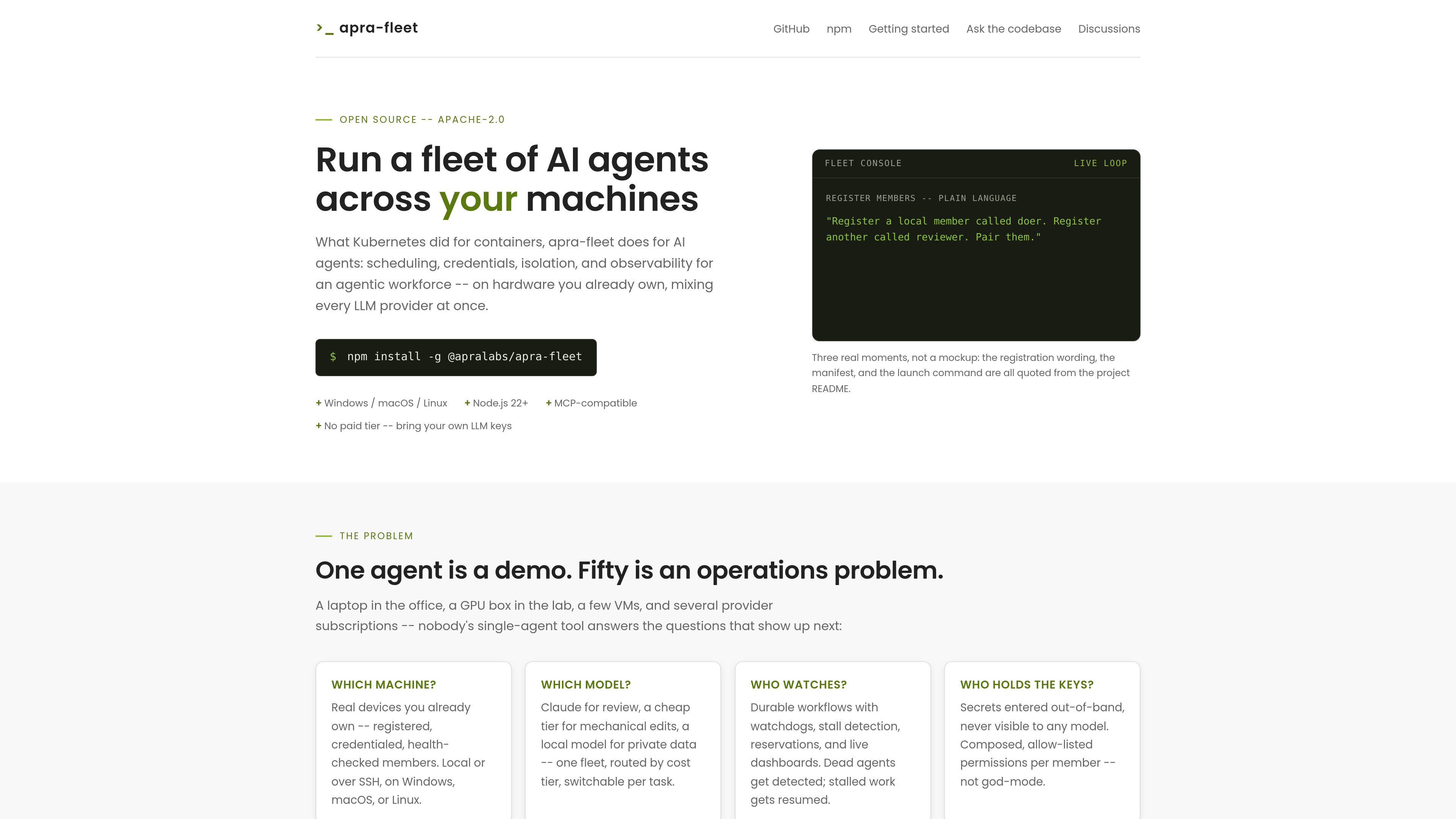
apra-fleet runs a fleet of AI agents across multiple machines and provider CLIs. It provides a common execution model for combining Claude, Codex, Copilot, Antigravity, and local models.
apra-fleet is a tool for running a fleet of AI agents across machines and vendors. Its unit of execution is a member, defined as a machine paired with a provider CLI. Members can be registered with different providers, allowing a fleet to span more than one agent ecosystem.
The provider connection is swappable at registration. Each provider is placed behind a shared strategy interface, giving the fleet a consistent abstraction while supporting multiple provider implementations. The documented provider examples include Claude, Codex, Copilot, Antigravity, and local models.
Models each execution unit as a member consisting of a machine and a provider CLI.
Organizes AI agent execution across multiple machines rather than limiting the execution model to one host.
Allows the provider CLI associated with a member to be swapped at registration.
Places each provider behind one strategy interface, giving different provider implementations a common integration boundary.
The documented model supports combining Claude, Codex, Copilot, Antigravity, and local models within the same fleet concept.
Use members to represent agent-running machines when execution needs to span more than one host.
Register members with different provider CLIs to work with a fleet that includes providers such as Claude, Codex, Copilot, Antigravity, and local models.
Use swappable registration when a machine’s associated provider CLI needs to change without changing the broader member-based fleet model.
A member is the product’s unit of execution: a machine paired with a provider CLI.
The site names Claude, Codex, Copilot, Antigravity, and local models as providers that can work through the shared strategy interface.
The provider is swappable at registration, according to the site description.
No. Its strategy interface is designed to support mixing multiple providers across the fleet.
No pricing, setup instructions, platform requirements, output formats, or deployment details are provided in the available site content.

www.edgee.ai
Edgee is an agent gateway for coding teams that reduces token usage, routes requests across models, and provides usage visibility. Its Compression V2 works as a drop-in CLI layer for Claude Code, Codex, OpenCode, Cursor, and other supported agents.

flocker.md
Flocker is an AI agent management platform for creating agent profiles, coordinating multi-agent work, and monitoring activity from a shared dashboard. It is designed for people running multiple agents across tools such as Claude Code, Codex, OpenClaw, OpenCode, and MCP-compatible workflows.

kody.codes
Kody is a software platform that gives connected AI agents shared memory, credentials, reusable packages, integrations, and scheduled execution. It helps developers carry work between agents such as Cursor, Claude, ChatGPT, and Codex without rebuilding the same automation each time.

opentrade.io
OpenTrade is an open-source trading harness for Claude Code and Codex agents. It provides a repository-based app, agent templates, and scheduling-oriented run management for automated trading workflows.

autoloops.ai
Autoloops provides speech infrastructure for voice agents, combining streaming speech-to-text with realtime serving for open-weight language models. It offers serverless APIs and on-demand clusters for teams building or testing realtime voice and agent workloads.

ai-sdk.dev
AI SDK is a TypeScript toolkit for building AI-powered applications and agents across supported model providers and web frameworks. It provides shared APIs for model generation, tool use, streaming, structured output, and AI user interfaces.