
phosphobot
An open-source robotics toolkit intended for developers who want to control robots and work with robot data and model training.

phospho offers open-source robotics tools, hardware kits, PRO subscription, and custom solutions for robot control, dataset collection, and AI model training.
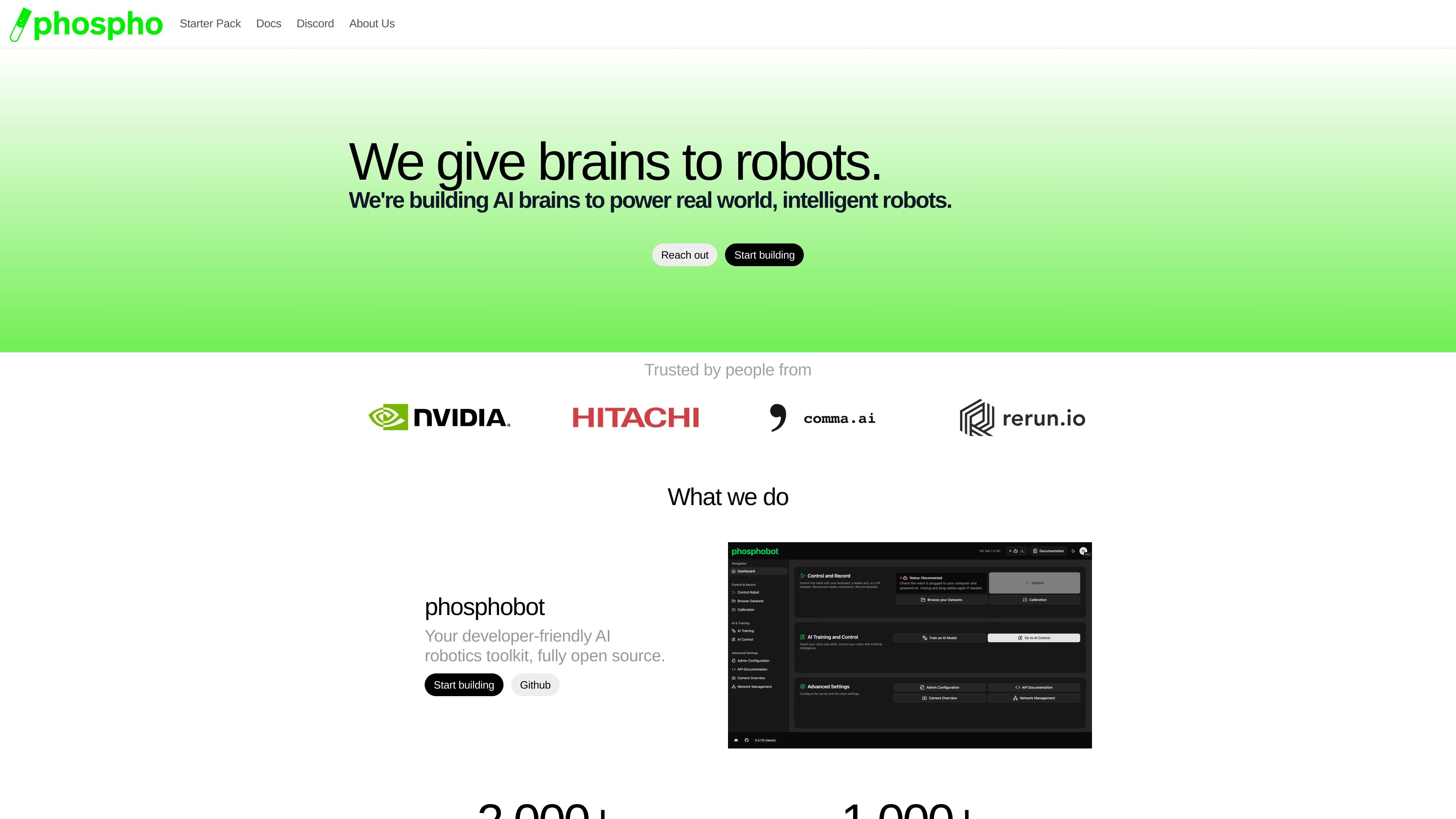
phospho is an AI robotics company focused on giving robots software brains. On its homepage, the company describes a product stack that includes an open-source robotics toolkit, a hardware shop, a paid subscription, and custom solution services.
The open-source toolkit, phosphobot, is positioned for developers who want to control robots, record datasets, and train AI models. The broader site also points to phospho PRO for cloud AI training and VR teleoperation, plus custom work for datasets, models, and evaluations.
An open-source robotics toolkit intended for developers who want to control robots and work with robot data and model training.
A hardware shop that sells dev kits with vetted hardware to help people start learning and experimenting in robotics.
A paid subscription that adds cloud AI training, VR teleoperation, dedicated support, and similar experiment-accelerating services.
Custom project support for datasets, AI models, and evaluations for teams that need tailored help.
Documentation entry points and a GitHub link are surfaced directly from the homepage for users who want to inspect the open-source toolkit.
Developers can use the open-source toolkit to control robots and build around robot data and model training workflows.
Learners can start with dev kits from the hardware shop when they want vetted hardware for robotics practice.
Teams that need more speed or remote operation can use phospho PRO for cloud AI training and VR teleoperation.
Organizations with specific data or evaluation needs can contact phospho for custom datasets, AI models, and evaluations.
Phospho’s homepage presents it as an AI robotics company that provides software to give robots more intelligence. The site also highlights an open-source toolkit called phosphobot, a hardware shop, and a paid phospho PRO subscription for more advanced experimentation.
The homepage says phosphobot is a developer-friendly AI robotics toolkit that is fully open source. It is positioned for controlling robots, recording datasets, and training AI models.
The site indicates that phospho PRO is a subscription that adds cloud AI training, VR teleoperation, dedicated support, and related capabilities. The pricing page itself was unavailable, so the public site evidence is limited to those homepage mentions.
The homepage includes links for documentation, hardware, and contact options, but it does not provide a detailed setup flow or implementation guide in the available text. Specific integrations and supported hardware are not listed in the collected evidence.