
Always-on execution
Daemons are described as always-on AI processes that work without explicit prompts, so they can keep acting as new signals arrive instead of waiting for a manual request.

Charlie Labs’ Daemons are always-on AI processes for Slack, Linear, GitHub, and Sentry, built for recurring maintenance and coordination.
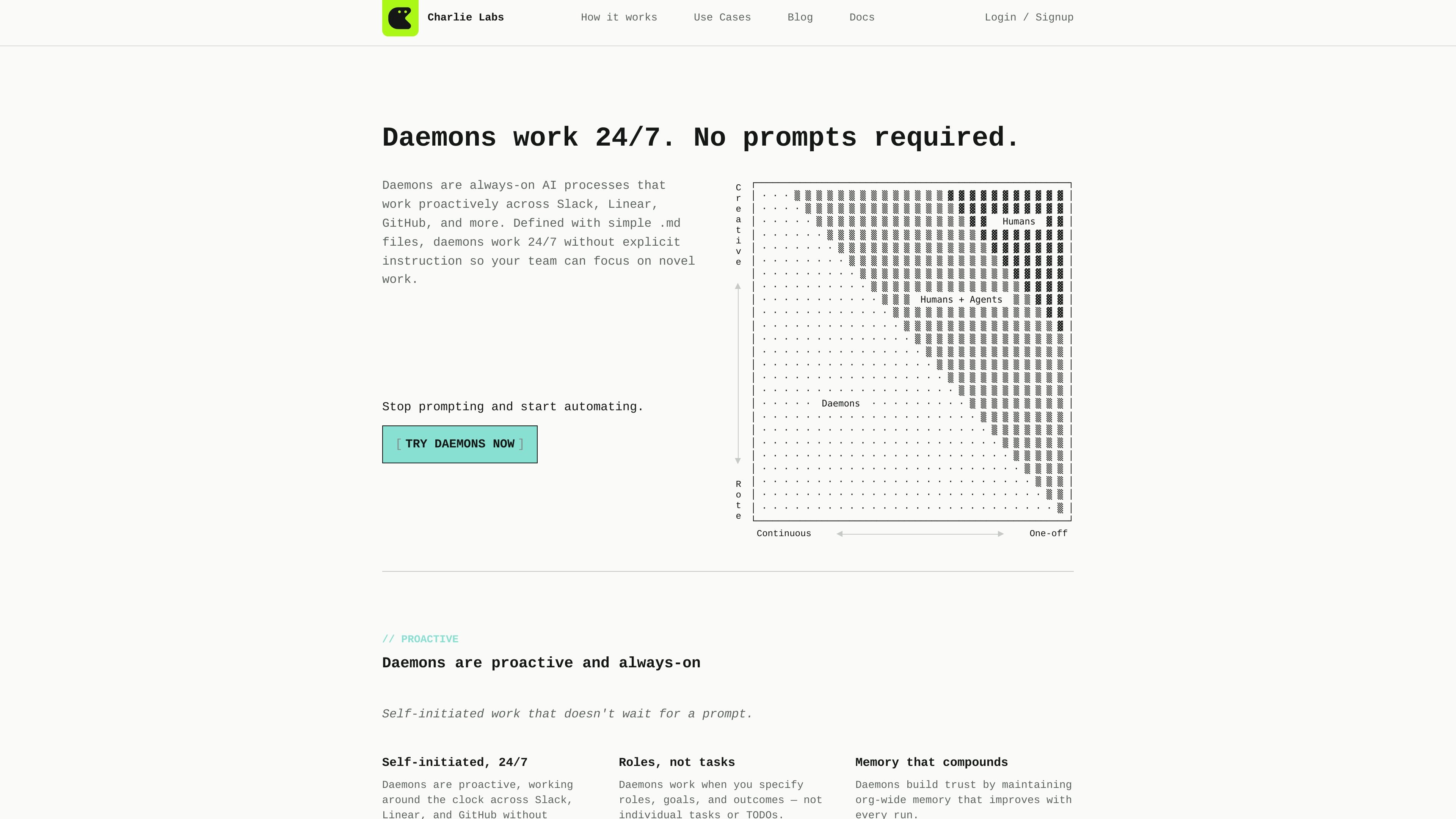
Charlie Labs offers Daemons, always-on AI processes that act proactively across team systems such as Slack, Linear, GitHub, and Sentry. Rather than waiting for prompts, a daemon runs from a defined role and policy so it can keep recurring work moving in the background.
Each daemon is configured in a Markdown file in the repo. The product combines policy-driven execution, verification, durable updates, and approval gates for higher-risk changes, which makes it suited to maintenance, coordination, and other ongoing operational tasks.
Daemons are described as always-on AI processes that work without explicit prompts, so they can keep acting as new signals arrive instead of waiting for a manual request.
The product centers each daemon on a role, goal, and outcome rather than a single task, which fits recurring responsibilities like maintenance or follow-through.
Daemon behavior is defined in Markdown files with frontmatter and body content, making the operating rules readable and editable in the repository.
The how-it-works flow shows daemons gathering context, setting boundaries, executing approved changes, verifying results, and posting durable updates.
The site emphasizes outputs such as PRs, comments, checks, escalations, fixes, and no-op decisions, so the work leaves an audit trail instead of disappearing into background automation.
The execution model includes approval gates for higher-risk or broader changes, keeping sensitive actions human-controlled when needed.
Keep pull requests review-ready by watching for new or updated PRs, suggesting better descriptions, and flagging missing reviewer context.
Monitor issue trackers for recurring problems, add the right labels or updates, and help prevent the same bug from resurfacing.
Track documentation drift after code changes and propose scoped updates when shipped behavior no longer matches the docs.
Maintain codebase hygiene by keeping dependencies, patches, and other recurring upkeep tasks moving without waiting for a separate prompt.
Charlie Daemons are defined in Markdown files in your repo. The page describes the contract as a DAEMON.md file with frontmatter for name, purpose, watch conditions, routines, deny rules, and schedule, plus Markdown body content for policy and output format.
The pricing page says plans are based on daily and weekly Charlie usage limits, not monthly credits. If a workspace reaches its limits, it can buy overage credits or wait for limits to reset, and usage counts both daemons and human-invoked Charlie workflows together.
The how-it-works page shows daemons can operate across GitHub, Linear, Slack, and Sentry, and the homepage also mentions Slack, Linear, and GitHub. The source does not provide a full integration list beyond those examples.
The product is built around policy-driven runs with approvals when needed. The execution model includes intake, context building, planning with boundaries, execution, verification, reporting, and continued monitoring from saved state.
The site presents daemons as ongoing roles rather than one-off tasks. They are meant for recurring maintenance, updates, and follow-through work that continues after a team has moved on.