
Vector data database
Weaviate is designed specifically for storing and working with vector data, supporting AI applications that depend on similarity-based retrieval.

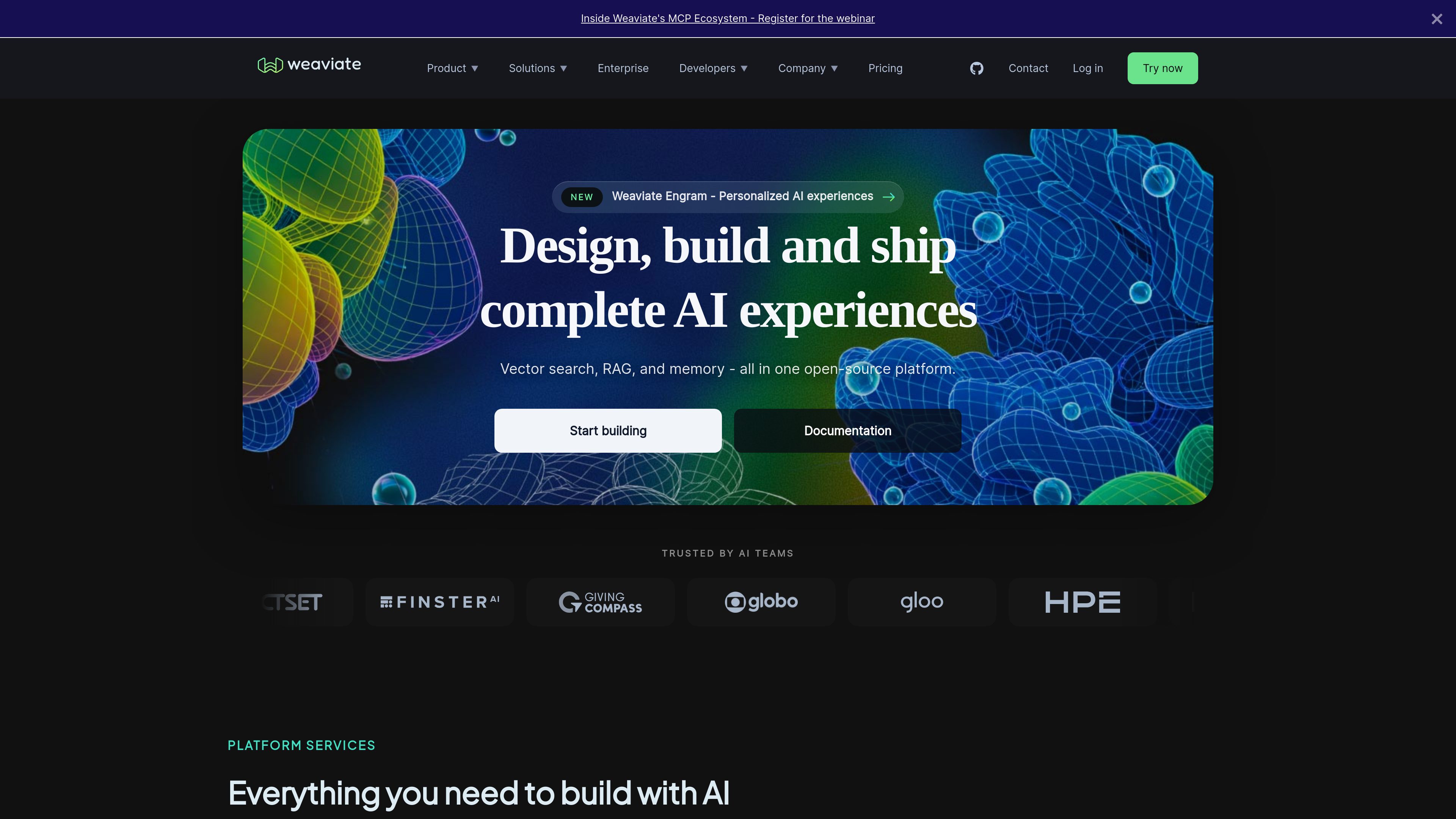
Weaviate is a vector database for building AI-native applications, including retrieval-augmented generation systems. It helps developers store and retrieve vector data, connect applications to language models, and deploy the database in a managed, self-hosted, or private-cloud environment.
Weaviate is a vector database and AI database for developers building AI-native applications. Its design is aimed at vector data and supports retrieval workflows in which relevant external knowledge is supplied to a large language model (LLM). This makes it suitable for applications that need contextual, searchable data alongside generative AI.
The platform supports retrieval-augmented generation (RAG), using hybrid search to help applications return relevant information for generated answers. Weaviate can be self-hosted or hosted and managed within a customer's own VPC, allowing teams to keep data in their chosen environment. Developers can also connect to different LLMs with a single line of code and use GUI-based tools and apps intended to simplify development and scaling.
Weaviate is designed specifically for storing and working with vector data, supporting AI applications that depend on similarity-based retrieval.
RAG applications can use hybrid search to retrieve relevant information for contextual answers.
Developers can connect to different large language models with a single line of code, making it possible to test different models during development.
Weaviate can be self-hosted or hosted and managed within a customer's own VPC.
The product ecosystem includes graphical tools and applications intended to make building and scaling AI-native applications easier.
Add external knowledge to an LLM workflow so generated content can be based on retrieved, relevant data rather than the model alone.
Deploy Weaviate yourself or use a managed deployment in your own VPC when the database needs to remain within a controlled environment.
Connect different LLMs during application development to compare options and iterate on the model that fits a particular use case.
Use retrieval and generative AI together to support customer-service applications with contextual answers; the site identifies customer service as a RAG application area.
Weaviate is used to build AI-native applications that need vector-data retrieval, including retrieval-augmented generation systems. It can supply relevant external knowledge to an LLM before the model generates an answer.
Yes. The source describes both self-hosting and a managed option hosted within your own VPC.
Yes. Weaviate states that developers can connect to different LLMs with a single line of code, supporting experimentation and iteration across models.
Yes. The always-free managed tier requires no credit card and includes one cluster per user. The published allowance is 100,000 objects, 1 GB of memory, 10 GB of disk, one collection, up to three tenants, embeddings at 2,000 requests per day, Query Agent at 1,000 requests per month, and basic support.

supabase.com
Supabase is a Postgres development platform for building applications with a database, authentication, APIs, realtime features, serverless functions, storage, and vector support. It helps developers move from application code to a managed backend through a dashboard, client libraries, CLI, and generated APIs.

myscale.com
MyScale queries vector and structured data with SQL. Build similarity and filtered retrieval over embeddings and metadata on a managed cloud cluster.

redis.io
Redis is a real-time data platform and database for applications, with Redis Cloud providing a fully managed deployment on major public cloud services. It supports application data, caching, search, and AI-oriented workflows through Redis and Redis Stack.

serenedb.com
SereneDB is a search-OLAP database for real-time full-text, vector, hybrid search, and analytical queries over the same data. It uses SQL and the PostgreSQL wire protocol, helping developers connect with familiar clients while keeping search and analytics in one engine.

pgvector.org
pgvector is an open-source PostgreSQL extension for storing vectors and running exact or approximate nearest-neighbor searches alongside relational data. It supports multiple vector formats, distance functions, and standard PostgreSQL operations for applications that need similarity search.

upstash.com
Upstash Vector is a serverless vector database for storing and querying embeddings and metadata in AI and machine-learning applications. It supports dense, sparse, and hybrid indexes through a REST API and SDKs for Python, TypeScript, Go, and PHP.