
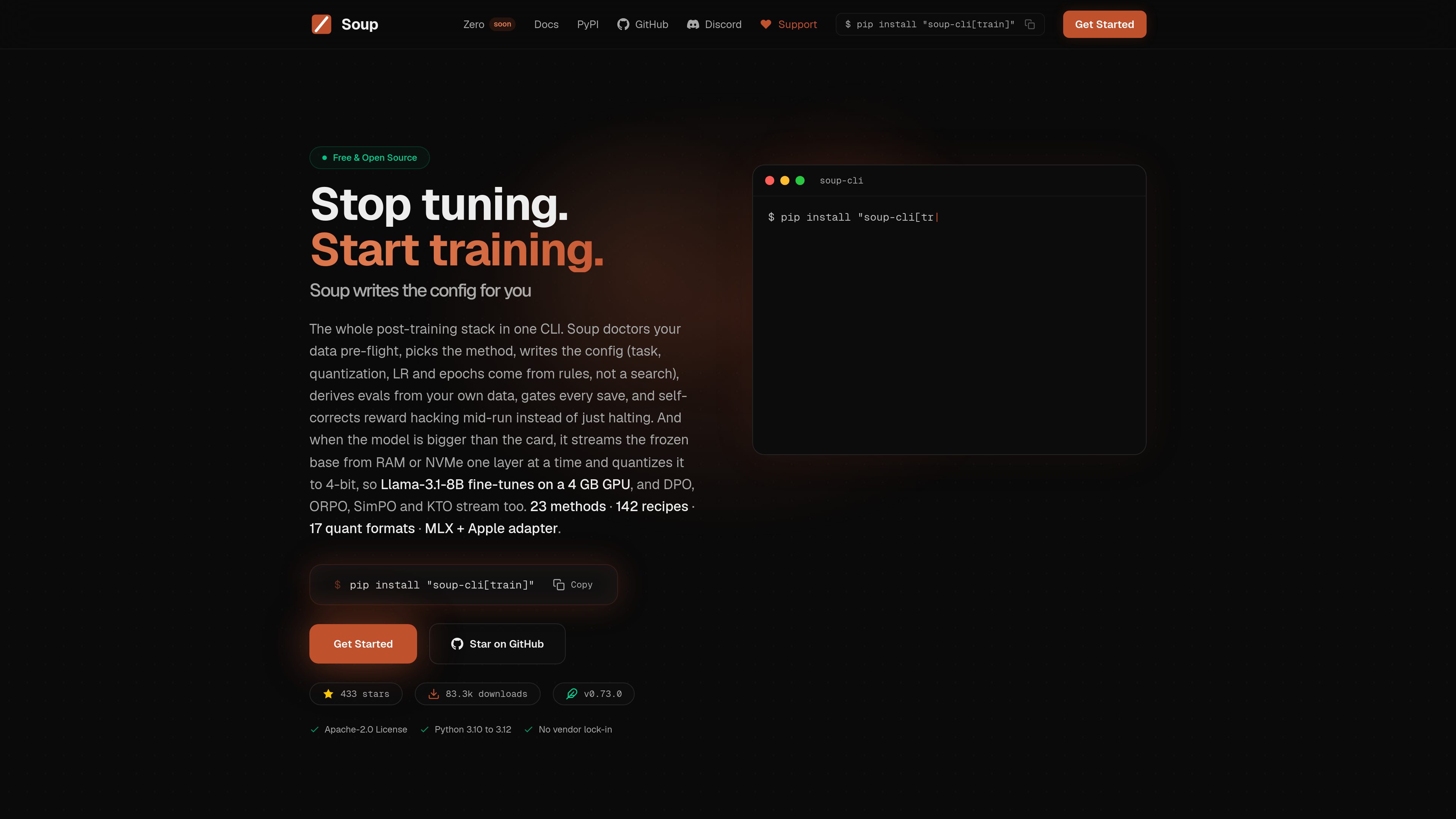
Config-driven training setup
`soup init` creates a `soup.yaml`, and the site states that Soup writes much of the training configuration automatically, including task, quantization, learning rate, and epochs when rules determine them.

Soup CLI é uma ferramenta de linha de comando de código aberto para pós-treinamento e fluxos de trabalho relacionados a modelos, incluindo ajuste fino, treinamento por preferência, avaliação, combinação de modelos, implantação e preparação de dados. É voltada a quem quer gerenciar o treinamento e a entrega de modelos com uma única CLI offline, em hardware próprio ou emprestado.
Soup CLI is an offline, CLI-first toolkit for post-training language models and related workflows. It combines training setup, data preparation, evaluation, model merging, inference serving, export, and deployment commands in one interface.
Its core training workflow is designed to work from a config file generated by the tool, with rules that set many defaults automatically. The site emphasizes methods such as supervised fine-tuning and preference training, plus layer streaming so the frozen base model can stay in CPU RAM or NVMe instead of occupying full VRAM.
The product is positioned for users training on limited hardware, including cases where a model is too large to fit resident in GPU memory. The docs also show commands for migrating configs from other tools, browsing recipes, running eval gates, and pushing or deploying models to external runtimes.
`soup init` creates a `soup.yaml`, and the site states that Soup writes much of the training configuration automatically, including task, quantization, learning rate, and epochs when rules determine them.
Soup can stream the frozen base layer-by-layer from CPU RAM or NVMe into VRAM so only one layer is resident at a time, which the site says supports training models that do not fit on the card.
The training docs and home page mention support for supervised fine-tuning and preference methods including DPO, ORPO, SimPO, and KTO, with the training page stating 23 task values in the schema.
`soup train` supports `--gate` to run evaluation suites at epoch boundaries and halt on regression, and the home page says Soup derives evals from the user’s own data and gates saves on a ship/don’t-ship verdict.
`soup migrate` imports configs from tools like LLaMA-Factory, Axolotl, and Unsloth, while `soup recipes` lets users list, inspect, search, and copy from 142 ready-made recipes.
The reference includes commands for chat, serving, export, merge, push, evaluation, data validation, deduplication, generation, and dataset publishing, making the tool a broader model ops CLI rather than a training-only utility.
Use Soup when a base model is too large to load fully into VRAM and you need a streaming approach that keeps the frozen base in RAM or on NVMe.
Use it for DPO, ORPO, SimPO, or KTO runs where you want the reference model to come from the same streamed base rather than loading a second resident copy.
Use `soup migrate` to convert existing setups from LLaMA-Factory, Axolotl, or Unsloth into Soup YAML with minimal manual rewriting.
Use gating and checkpoint-related flags when you want runs to stop on eval regressions or automatically resume and push checkpoints during training.
Use Soup when you want a single workflow for data review, training, evaluation, adapter merging, deployment, and export to serving formats.
Soup CLI is a command-line tool for post-training workflows such as training, evaluation, merging, deployment, data preparation, and dataset handling.
Yes. The site says Soup can stream the frozen base from CPU RAM or NVMe layer by layer so the model does not have to stay resident in VRAM.
The site explicitly mentions SFT, DPO, ORPO, SimPO, and KTO, and the training docs describe 23 task values in the schema.
Yes. `soup migrate` is documented for importing configs from LLaMA-Factory, Axolotl, and Unsloth.
No. The CLI reference also documents chat, serving, export, merge, push, eval, and data commands.
Os dados de tráfego são apenas para referência.
| mai. | 0 |
|---|---|
| jun. | 0 |
| jul. | 0 |
As análises de tráfego ainda não estão disponíveis.
As análises de tráfego ainda não estão disponíveis.

www.coldtea.ai
Coldtea é um ambiente de entrega de software com tecnologia de IA para equipes que querem gerenciar QA, monitoramento de produção, detecção de bugs, criação de tarefas e correções em um só lugar. Ele roda na sua máquina e ajuda a identificar regressões e problemas de produção depois que o código é escrito.

antideploy.com
Antideploy é uma plataforma de implantação que analisa o código da aplicação, determina o runtime e a infraestrutura necessários, cria tudo e disponibiliza o serviço via HTTPS. Faça deploy pelo GitHub, uma pasta local, uma API ou agentes de programação sem escrever um Dockerfile ou uma configuração YAML.

nuphos.ai
Nuphos é um espaço de trabalho DevOps nativo de IA para equipes de engenharia. Ele oferece um ambiente compartilhado onde agentes de IA podem aprender a infraestrutura, investigar problemas e operar sistemas de produção com aprovação humana e trilhas de auditoria.

dagster.io
Dagster é uma plataforma nativa de IA para pipelines de dados confiáveis

middleware.io
Observabilidade full-stack para logs, métricas, traces, infraestrutura, aplicações e experiência do usuário, com OpsAI para detectar problemas e apoiar a remediação.

devtron.ai
Gestão Kubernetes nativa de IA para entrega, infraestrutura e custos