
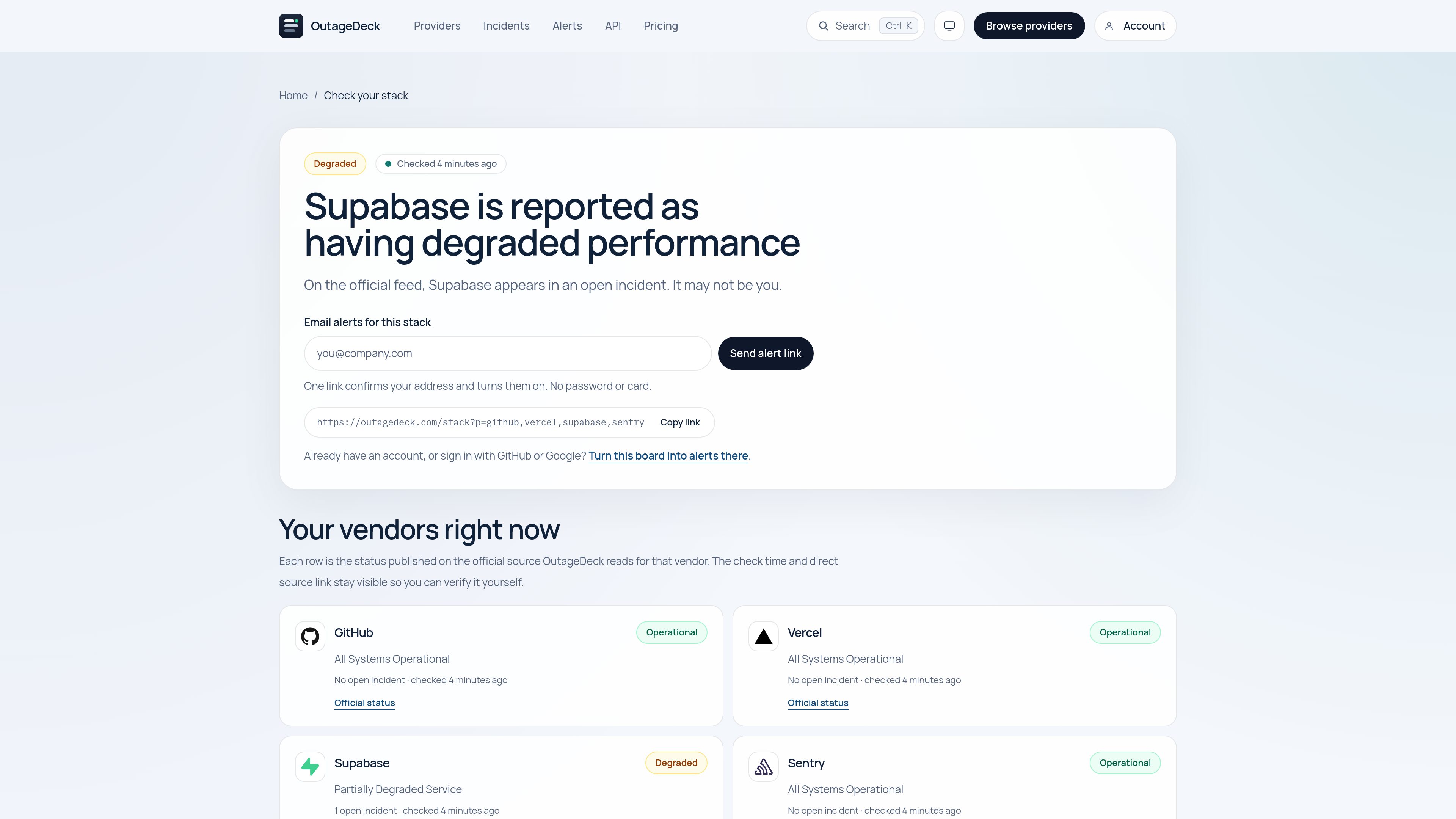
Official status and incident views
Shows each selected provider's published status, open incident count, latest check time, and a direct link to the official source. A read failure is not treated as a provider outage.

OutageDeck monitors official status feeds for cloud and software providers, then shows current incidents and sends change-based alerts. It helps individuals and teams determine whether a service problem is external before troubleshooting their own systems.
OutageDeck is a provider-status monitoring service for checking whether a vendor outage may be affecting your stack. It reads official status sources, displays current provider states and open incidents, and keeps the check time and direct source link visible for verification. Shareable stack boards can contain up to 12 vendors and are represented by a link rather than a stored board.
Users can receive email alerts on the free plan and configure Slack, Microsoft Teams, Discord, generic webhook, and email destinations on paid plans. OutageDeck also exposes provider and incident information through a public JSON API, status badges, RSS feeds, Markdown status walls, and an MCP server for coding-agent queries.
Shows each selected provider's published status, open incident count, latest check time, and a direct link to the official source. A read failure is not treated as a provider outage.
Build a link-based board for up to 12 vendors, including services such as GitHub, Vercel, Supabase, and Sentry. The selected stack is not stored and can be bookmarked or shared in an incident channel.
Compares each ingestion run with the previous known state and alerts on new incidents, incident status changes, resolutions, and provider status changes. Alerts do not fire for historical incident backfills.
Email alerts are available on free accounts. Paid plans support Slack, Microsoft Teams, Discord, and generic HTTPS webhooks, with destination-specific setup and test delivery.
Provides a public JSON API, status badges, RSS feeds, Markdown status walls, and an MCP server for querying provider status from compatible coding-agent workflows.
Webhook payloads use a versioned JSON envelope, include incident or provider-status data, and carry an OutageDeck-Signature HMAC-SHA256 header so receiving systems can verify delivery authenticity.
When an application starts failing, open a stack board to compare the current official status of its selected cloud, monitoring, database, and developer-tool providers before changing application code or infrastructure.
Configure a Slack, Teams, or Discord destination so a team receives provider incidents and status changes in the channel it already uses for operational work.
Send signed webhook payloads to an HTTPS endpoint and process versioned incident or provider-status events in internal automation, provided the endpoint acknowledges deliveries with a 2xx response within 10 seconds.
Paid alert rules and custom providers support separate destinations and scopes for teams, clients, or services that need different subsets of a broader vendor stack.
Use the JSON API, RSS, Markdown status wall, or MCP server to expose current provider verdicts in a dashboard, documentation page, feed reader, or coding-agent workflow.
OutageDeck re-reads the official status feed of tracked providers about every 10 minutes. Each provider view shows its check time, so users can judge how current the displayed result is.
Alerts are triggered when an ingestion run detects a change: a new incident, an incident status change, an incident resolution, or a provider-level status change. Historical incidents added during a backfill do not trigger alerts.
Email is available on every account. Paid plans add Slack, Microsoft Teams, Discord, and generic HTTPS webhooks. Slack, Discord, and Teams use their respective webhook or workflow URLs, and each can be tested after setup.
Yes. A subscription can watch all providers or selected providers, and can be narrowed with provider-specific services or regions where the provider's feed supplies that separation. A narrowed subscription only receives matching incidents and deliberately skips provider-level status changes.
Each generic webhook includes an OutageDeck-Signature header containing a timestamp and HMAC-SHA256 signature over the timestamp and raw request body. The receiving system should verify the signature before parsing the JSON payload.
Os dados de tráfego são apenas para referência.

hypermonitor.elemento.cloud
HyperMonitor is a cloud incident intelligence dashboard that collects, classifies, and correlates provider status and outage feeds in one place. It helps teams monitor cloud services, understand incident impact, and receive real-time notifications when a provider reports a problem.

trybundi.com
Bundi monitors websites, TCP services, scheduled jobs, and server health, then alerts designated people when incidents occur. It is built for small teams, self-hosted infrastructure operators, and client-facing hosting workflows.

pulsetic.com
Pulsetic is a website and infrastructure monitoring service that checks uptime, performance, certificates, ports, APIs, scheduled jobs, and dependencies. It confirms failed checks from additional regions before alerting teams and provides status pages for communicating incidents.