HyperMonitor logo

HyperMonitor

Freemium
Visitar

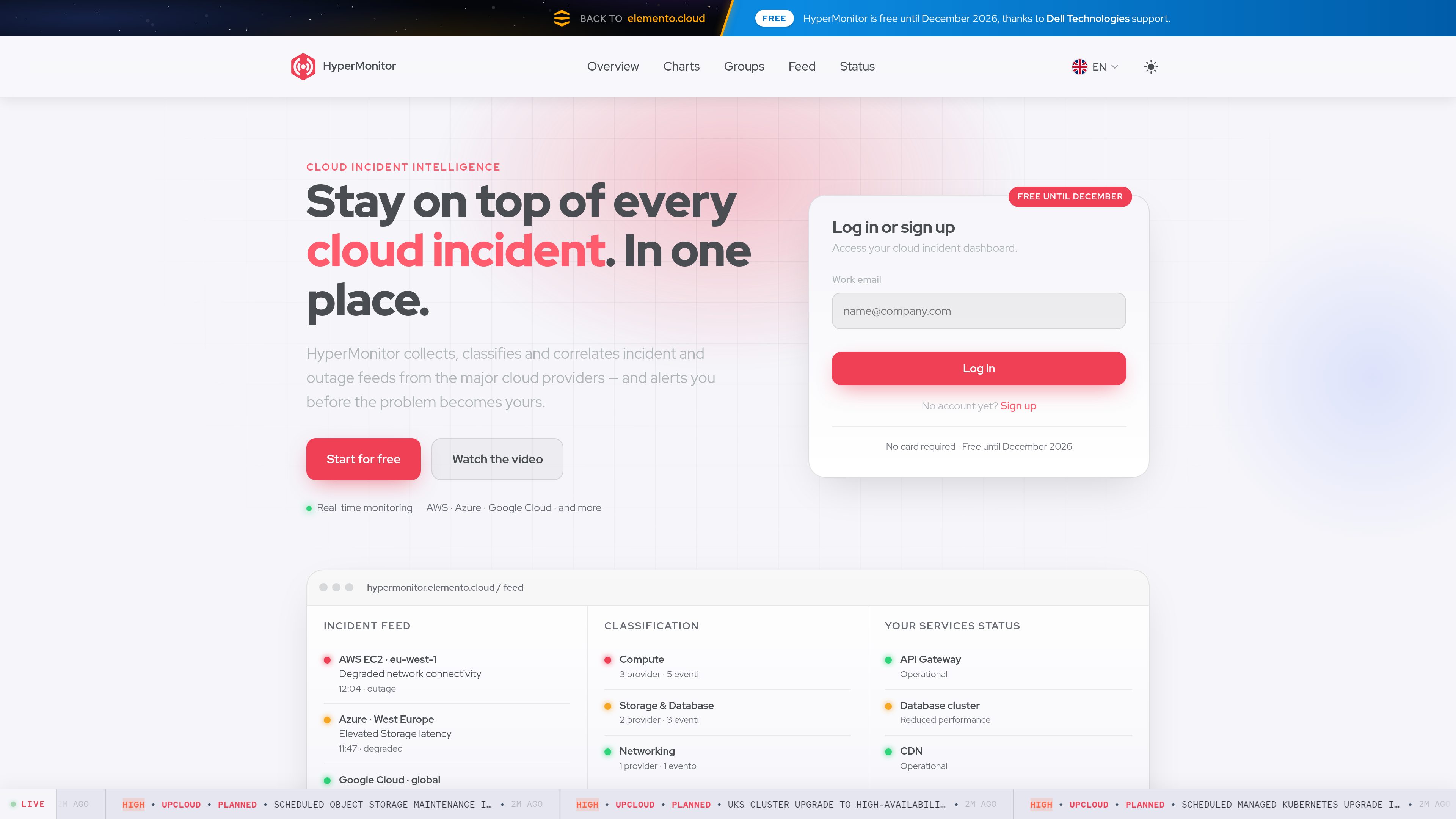
HyperMonitor is a cloud incident intelligence dashboard that collects, classifies, and correlates provider status and outage feeds in one place. It helps teams monitor cloud services, understand incident impact, and receive real-time notifications when a provider reports a problem.

O que é HyperMonitor?

HyperMonitor is a cloud incident intelligence dashboard that brings provider status and outage feeds into one view. It collects information from AWS, Azure, Google Cloud, and other providers, classifies incidents by provider, service, and severity, and correlates related events to help users understand which problems may affect their systems.

The service combines a live incident feed with grouped service views, status summaries, and charts for reviewing reliability and outage frequency over time. It is intended for teams that need to monitor dependencies across multiple cloud providers without repeatedly checking separate status pages. The site advertises real-time alerts, but does not specify the available delivery channels in the published material.

O que HyperMonitor pode fazer?

Unified provider feed

Collects cloud status and outage information into a single real-time stream. The site names AWS, Azure, and Google Cloud, while the dashboard feed also displays incidents from providers including UpCloud, Scaleway, Cloudflare, and Linode/Akamai Cloud.

Incident classification

Tags incidents by provider, service, and severity, with feed entries also showing states such as planned, investigating, ongoing, monitoring, and completed.

Related-event correlation

Links related events so users can assess a broader incident or likely infrastructure impact instead of treating every provider update as an isolated alert.

Real-time monitoring and alerts

Provides a live view of provider problems and advertises notifications when a provider reports an issue, reducing the need to refresh individual status pages.

Charts and trends

Visualizes reliability and outage frequency over time and supports comparisons between providers using historical status data.

Groups and service status

Lets users group services they care about and view their status together, creating a focused service view similar to a private status page.

Casos de uso

“Multi-cloud dependency monitoring”

Use one feed to follow incidents across services that depend on AWS, Azure, Google Cloud, or other listed providers instead of manually switching among provider status pages.

“Incident triage”

During a provider disruption, filter the signal by provider, service, and severity, then use correlated events and status states to build a faster view of what is happening.

“Planned maintenance awareness”

Review planned and ongoing maintenance entries, including region-specific provider events, so scheduled changes can be considered during operational checks.

“Reliability review”

Use charts and outage-frequency views to examine provider reliability over time and compare historical patterns when reviewing infrastructure choices or service dependencies.

“Focused service watchlists”

Create groups for the services that matter to a particular environment and check their combined state from a single status view.

Perguntas frequentes

Which cloud providers does HyperMonitor cover?

The site explicitly names AWS, Azure, and Google Cloud, and describes support for other providers. The dashboard feed shown in the source also includes UpCloud, Scaleway, Cloudflare, and Linode/Akamai Cloud. The complete provider list is not published in the supplied material.

What information is shown for an incident?

Incidents can be classified by provider, service, and severity. Feed entries also show operational states such as investigating, identified, ongoing, monitoring, completed, and planned, along with details such as affected regions when the provider supplies them.

Does HyperMonitor provide alerts?

Yes. The product describes real-time alerts that notify users when a provider they use has a problem. The available notification channels are not specified in the published source.

Can users monitor selected services instead of the entire feed?

Yes. The Groups & Status feature allows users to group services they care about and monitor their state together in a focused view.

How much does HyperMonitor cost?

The site states that HyperMonitor is free until December 2026, with no credit card required. It does not provide additional plan limits or longer-term pricing in the supplied material.

Informações rápidas

Category
Cloud incident monitoring
Primary function
Collects, classifies, and correlates provider status and outage feeds
Named providers
AWS, Azure, and Google Cloud; other providers are also supported
Dashboard views
Overview, charts, groups, feed, and status
Access
Account required; log in or register with an email address
Current offer
Free until December 2026; no credit card required

Análise de tráfego de HyperMonitor

Os dados de tráfego são apenas para referência.

Classificação do domínio
32

Alternativas ao HyperMonitor

OutageDeck logo

OutageDeck

outagedeck.com

OutageDeck monitors official status feeds for cloud and software providers, then shows current incidents and sends change-based alerts. It helps individuals and teams determine whether a service problem is external before troubleshooting their own systems.

FATHER logo

FATHER

coastcreative.studio

FATHER is a macOS mission-control dashboard for teams managing sites and deployments on Vercel. It brings deployment status, uptime, and speed metrics into one live view, with menu-bar indicators and notifications for issues.

Bundi logo

Bundi

trybundi.com

Bundi monitors websites, TCP services, scheduled jobs, and server health, then alerts designated people when incidents occur. It is built for small teams, self-hosted infrastructure operators, and client-facing hosting workflows.