
Multiple content types
Work with PDFs, DOCs, TXT files, audio, YouTube videos, webpages, and other supported content from one interface.

Ask questions across documents, media, YouTube videos, and webpages with GPT-powered answers.
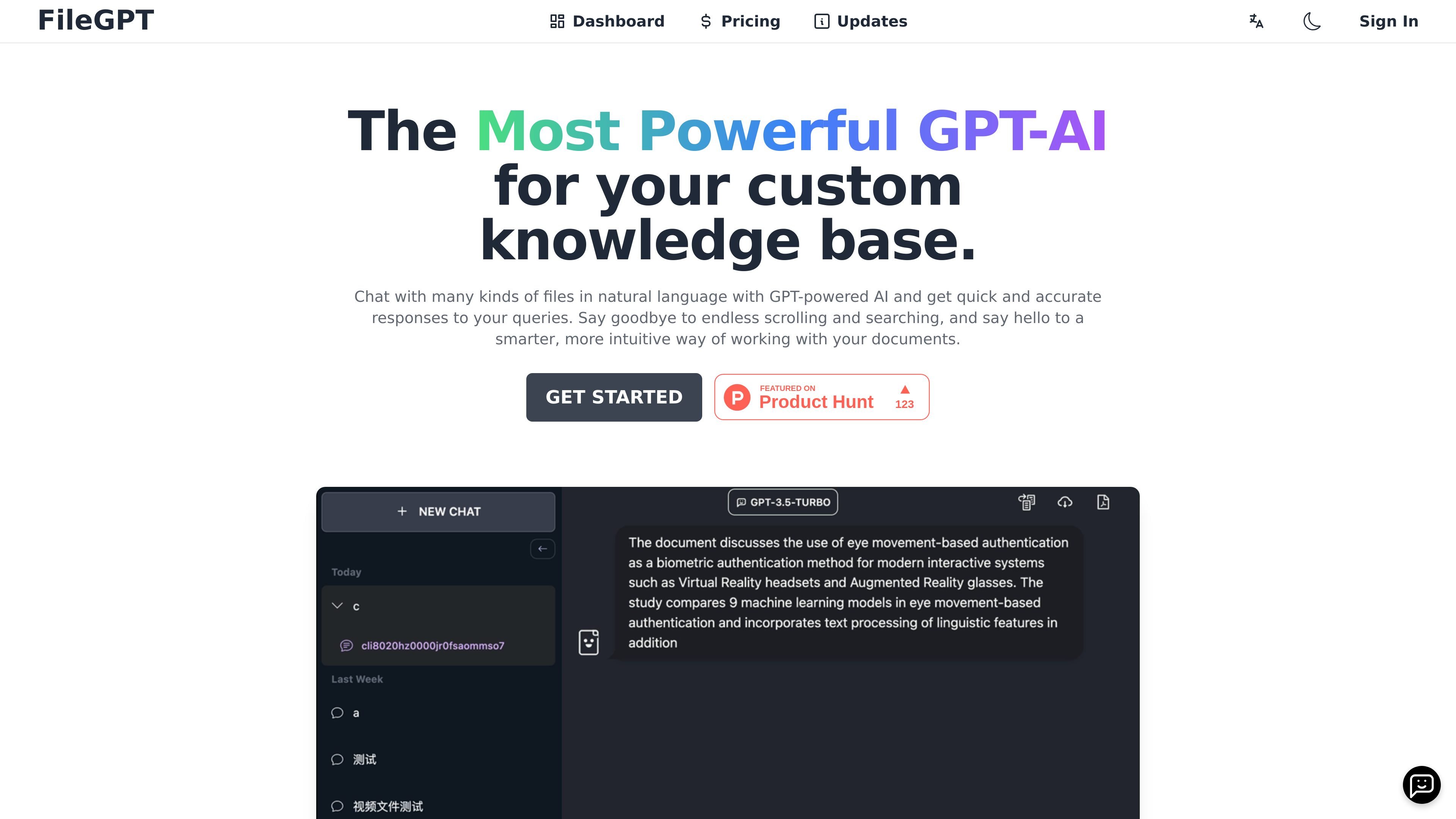
FileGPT is an LLM-based knowledge assistant for asking questions about content held in files and online sources. Users can chat with individual items or select multiple sources and query them together, receiving answers grounded in the supplied material. It supports document formats alongside audio, video, YouTube, and webpages, with features for long texts and large files. The product is intended to make research and document review more direct by replacing manual searching through collections with question-led retrieval.
Work with PDFs, DOCs, TXT files, audio, YouTube videos, webpages, and other supported content from one interface.
Select multiple files or other sources and ask a question across them, allowing the response to draw on the selected collection.
The service supports long texts and large files. Plan limits vary: listed single-file limits are 100 MB on Basic and 200 MB on Pro.
FileGPT can analyze audio and video content; the Pro plan also lists support for audio, video, and image files, as well as Bilibili.
Smart parsing extracts text from handwritten documents, and the Pro plan lists support for unstructured PDFs and handwritten text.
Growth and higher plans support embedding FileGPT in a user's website. Elite adds basic usage and engagement analytics, while Enterprise lists enhanced growth, engagement, and conversion analytics.
Students and researchers can query multiple documents together to locate relevant material and form answers without repeatedly searching each file.
People working with lengthy reports or large documents can ask focused questions about their contents instead of navigating page by page.
Users can ask about audio or video content, including supported YouTube material, when reviewing recordings or other media.
Combine selected webpages with files to query information collected from online sources and local documents in a single workflow.
Organizations on Growth, Elite, or Enterprise plans can embed FileGPT in their own website; Enterprise also includes enhanced analytics and priority processing.
Yes. The site says FileGPT can be tried for free; increasing usage requires upgrading an account.
The site lists PDF, DOC, and TXT files, audio, YouTube videos, and webpages. Plan-specific features also include video and image files, Bilibili, unstructured PDFs, and handwritten text.
Yes. You can select sources and query files together, with answers that integrate information across the selection.
The yearly pricing page lists 10 files per collection and a 100 MB single-file limit for Basic, and 20 files per collection and a 200 MB single-file limit for Pro. Monthly token allowances are also specified by plan on the pricing page.
Website embedding is listed for Growth, Elite, and Enterprise plans.
Os dados de tráfego são apenas para referência.

notegpt.io
An AI work assistant for research, writing, learning, and creating documents and media.

speechify.com
Speechify reads documents and web content aloud, with voice typing and AI tools across devices.

thedrive.ai
AI file management for organizing, searching, and working with documents across team drives.