PagerDuty logo

PagerDuty

Reivindicar

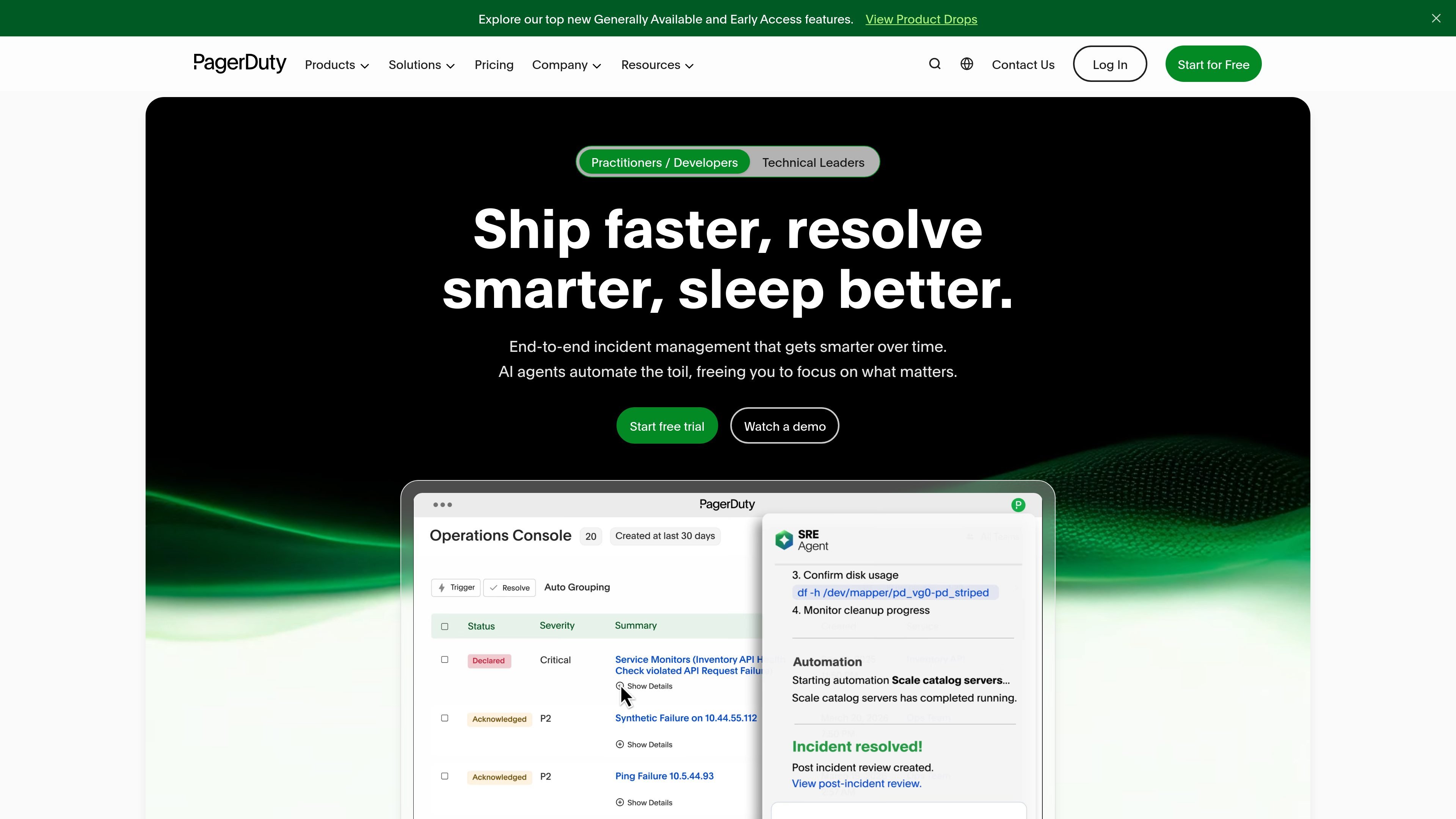
PagerDuty is an AI-first operations platform for incident management, on-call coordination, automation, and response workflows.

PagerDuty preview

Overview

PagerDuty is an AI-first operations platform for incident management, on-call coordination, automation, and related operational workflows. The site presents it as a way for engineering and operations teams to detect issues, route the right people, and resolve incidents faster from the tools they already use.

Its platform spans on-call schedules and escalations, incident workflows, integrations, and AI agents. The product pages also show a tiered pricing model with a free plan for small teams, paid plans for growing teams, and enterprise pricing available on contact.

Core capabilities

On-call scheduling and escalations

Route alerts to the right responders with schedules, escalation policies, and notification methods such as SMS, phone, push, and email. The on-call management page emphasizes flexible rotations and self-serve schedule management.

Incident management workflow

Detect, triage, respond to, resolve, and review incidents in one workflow. The incident-management and home pages describe end-to-end handling, bulk incident actions, post-incident reviews, and work from Slack or Microsoft Teams.

AI-assisted operations

Use AI agents and automation to reduce manual incident work. The home page describes agents that can detect issues, diagnose root causes, orchestrate fixes, and support documentation, scheduling, and pattern detection.

Integrations and extensibility

Connect PagerDuty to the rest of your stack with 750+ integrations and open APIs. The site positions the platform as a hub for monitoring, chat, ITSM, and developer tools.

Service-aware routing and context

Organize services, ownership, and dependencies so responders can see what is affected and who owns it. The pricing and on-call pages mention service directories, dependencies, and contextual service information.

Collaboration and communication tools

Support incident communication and follow-up with chat experience, status pages, and post-incident reviews. These capabilities appear in the pricing tiers and platform copy as part of higher plans.

Common use cases

  • Incident response for operations teams

    Coordinate incident response from alert to resolution using schedules, escalation policies, chat integrations, and post-incident review. This is the core workflow described across the incident-management and pricing pages.

  • On-call management

    Distribute coverage across engineers with flexible rotations, self-serve overrides, and mobile-friendly notification options. The on-call page focuses on equitable workload sharing and ensuring the right person is notified when time is critical.

  • Service ownership and alert routing

    Keep service ownership clear by mapping services, dependencies, and responders so alerts reach the correct team. The product pages describe service directories and service-aware routing as part of the response workflow.

  • Workflow automation across the stack

    Automate repetitive incident tasks and connect PagerDuty to monitoring, chat, ITSM, and developer tools. The home page and pricing page both emphasize automation, APIs, and a broad integration library.

  • AI-assisted operations

    Use AI agents to detect issues, diagnose root causes, and help orchestrate fixes while humans step in where needed. The home page positions these agents as support for teams that want to reduce manual toil during operational work.

  • Chat-based incident collaboration

    Share incident updates and collaborate in Slack or Microsoft Teams without leaving the response workflow. The pricing and home pages mention chat-based incident management and collaboration features.

Pros and Cons

Pros

  • Covers incident response from alerting through post-incident review in one platform.
  • Supports on-call scheduling, escalation policies, and multiple notification channels.
  • Connects with 750+ integrations and open APIs for broader workflow automation.
  • Can be used directly in Slack or Microsoft Teams for incident response.
  • Adds AI agents and automation to help reduce manual toil.

Cons

  • The source pages do not provide a single, fully detailed breakdown of every feature across all plans and add-ons.
  • Some capabilities, such as status pages and advanced workflow controls, appear tied to higher tiers or add-ons, so buyers will need to check plan fit carefully.

FAQ

What does PagerDuty do?

PagerDuty is designed for teams that need to detect, route, respond to, and review operational incidents from one platform. The source pages show incident management, on-call management, status pages, automation, and AI-assisted workflows as part of the product family.

Does PagerDuty offer a free plan or trial?

The pricing page shows a free plan for up to 5 users, a Professional plan, a Business plan, and an Enterprise plan with contact sales pricing. It also notes a 14-day free trial with no credit card required.

Where can teams use PagerDuty during an incident?

PagerDuty supports incident response in Slack and Microsoft Teams, and its on-call page says responders can take action from any device wherever they may be. The product also includes mobile incident management and integrations with many tools.

How many integrations does PagerDuty have?

The site says PagerDuty integrates with 750+ tools out of the box and can connect alerts, workflows, and data across a wider stack. The integrations page and home page both emphasize broad coverage across monitoring, chat, and other operational tools.

What should buyers verify before choosing PagerDuty?

PagerDuty’s source pages describe on-call management, incident management, automation, AI agents, and integrations. They do not establish a full status-page product lineup or every capability in detail, so teams should review the specific feature pages for fit.

Quick Facts

Category
AI-first operations platform
Primary use
Incident management and on-call operations
Platform scope
On-call, incident management, automation, AI agents, integrations
Integrations
750+ out of the box
Pricing shape
Free plan, paid tiers, and enterprise contact sales
Source domain
pagerduty.com