
Asset-based orchestration
Dagster defines workflows around the assets they produce, which makes lineage, dependencies, and health part of the orchestration model instead of an afterthought.

Dagster is an AI-native data orchestration platform for building, scheduling, observing, and running reliable data pipelines with asset-based workflows and hybrid deployment.
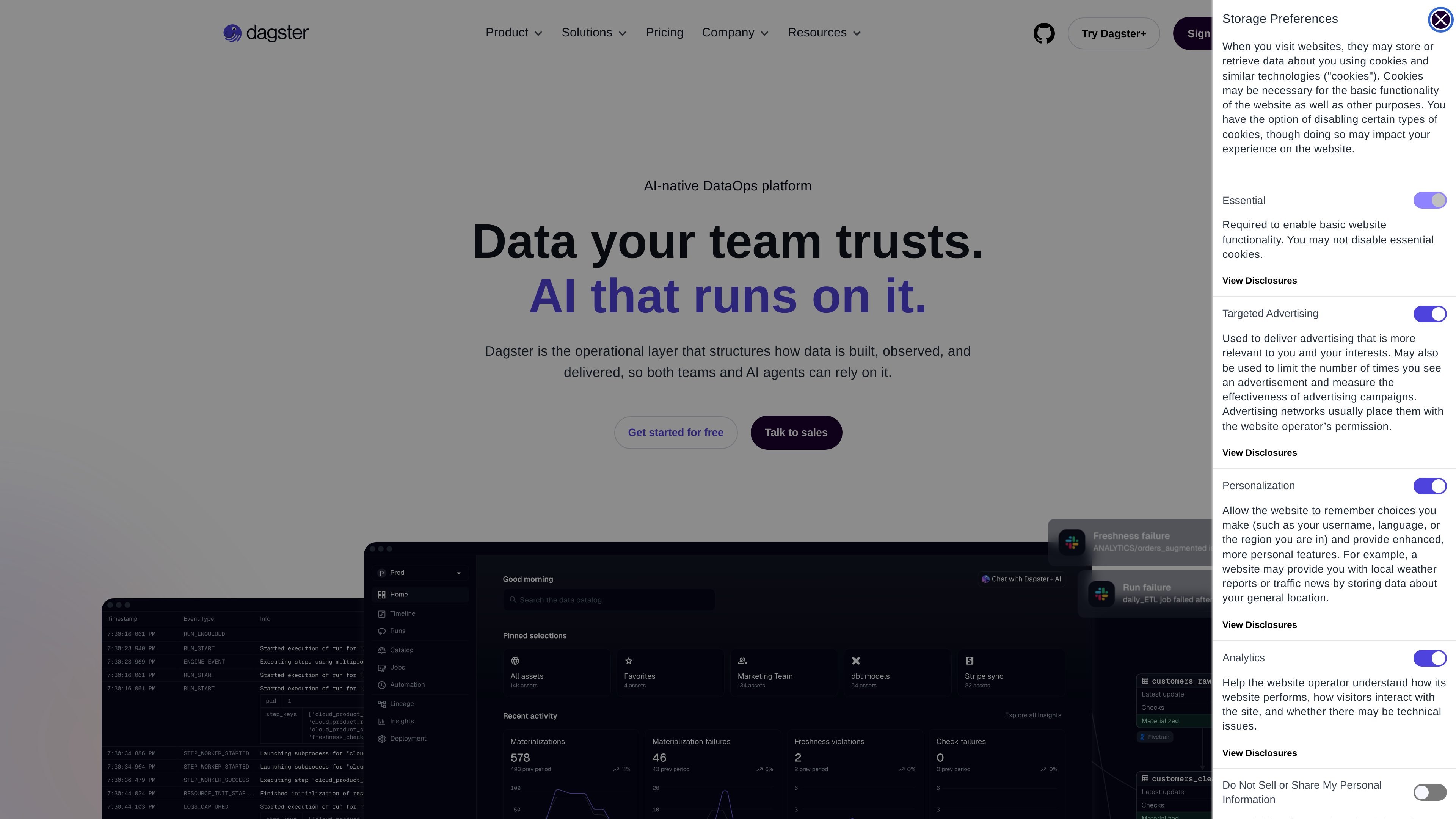
Dagster is a modern data orchestrator platform and AI-native DataOps platform for teams that need to build, schedule, observe, and activate reliable data pipelines. The product centers on assets rather than isolated tasks, so it can attach lineage, dependencies, freshness, and quality signals directly to the data your workflows produce.
The platform is designed to support both traditional analytics pipelines and newer AI-oriented workflows. The site describes Dagster+ as an operational layer for data and AI systems, with deployment options that include local development, cloud, on-premises, and hybrid execution depending on the plan and architecture.
Dagster defines workflows around the assets they produce, which makes lineage, dependencies, and health part of the orchestration model instead of an afterthought.
The platform provides lineage, dependencies, data health, asset metadata, and asset-level views so teams can understand what changed and what it affects.
Branch deployments let teams validate changes in a production-like environment before they affect real data, reducing risk during pipeline updates.
Dagster+ AI uses operational context such as assets, runs, lineage, freshness, failures, and automation history to support faster diagnosis and action.
Hybrid deployment lets teams run compute in their own infrastructure while Dagster manages the control plane, supporting cloud, on-premises, and mixed environments.
Enterprise plans add security and governance features including RBAC, SSO, SCIM provisioning, audit logs, and retention policies.
Use Dagster to build pipelines around assets so engineers can see lineage, freshness, and dependencies while they develop and operate data workflows.
Use hybrid deployment when your team needs to keep compute in its own infrastructure but still manage orchestration through Dagster’s control plane.
Use Dagster+ AI when you want operational context from runs, failures, freshness, and history to support faster debugging and more confident action.
Use the enterprise features when teams need production change control, role-based permissions, and auditability for larger or regulated environments.
Use the published pricing tiers to start with individual or small-team usage and move toward contact-sales plans as orchestration needs grow.
Dagster is an AI-native DataOps platform that orchestrates, observes, and activates data across a stack. Its FAQ describes it as asset-centric rather than task-centric, so it is designed around the data assets a workflow produces rather than only whether a job completed.
The site says Dagster is asset-centric while Apache Airflow is task-centric. Dagster attaches lineage, quality signals, and dependency context to assets, which helps show what broke, why, and what depends on it.
Yes. The homepage and FAQ state that Dagster supports dbt, Snowflake, and Fivetran with native integrations, and the enterprise page highlights dbt + Snowflake support.
Yes. Dagster supports hybrid deployment, which lets you run compute in your own cloud or on-premises infrastructure while Dagster manages the control plane.
Dagster offers a free 30-day trial. The pricing page also shows a mix of self-serve plans and contact-sales enterprise plans, with usage-based credits for Solo and Starter.