
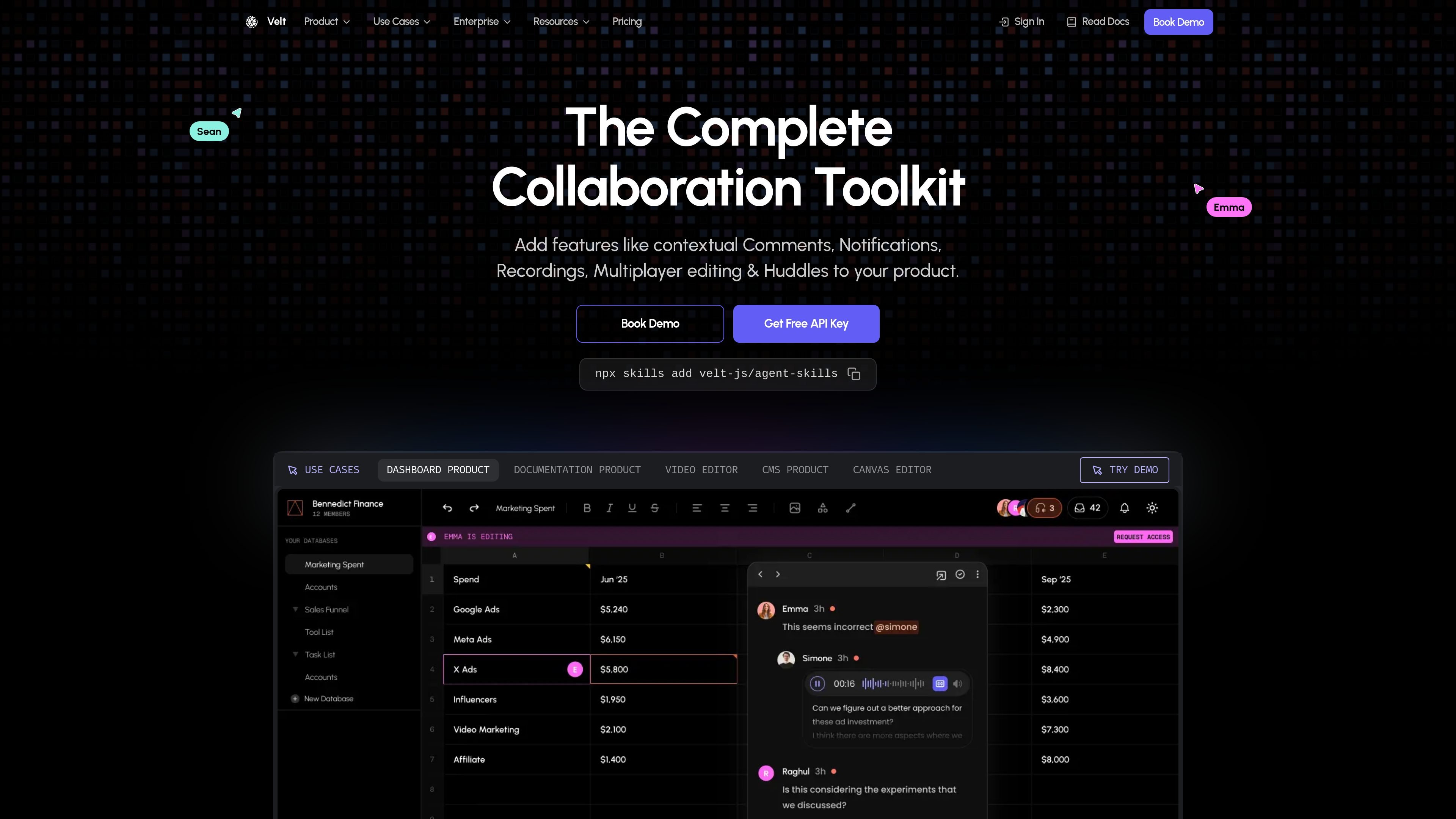
Contextual comments
Add threaded comments to elements, documents, cells, or canvases so feedback stays attached to the item being reviewed. The SDK includes comment components and tools.

An embeddable collaboration and review SDK for apps that need comments, approvals, and agent-assisted workflows.
Velt is an embeddable SDK for adding collaboration, review, and approval workflows to applications. Developers can place contextual comments on elements such as documents, cells, and canvases, and combine human feedback with review-agent activity. The product also includes approval flows, suggestions, notifications, and audit records, giving application teams building blocks for in-product review rather than relying only on external email or screenshot-based feedback. An admin console provides tools to monitor adoption, inspect live state and activity, browse or export records, manage feature settings, and deliver events through webhooks.
Add threaded comments to elements, documents, cells, or canvases so feedback stays attached to the item being reviewed. The SDK includes comment components and tools.
Define staged approval chains, including quorum and rejection paths. The workflow can wait for unresolved comments before advancing and notify reviewers in-app, by email, or in Slack.
Agents can add findings as comments, while suggested edits can be accepted or rejected by a person. Agent activity is represented alongside human activity in the review workflow.
Keep a timestamped record of review decisions, approvals, agent findings, and changes, with records available to browse and export.
Monitor collaboration usage, inspect live SDK state and events, browse records, and configure features. The console also provides data export and a Chrome DevTools extension for debugging.
Manage workspaces, API keys, domains, and configuration through platform-management APIs. Send events to webhook endpoints with signing, retries, transforms, and encryption.
Let brand, legal, and client reviewers comment on decks, emails, and landing pages inside the platform, then route assets through approval before release.
Embed anchored discussion in document, spreadsheet, canvas, or presentation interfaces so reviewers can discuss specific content rather than exchange screenshots.
Use review agents to flag potential brand or compliance issues and propose edits, while keeping a human acceptance or rejection step before changes take effect.
Use the console to investigate activity, debug live integrations, export records, and configure review features for an application.
Velt is framework-agnostic and lists first-class adapters for libraries including Tiptap, Lexical, Slate, ProseMirror, CodeMirror, Highcharts, and React Flow. It can be used alongside existing libraries.
Velt says most teams ship a working integration in under a week. Its drop-in components cover common collaboration surfaces, with APIs and webhooks available for further customization.
Yes. Components support customization of layout, CSS, template variables, and conditional rendering, allowing teams to style them with their existing design system.
The site says self-hosting is an Enterprise option. It also identifies GCP as available and AWS and Azure as private beta, with residency pinning and bring-your-own-key encryption described for enterprise deployments.
The Hacker plan is free for development environments and includes 100 monthly active documents, pre-built components, customization, basic webhooks, and real-time infrastructure. It does not allow production deployment.
Traffic data is for reference only.

googleapis.github.io
A Python SDK for integrating Google’s generative models into applications through the Gemini Developer API and Gemini Enterprise Agent Platform APIs. It provides client libraries, typed request helpers, and synchronous or asynchronous workflows for developers building with Google’s generative AI services.