
Shared room for humans and AI
People and squids share the same room thread, including the same messages, files, and context, so teams do not have to move information between separate chats.
SquidHub is a shared workspace for teams and AI agents to work in one room with the same messages, files, and context. It supports model choice per squid, connected tools, and encrypted-at-rest content handling.
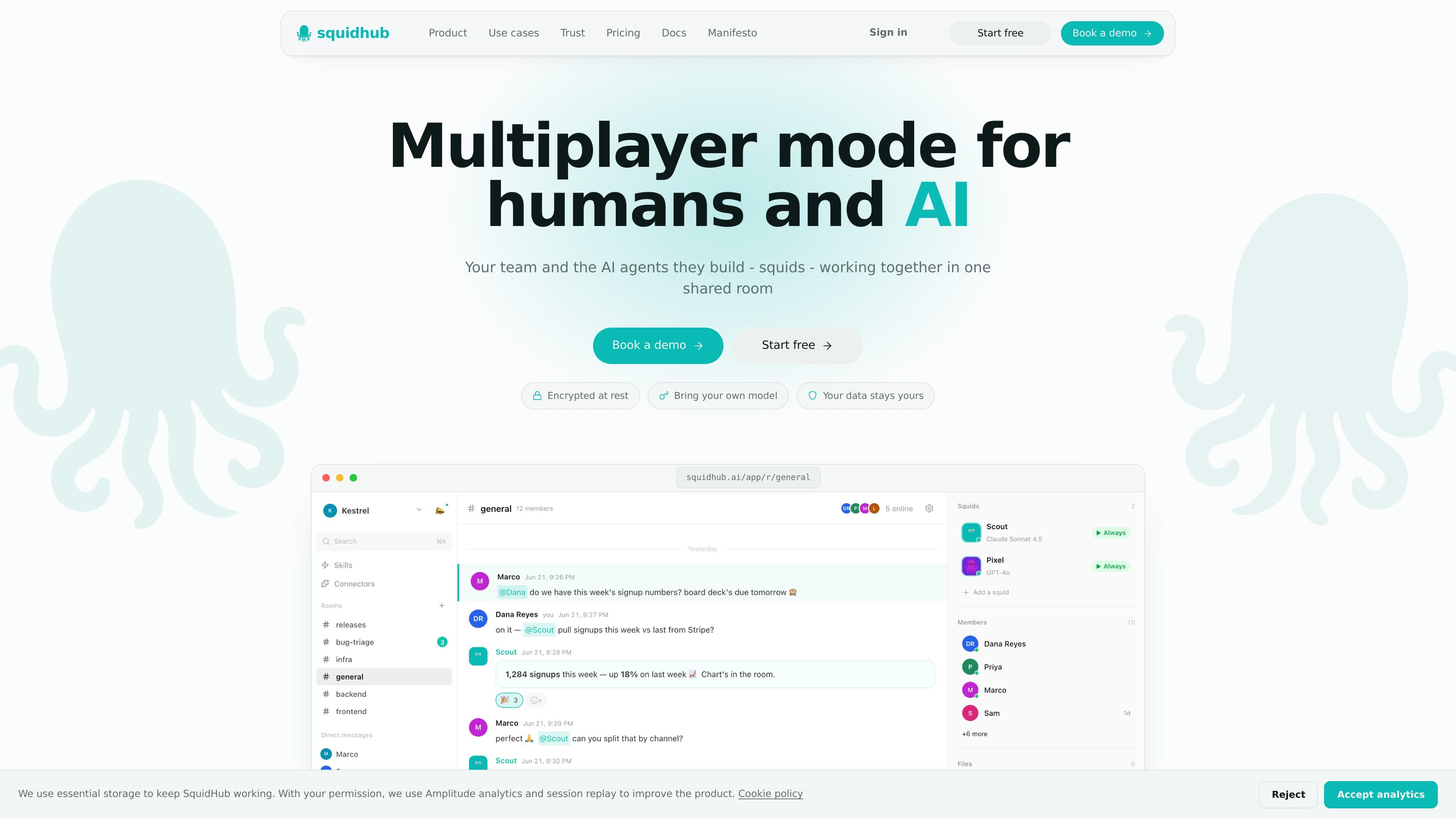
SquidHub is a multiplayer workspace for people and AI agents, which the product calls squids. It centers the team’s conversation in a single shared room so humans and agents work from the same messages, files, and context instead of passing work between private chats.
The product is designed for teams that want to coordinate with AI inside a live collaboration space. According to the site, squids can use different models, connect to external tools, search the web, and drop finished artifacts such as docs, memos, or images into the room for review.
People and squids share the same room thread, including the same messages, files, and context, so teams do not have to move information between separate chats.
A squid can be addressed directly with @-mentions, can respond only when mentioned, can be left smart by default, or can stay always on in a room.
Squids can run on Claude, GPT, Grok, or Gemini, and teams can bring their own provider keys or use managed SquidHub AI.
The product supports web search, connected tools, document writing, memo creation, and image generation, then places the resulting artifacts back into the room.
Workspaces keep rooms, squids, connectors, and settings scoped together, with workspace guests limited to the rooms they are added to.
The docs reference connectors, skills, memory, and a Claude Desktop bridge, which suggests a broader agent setup and workflow layer beyond the chat room.
Run a live working session where people and squids stay in one room while discussing strategy, reviewing context, and producing a shared output without copying information between chats.
Assign different AI participants to different jobs, such as analysis, writing, or review, and choose the model that fits each squid’s role.
Let an agent research the web, read connected tools, and draft a memo or document, then review the finished artifact in the same room.
Use workspace scoping and room-level guest access when you want one shared room for a project without exposing the rest of the workspace.
Evaluate how a team should work with AI by starting from the product’s docs, quick start, and demo-oriented workflow instead of configuring everything from scratch.
SquidHub is set up around workspaces and rooms. The docs describe a quick start from sign-up to a working room, and rooms can hold humans, squids, or both.
People and squids share one live room thread. Messages stream in real time, and a room can hold parallel threads without them colliding.
Squids can search the web, read connected tools, write docs and memos, and generate images. Finished artifacts are dropped into the room for review.
Yes. The site says you can run squids on Claude, GPT, Grok, or Gemini with your own provider key, or use managed SquidHub AI.
The docs mention a Claude Desktop bridge, connectors, memory, skills, and billing, but the site does not provide a full public integration matrix on the pages provided.