Runpod logo

Runpod

Claim

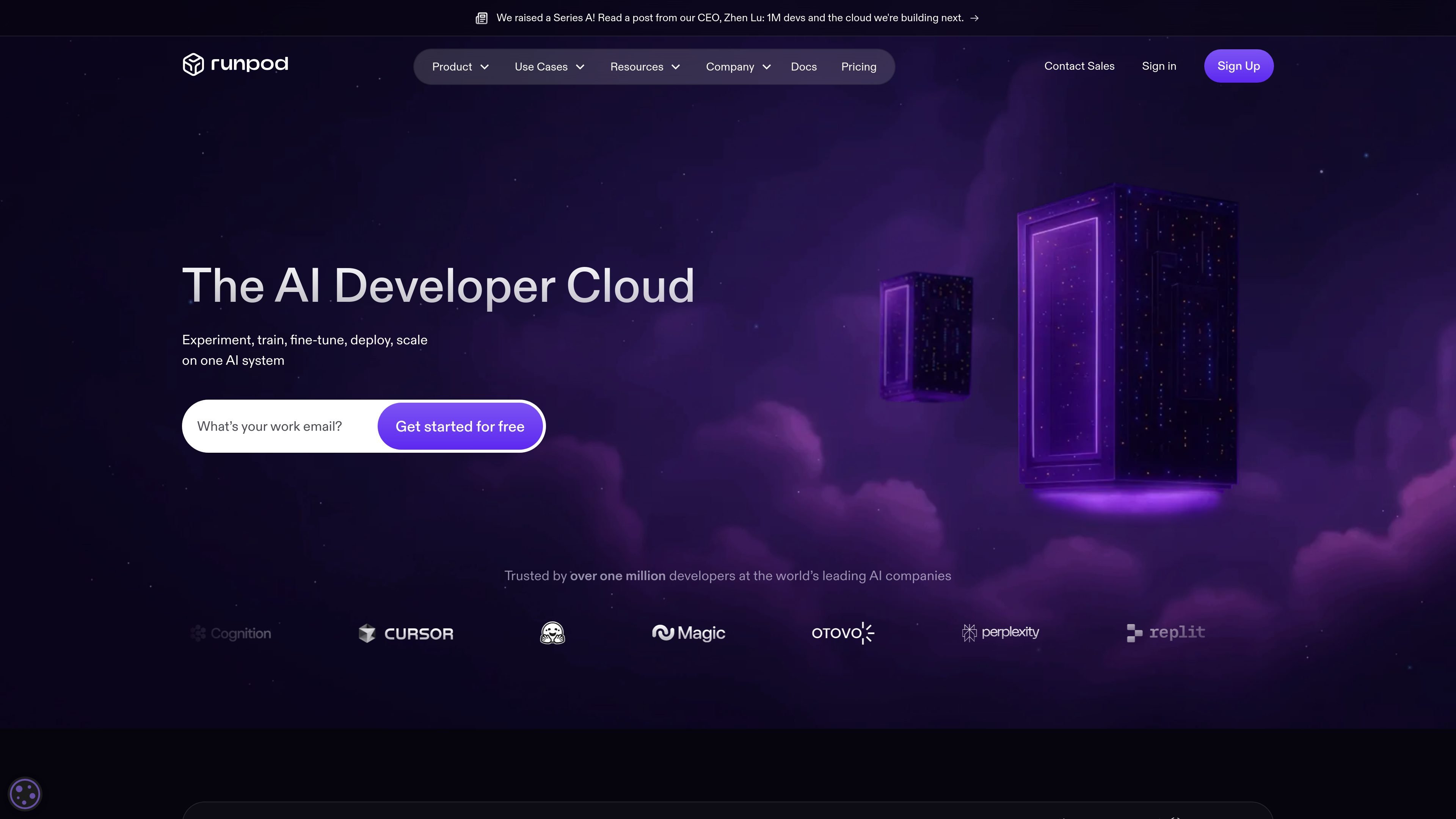
Runpod is an AI infrastructure platform for GPU workloads in the cloud, with dedicated Pods, Serverless inference, and multi-node Clusters for training and scaling.

Runpod preview

Overview

Runpod is an AI infrastructure platform for running GPU workloads in the cloud. Its main product lines cover dedicated GPU Pods, Serverless inference, and GPU Clusters, so teams can move from experimentation to production without changing platforms.

The site positions Runpod for training, fine-tuning, inference, batch jobs, and distributed workloads. It also emphasizes self-service provisioning, per-second billing on Pods and Clusters, and usage-based Serverless compute, with storage and deployment choices affecting total cost and control.

For teams that need GPUs on demand, Runpod combines fast environment startup, multi-region availability, and managed orchestration features such as autoscaling, logs, and metrics. The platform also includes public endpoints for pre-deployed models and enterprise options for reserved capacity.

Core capabilities

Pods, Serverless, and Clusters

Runpod offers three main execution models: Pods for dedicated GPU instances, Serverless for inference workloads, and Clusters for multi-node jobs. This lets teams choose the deployment style that matches the workload rather than forcing every project into one runtime.

Fast environment provisioning

The platform supports launching GPU environments quickly, including a GPU pod in under a minute and multi-node clusters in minutes. That makes it suitable for short experiments as well as recurring production work.

Autoscaling inference workflows

Serverless can autoscale from zero to many workers and the site says it handles queues, task distribution, logs, monitoring, and metrics. It is designed for inference endpoints where idle capacity and cold starts both matter.

Multi-node compute orchestration

Clusters support distributed training and batch workloads with high-speed networking, per-second billing, and the option to attach shared storage. The product pages also mention Slurm support and the ability to run arbitrary Docker workloads.

Flexible storage tiers

Storage options include container disk, volume disk, and network storage with standard and high-performance tiers. The pricing page also notes that storage and deployment choices affect the overall cost of a workload.

Hosted model endpoints

Public endpoints expose pre-deployed AI models through an API without requiring infrastructure setup. The pricing page lists audio, image, language, and video models with request-based or token-based pricing.

Common ways teams use Runpod

  • Dedicated GPU development and training

    Use Pods when you want a dedicated GPU environment for development, fine-tuning, or long-running jobs that need a persistent machine rather than an autoscaled endpoint.

  • Production inference APIs

    Use Serverless when you need an inference endpoint that scales with traffic, with no idle cost when workers are not running and automatic task distribution handled by the platform.

  • Multi-node and distributed workloads

    Use Clusters for distributed training, large batch processing, or other jobs that require more than one GPU node and high-speed interconnects between machines.

  • Enterprise capacity planning

    Use the reserved cluster path when you need dedicated capacity, custom configurations, and longer-term planning for larger deployments.

  • Hosted model access

    Use Public Endpoints when you want access to pre-deployed models through an API and prefer to avoid setting up your own GPU infrastructure.

Pros and Cons

Pros

  • Covers the full lifecycle from experimentation to production in one platform.
  • Offers distinct compute models for dedicated jobs, autoscaling inference, and multi-node workloads.
  • Provides per-second billing for Pods and Clusters, which fits intermittent or variable workloads.
  • Includes storage options and shared storage support for workloads that need persistence.
  • Exposes pre-deployed models through public endpoints for teams that want API access without infrastructure setup.

Cons

  • The source does not show a single fixed workflow for every use case, so teams still need to choose between Pods, Serverless, Clusters, and storage options.
  • Some larger cluster and reserved-capacity details require contacting sales or requesting a spend-limit increase.
  • The public source does not list a broad integration catalog, so external tool compatibility is only partially documented.

FAQ

What is the difference between Pods, Serverless, and Clusters?

Runpod offers several deployment paths: Pods for dedicated GPU instances, Serverless for API-style inference, and Clusters for multi-node workloads. The best fit depends on whether you need a single GPU environment, autoscaling inference, or coordinated compute across multiple nodes.

How does Runpod pricing work?

The pricing page says Pods and Clusters are billed by the second, while Serverless bills inference workers based on usage. Storage, deployment choices, and workload duration can affect total cost.

What kind of workflow does Runpod support?

The product pages describe support for bringing your own Docker containers and using optimized templates for inference, training, and research workloads. Runpod also shows workflow controls such as logs, monitoring, metrics, and autoscaling for Serverless.

Who is Runpod for?

Runpod is positioned for teams that need GPU infrastructure for training, inference, batch jobs, and distributed workloads. The site also presents enterprise options for dedicated capacity and larger-scale deployments.

How quickly can teams get started?

The source does not describe a single universal setup flow for every product, but it does show self-service provisioning, launching clusters in minutes, and pushing code to Serverless for live inference endpoints.

Quick Facts

Category
AI infrastructure / Developer cloud
Primary users
AI developers, ML teams, and engineering teams running GPU workloads
Platform
Cloud GPU instances, serverless inference, and multi-node clusters
Pricing shape
Usage-based pricing with per-second billing on Pods and Clusters and usage-based Serverless
Source domain
runpod.io
Notable workflow
Experiment, train, fine-tune, deploy, and scale on one platform