
Curated UX corpus over MCP
Provides a specific corpus of UX rules that agents can query through MCP instead of relying on broad, generalized design advice.

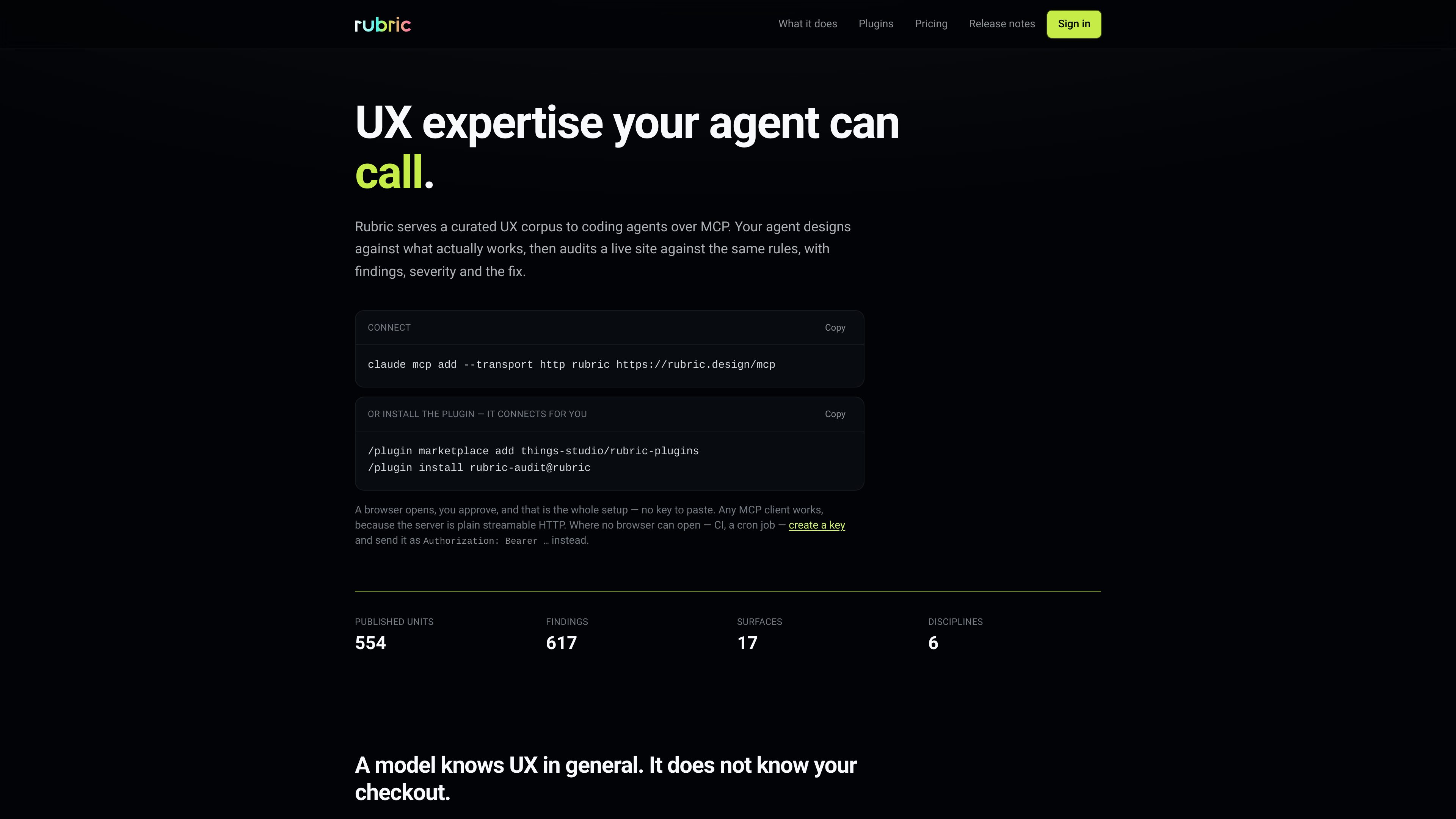
Rubric is a curated UX corpus served to coding agents over MCP. It helps agents design against documented UX rules, then audit live pages against those same rules—with findings, severity levels, and fixes.
Rubric serves a curated UX corpus to coding agents over MCP. It is designed to help agents work from specific UX rules rather than general design advice, so they can make decisions based on documented guidance.
The same corpus is used before and after launch: agents can pull guidelines while designing, then audit a live site against the same rules and produce findings with severity, evidence, and suggested fixes.
Provides a specific corpus of UX rules that agents can query through MCP instead of relying on broad, generalized design advice.
Lets agents fetch prescriptive UX guidance before code is built, including what the rule is, why it matters, and what breaks without it.
Evaluates a real page against the same checklist used at design time and returns findings ranked by severity.
Returns findings as separate blocks that include the issue, severity, impact, actions, and references rather than a single paragraph summary.
Runs as a standard MCP server over streamable HTTP, which the site says works with any MCP client that speaks the protocol.
Includes a plugin flow that installs the MCP connection and supports UX audit and reporting tasks from Claude Code.
Use Rubric before implementation to pull relevant guidance for a component or flow, so the agent designs to the corpus rather than guessing from general UX advice.
Run a live page through the checklist after release to identify issues, rank them by severity, and generate a report that can be handed to the team fixing them.
Use the HTTP server with a bearer token when no browser can open, such as in CI or a cron job, to run the same audit workflow in automated environments.
Connect Rubric from an MCP-compatible client such as Claude Code, Codex, Cursor, Windsurf, Zed, Cline, Goose, or Manus to keep the same UX rules available across tools.
Rubric provides a curated UX corpus to coding agents over MCP, then uses the same corpus to audit live pages against the same rules and report findings with severity and fixes.
The site says you can add it as an MCP server over streamable HTTP, or install the Claude Code plugin that wires up the connection for you.
No. The site says any MCP client works, and it lists Claude Code, Codex, Cursor, Windsurf, Zed, Cline, Goose, and Manus as compatible clients.
A finding is presented as separate blocks, including the issue, severity, impact, actions, and references.
Yes. The pricing page shows a free tier, a pay-as-you-go usage-based plan, and an enterprise option with invoicing and volume terms.
Traffic data is for reference only.

getprojekt.com
Projekt is a visual workspace for design engineers with AI coding agents, live preview, and inline editing. Available in alpha on macOS with a free download and limited founder tier.

impeccable.style
A design skill for AI coding harnesses, enabling frontend workflows with structured setup, command-based editing, and browser-based live iteration.

pixelcrew.ai
PixelCrew is an AI design workflow that coordinates specialized agents to turn a written brief into research, creative direction, UX wireframes, copy, design-system assets, QA documentation, and production HTML/Tailwind. It’s for people and teams who need websites, dashboards, landing pages, or design systems without starting from a rigid template.

siteprint.app
A Safari extension for Mac that measures website design and prepares it for AI coding agents.

tastemaker-skill.online
Tastemaker is a workflow skill for coding agents that turns product context and visual references into UI screens, assets, contrast-checked color systems, and local design decisions. It is designed for agents such as Claude Code, Windsurf, and Gemini CLI.

magicpath.ai
A shared design canvas for humans and AI agents