
Style-based QR generation
Choose between style families such as the generative AI style and the basic parametric style. The rendered pages show style-specific controls, which indicates different generation modes rather than a single fixed template.
QRBTF is a web-based AI and parametric QR code generator for stylized, scannable QR codes. Free trial, Pro plan, and open-source SVG output.
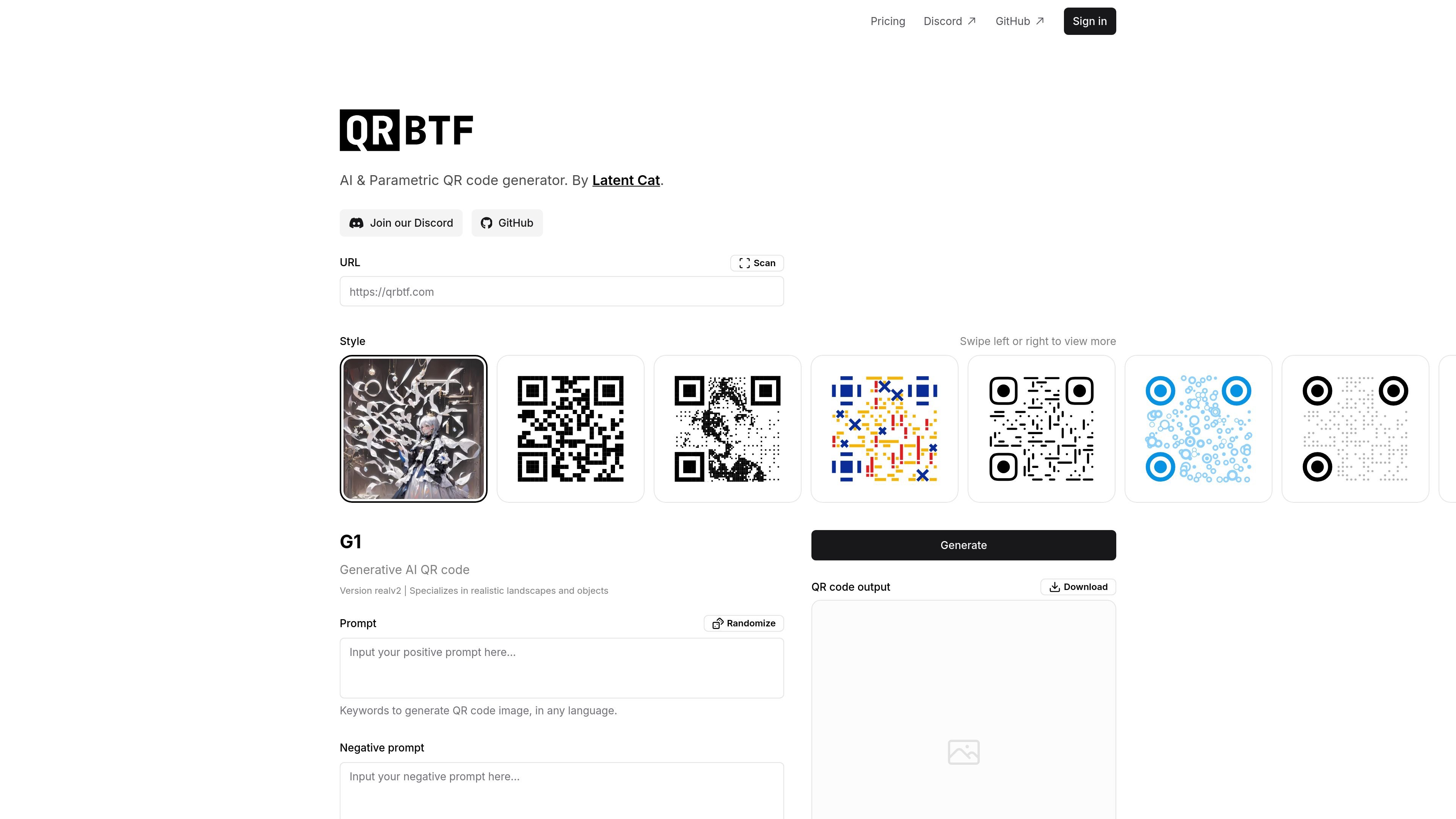
QRBTF is an AI and parametric QR code generator for creating scannable QR codes with custom visual styles. The homepage frames it as an AI QR code generator, while the style pages show two approaches: a generative AI mode for image-led QR codes and a parametric mode for more controlled QR patterns.
The generator exposes detailed controls for scanability and appearance, including prompt and negative prompt inputs, seed, strength, restoration rate, padding ratio, correction level, and anchor settings in the AI workflow. The parametric workflow offers its own pattern controls such as positioning, content scale, opacity, and color, making the product useful for users who want QR codes that balance readability with a specific visual treatment.
The pricing page shows a free trial for AI QR codes, a Pro subscription with unlimited generation subject to rate limits, and a separate free parametric QR code offering that is open source and supports SVG output. That combination makes QRBTF relevant both for experimenting with stylized QR codes and for generating production-ready codes in different formats.
Choose between style families such as the generative AI style and the basic parametric style. The rendered pages show style-specific controls, which indicates different generation modes rather than a single fixed template.
The AI style includes controls for prompt, negative prompt, seed, strength, restoration rate, size, padding ratio, correction level, and anchor style. These controls let users steer both image appearance and scan reliability.
The AI style description says it specializes in realistic landscapes and objects, which points to image-led QR codes built from prompt input instead of simple pattern variations.
The parametric style page shows options like positioning type, positioning color, content type, content scale, content opacity, and content color, giving users direct control over the QR pattern’s visual structure.
The site supports QR code output and download directly from the generator. The pricing page also states that the parametric QR code product supports SVG format.
The homepage and pricing page both show public statistics, including AI QR code generated, total downloads, and page views, which suggests the product is built around a shared generation workflow with visible usage metrics.
Generate a QR code that visually matches a campaign image, product page, or poster while still linking to a real destination. The AI style controls are designed for prompt-led image generation with scanability tuning.
Create a more restrained QR code with direct control over positioning, content opacity, color, and scale. This is a better fit when the code needs to blend into a layout without relying on prompt-based image generation.
Iterate on scanability for longer URLs by increasing correction level and adjusting strength or restoration rate. The site explicitly ties these settings to recognition and visual fidelity.
Use the free parametric QR code option when you need an open-source workflow with SVG support and no backend requirement. This suits simpler production pipelines or teams that prefer editable vector output.
Experiment with different QR styles and settings before moving to a higher-volume plan. The pricing page offers a free trial and a Pro plan with unlimited generation subject to rate limits.
You can start by choosing a QR code style, entering a URL or prompt, adjusting controls such as strength, restoration rate, size, padding ratio, correction level, or anchor settings depending on the style, and then generating the QR code for download.
QRBTF is an AI and parametric QR code generator. The site also highlights style-based generation, with options such as a generative AI style and a basic parametric style.
The site supports QR code generation with customizable styles and controls, and the pricing page mentions both AI QR Codes and Parametric QR Codes. It does not list every output scenario in detail.
Not always. The homepage explains that higher strength can make the code easier to scan, while lower strength can make the image look more natural but potentially harder to scan. It also notes that longer links require higher correction levels for scanning.
The homepage suggests increasing correction level for longer links, using higher strength for better scanability, and adjusting restoration rate, padding ratio, and anchor style to balance recognition with image appearance.