
Incident response with PR-based remediation
Plural’s agents can investigate incidents using observability and infrastructure context in parallel, identify a root cause, and open a pull request with the minimum-viable fix.

Plural is an AI-for-infrastructure platform for platform and DevOps teams. It runs agents in your clusters to help with incident response, cluster upgrades, vulnerability remediation, cloud cost optimization, and other infrastructure changes.
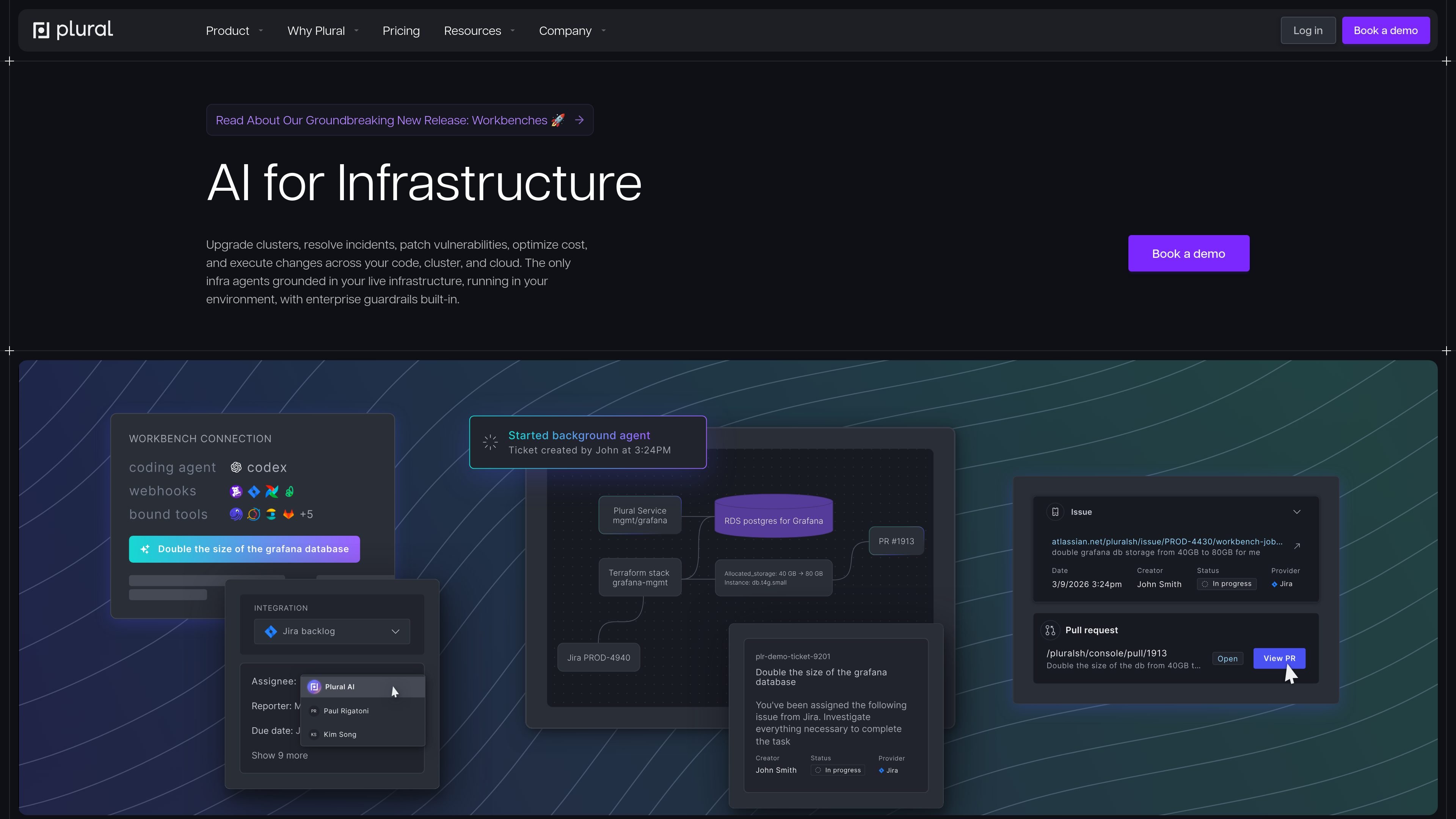
Plural is an AI-for-infrastructure platform for platform and DevOps teams. It runs agents in your clusters to help upgrade clusters, resolve incidents, patch vulnerabilities, optimize cost, and execute changes across code, cluster, and cloud.
The platform is built around live infrastructure context, human review, and PR-based workflows. Plural says its agents bundle the tools teams already use, the operational knowledge encoded in runbooks and remediation patterns, and purpose-built subagents for observability, infrastructure analysis, and code changes.
Plural’s agents can investigate incidents using observability and infrastructure context in parallel, identify a root cause, and open a pull request with the minimum-viable fix.
Agents inventory cluster estates, map component dependencies, and plan rollout order across environments to support cluster upgrades.
Scheduled jobs scan the estate for known CVEs, prioritize issues by exposure, and create pull requests for affected services or stacks.
Agents can pick up infrastructure tickets, identify the relevant Terraform module and dependencies, and turn the request into a linked pull request.
FinOps agents inventory cloud spend by cluster, query billing tables, and open Terraform PRs for right-sizing changes.
Plural keeps a live semantic graph of clusters, stacks, services, and changes, and lets subagents show their work through inspectable tool calls and artifacts.
Use Plural when an alert fires and you need infrastructure context, root-cause analysis, and a minimal fix packaged as a PR for review.
Use Plural to inventory a cluster estate, map dependencies, and stage upgrades across dev, staging, and production without manually coordinating each step.
Use Plural to scan for known vulnerabilities, prioritize exposed services or stacks, and create remediation PRs before the backlog grows.
Use Plural when an internal ticket requests an infrastructure change, such as resizing a production database, and you want the request converted into a linked pull request.
Use Plural to review cloud spend by cluster and generate right-sizing changes as Terraform pull requests for FinOps review.
Plural is an AI-for-infrastructure platform that runs agents in your clusters and executes actions server-side with human review. The source describes workflows such as incident response, cluster upgrades, CVE remediation, ticket-to-PR changes, FinOps tasks, and drift checks.
Plural says agents run in your clusters and can use a BYO LLM setup with providers including OpenAI, Anthropic, Bedrock, Azure, and more. The platform also states that every action is logged and changes land as pull requests for human review.
The pricing page shows a 14-day free Sandbox trial, a Pro plan starting at $450 per month for one cluster, and an Enterprise plan with pricing based on cluster count and support requirements.
The pricing page lists enterprise-focused capabilities such as multi-cluster deployment, CD pipelines, IaC management, PR automations, Git integrations, and policy management. It also notes hosting options that include Plural shared infrastructure and shared, dedicated, or on-prem infrastructure for Enterprise.
The source does not provide detailed setup steps or an exhaustive integrations catalog. It does state support for tools such as observability providers, SCM systems, ticket systems, arbitrary MCP servers, and Git integrations.