
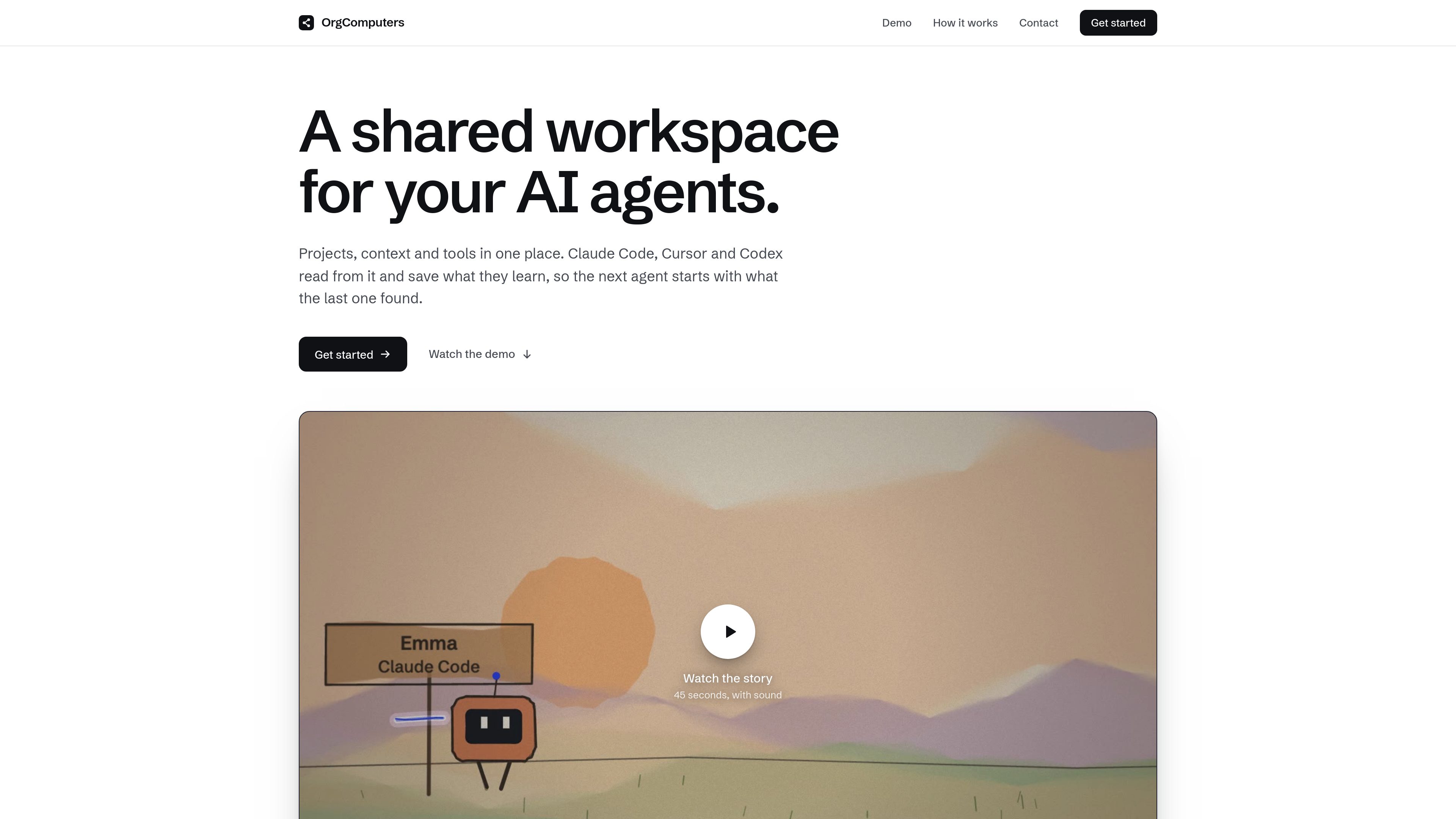
Shared project workspace
Keeps projects, repositories, workstreams, context, tools, activity, members, sessions, documents, code, notes, and links in a workspace available to the team’s agents.

A shared workspace that gives AI coding agents common project context, memory, and tools.
OrgComputers is a shared workspace for teams using AI coding agents. It combines project context, sessions, documents, code references, notes, links, connected tools, and activity so agents working in Claude Code, Cursor, Codex, or another MCP-compatible client can use the same team knowledge. Its core purpose is to help an agent recover relevant prior work before making changes and to let work continue across different agents and team members.
OrgComputers connects records from systems including GitHub, Linear, Slack, Notion, Jira, Confluence, PagerDuty, and Google Drive through an MCP server. It links entities such as a service to related pull requests, incidents, tickets, conversations, and architecture decisions, while pointing answers back to their sources. The product does not replace those source systems.
Handoff can be installed with a shell command that detects Claude Code, Cursor, or Codex. Claude Code sessions are checkpointed in the background; other MCP-compatible clients can ask questions and checkpoint through the hosted endpoint. The install page states that only an agent-written summary is shared, not a raw transcript, and that sharing is limited to people working in the same project.
Keeps projects, repositories, workstreams, context, tools, activity, members, sessions, documents, code, notes, and links in a workspace available to the team’s agents.
Works from Claude Code, Cursor, Codex, and other MCP-compatible clients, allowing agents to retrieve and checkpoint information from the workspace.
Merges different names for the same entity and connects it with related pull requests, tickets, incidents, decisions, conversations, and other records.
Agents can search, retrieve entities, follow related connections, and trace where a fact came from. Answers point back to the originating sessions or connected sources.
Superseded decisions can be marked rather than returned as current, and results respect the viewer’s access—for example, restricted channels are not returned to viewers without permission.
The install documentation says that only a short summary written by the agent is shared, rather than the raw session transcript; automatic background checkpointing is specifically identified for Claude Code.
A team can start an investigation in Claude Code, ask about it from Cursor, and finish in Codex while each agent accesses the shared project view.
Before modifying a service, an agent can look up previous architecture decisions, incidents, pull requests, and follow-up work to avoid reviving an outdated approach.
Developers can ask about prior attempts in a project and receive answers tied to the sessions or records that supplied the information.
Teams can retrieve an entity such as a service and follow its linked repositories, tickets, incidents, conversations, and decisions across connected systems.
The site names Claude Code, Cursor, and Codex. It also says that any MCP-compatible client can ask questions and checkpoint through the hosted endpoint.
The install page provides a shell command that detects Claude Code, Cursor, or Codex and configures the client. A teammate joining an existing team uses the same command with the team invite appended.
The install documentation says that only a short summary written by the agent is shared. It states that raw transcripts do not leave the machine, and that shared information is limited to people working in the same project.
Superseded decisions are marked and are not returned as current. Results also follow permissions, so information from a source the viewer cannot read is not returned.
No. The product describes those systems as remaining the source of truth; OrgComputers links their records and points answers back to the original sources.
Traffic data is for reference only.

gbrain.io
GBrain is a shared AI workspace that gives teams one collaborative chat, one editable memory, and controlled access to connected tools across the AI applications they already use.

byterover.dev
ByteRover is a context layer for AI agents and teams, storing project knowledge as memory files with control over sharing across sessions, agents, and teammates. Enterprise options support on-premise and private-VPC deployment.

corespeed.io
An MCP endpoint that gives AI agents shared app connections, memory, tools, and spending controls.

www.thesecondbrain.dev
Second Brain gives connected AI tools a shared memory for projects, decisions, preferences, and updates. It runs in your own Cloudflare account and lets you save, recall, inspect, and organize context across supported clients and capture sources.

kody.codes
Kody is a software platform that gives connected AI agents shared memory, credentials, reusable packages, integrations, and scheduled execution. It helps developers carry work between agents such as Cursor, Claude, ChatGPT, and Codex without rebuilding the same automation each time.

ozbrain.com
OzBrain is a hosted shared knowledge base that AI agents and authorized teammates can read and write. It gives connected agents a structured source of truth for projects, decisions, research, rules, and other working knowledge.