
Single MCP endpoint
Connect an agent to https://api.corespeed.io/mcp and expose connected apps and CoreSpeed capabilities through one authenticated server. Available connector tools are limited to the apps the user has connected.

An MCP endpoint that gives AI agents shared app connections, memory, tools, and spending controls.
CoreSpeed is a server-side MCP endpoint for AI agents. It connects agents such as Claude Code, Codex, Cursor, OpenClaw, and Hermes to authorized workplace apps and shared capabilities through one setup. Connected apps, persistent memory, media generation, web search, social data, approvals, and spending controls are exposed as tools at the agent endpoint.
The product is designed for work that requires external systems rather than chat alone. Users can connect services through OAuth, then ask an agent to search and update those services, research live information, generate media, or retain relevant context such as people, projects, writing style, and prior decisions. Only connected apps appear as available connector tools.
CoreSpeed also provides plain-language approval policies, an audit trail, and usage-based billing on one surface. Policies can allow routine actions while pausing actions that need review, such as public claims or spending above a specified budget. The service can be started with 3,000 credits valid for 90 days on the free plan; Pro is listed at $20 per month with 10,000 credits per month, and Enterprise pricing is custom.
Connect an agent to https://api.corespeed.io/mcp and expose connected apps and CoreSpeed capabilities through one authenticated server. Available connector tools are limited to the apps the user has connected.
Connect services through OAuth rather than managing separate API applications or keys. Listed connectors include Gmail, Slack, Notion, GitHub, X, Google Calendar, HubSpot, LinkedIn, Salesforce, Jira, Figma, Shopify, and many others.
Store context about people, projects, writing style, and previous decisions, while using built-in web search, scraping, image generation, and social-data tools when those capabilities are authorized.
Describe which actions an agent may perform automatically and which require sign-off. The workflow can pause for approval before actions such as public posting or spending beyond a stated budget.
Carry connected apps, memory, voice, and policy logic across supported agents instead of tying them to a single client. Plans and usage are managed through one CoreSpeed billing surface.
Pull leads from HubSpot, enrich them with live web and LinkedIn research, draft personalized first-touch messages in the user's voice, and log emails and notes back to the CRM.
Turn a campaign brief into copy, schedule posts across X and LinkedIn, retrieve Google Ads spend and funnel figures, and send a recurring performance digest.
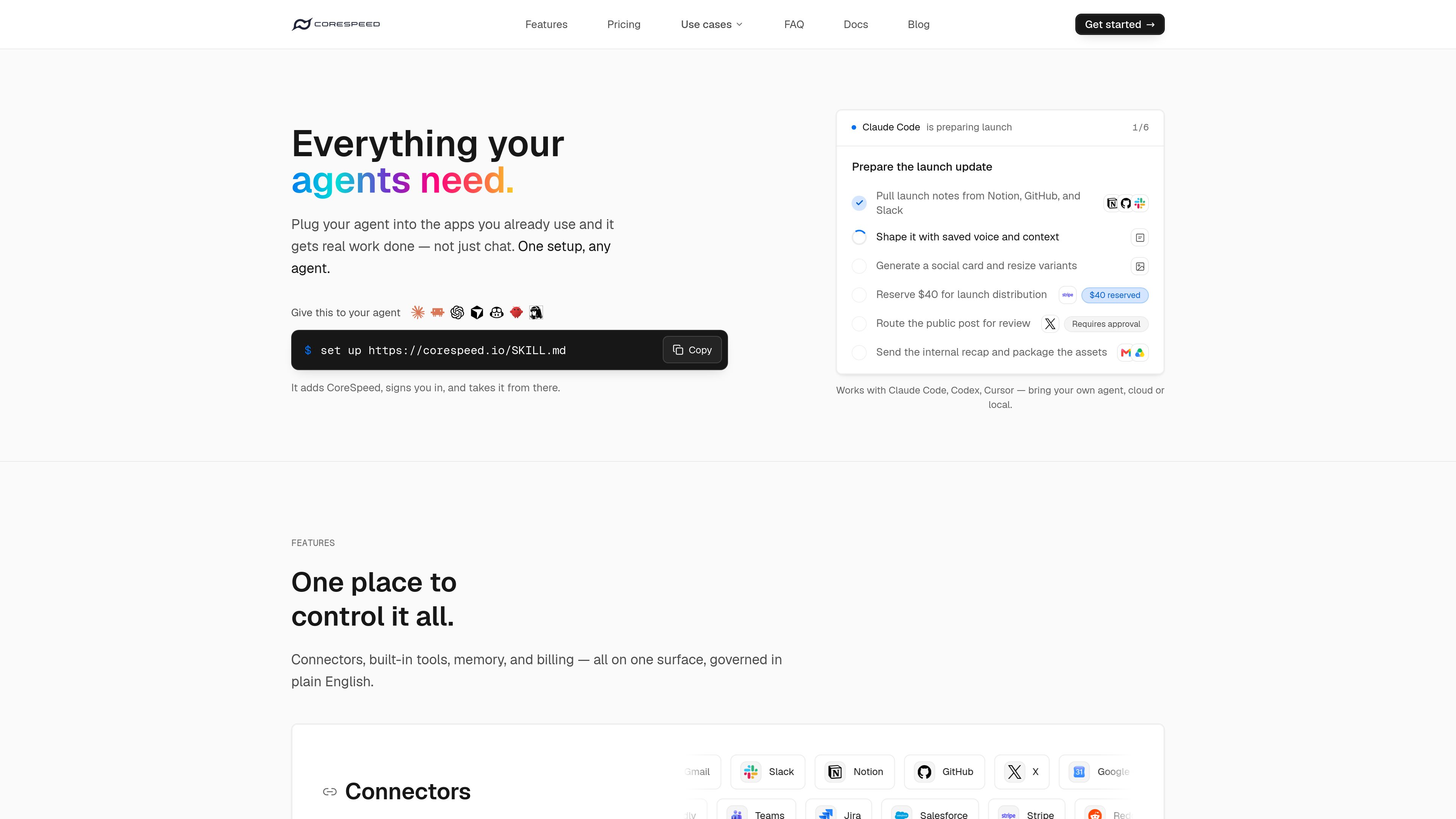
Combine launch notes from Notion, GitHub, and Slack, shape an update using saved context, generate and resize a social card, reserve a defined distribution budget, and route the public post for review.
Use connected business systems and retained context for recurring work such as inbox handling, calendar coordination, ticket triage, backlog review, expense categorization, or payout reconciliation.
Give a supported agent the CoreSpeed setup skill URL, or add https://api.corespeed.io/mcp as a user-level MCP server. The agent opens browser sign-in and asks which apps to connect. The documentation also provides configuration examples for Claude Code, Codex, Cursor, VS Code, and Claude’s custom connectors.
The site explicitly names Claude Code, Codex, and Cursor, and its portability examples also show OpenClaw and Hermes. The documentation describes CoreSpeed as an MCP server, so other MCP clients may be configured using their user-level MCP settings.
The product says its connectors use one OAuth tap per app and do not require users to create API applications or manage keys for those connections. Only apps that the user authorizes are exposed to the agent.
Yes. Smart approval policies are written in plain language. Actions covered by a policy can run automatically, while actions the policy says to review pause and ask for approval. The site also describes budgets, spending controls, and an audit trail.
The Free plan is $0 and includes 3,000 credits for 90 days, one member, 200 MB of memory, and 30 days of history. CoreSpeed Pro is listed at $20 per month with 10,000 credits per month, and Enterprise pricing is custom. Usage rates vary by connector and built-in tool.
Traffic data is for reference only.

www.orgcomputers.com
A shared workspace that gives AI coding agents common project context, memory, and tools.

kody.codes
Kody is a software platform that gives connected AI agents shared memory, credentials, reusable packages, integrations, and scheduled execution. It helps developers carry work between agents such as Cursor, Claude, ChatGPT, and Codex without rebuilding the same automation each time.

gbrain.io
GBrain is a shared AI workspace that gives teams one collaborative chat, one editable memory, and controlled access to connected tools across the AI applications they already use.

ozbrain.com
OzBrain is a hosted shared knowledge base that AI agents and authorized teammates can read and write. It gives connected agents a structured source of truth for projects, decisions, research, rules, and other working knowledge.

www.thesecondbrain.dev
Second Brain gives connected AI tools a shared memory for projects, decisions, preferences, and updates. It runs in your own Cloudflare account and lets you save, recall, inspect, and organize context across supported clients and capture sources.

treg.to
treg.to is an API gateway and MCP server for calling tools and data providers through one endpoint and credential. It helps agents and developers use cataloged SEO, enrichment, advertising, social, scraping, and other data tools without managing separate provider keys for every metered call.