
Shared memory across agents
Save facts and context that connected agents can search later. Account memories follow the user across hosts, unlike context kept only in a host-specific project or rules file.

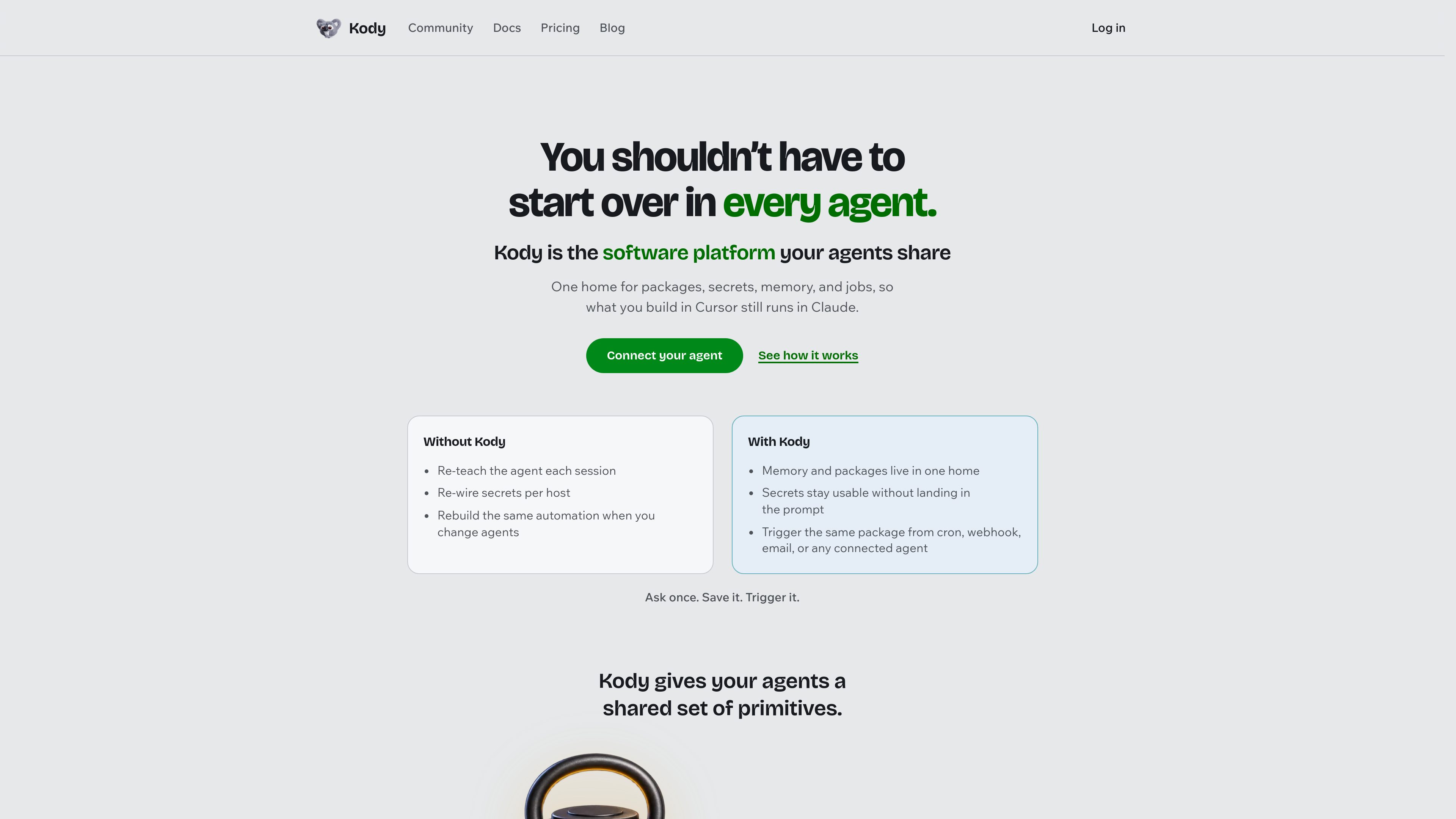
Kody is a software platform that gives connected AI agents shared memory, credentials, reusable packages, integrations, and scheduled execution. It helps developers carry work between agents such as Cursor, Claude, ChatGPT, and Codex without rebuilding the same automation each time.
Kody is a shared software platform for connected AI agents. It stores memory, credentials, reusable packages, and jobs in one account so work can move between agents such as Cursor, Claude, ChatGPT, and Codex.
The platform turns one-off agent work into software that can be reused or triggered later. Agents provide the reasoning and write the code; Kody provides durable storage, controlled credential use, cloud execution, schedules, webhooks, email events, and hosted pages.
Kody is not a replacement for an agent host and does not run its own chat-agent loop. Each user account is isolated, with its own packages, jobs, secrets, memories, and storage. Public packages can be published as catalog snapshots and installed as forks.
Save facts and context that connected agents can search later. Account memories follow the user across hosts, unlike context kept only in a host-specific project or rules file.
Store keys and tokens without returning their values to the agent. Code refers to secrets by name, and Kody substitutes approved credentials at the network boundary.
Turn agent-written code into durable software in an isolated repository. Packages can expose exports, scheduled jobs, inbound webhooks, or a small hosted app.
Start packages from cron schedules, webhooks, subscriptions, email, or other events, so saved work can run without keeping a chat open.
Reuse signed-in connections to services including GitHub, Discord, and Google. Documentation also covers providers such as Figma, Notion, Salesforce, Slack, and Spotify.
Download a JSON account export from settings with secret values excluded. Kody is Fair Source, with source available on GitHub to read, fork, and deploy.
Build a package in Cursor or another coding agent, then run it from Claude Code, ChatGPT, or another connected MCP-capable host without recreating the implementation.
Save a repository or service check, then run it on a schedule or from a webhook and notify through email or a connected service when appropriate.
Connect tools such as GitHub, Discord, or Google while keeping credentials outside the prompt. The agent invokes the connection without receiving the underlying secret value.
Expose package functionality through a hosted page or app that people can open directly instead of requesting the same operation through a new chat turn.
No. Kody connects to the agent hosts you already use. Those agents do the reasoning, while Kody supplies shared memory, credentials, packages, schedules, and execution.
Kody does not run its own agent loop or bill for chat tokens. Saved packages can run without another model inference call. Search indexing uses a small embedding model rather than a chat model.
Packages, secrets, jobs, memories, and other account data remain available when you connect another MCP-capable host. Context that exists only inside a host, such as local Cursor rules or a Claude Project, does not automatically transfer.
No. Each signed-in user has an isolated assistant with separate packages, jobs, secrets, memories, and storage. Public packages can be shared as snapshots, but Kody does not currently provide an organization or shared-team workspace.
You can download a JSON account export; secret values are not included. Kody is Fair Source, and its source is available on GitHub to read, fork, and deploy.
Traffic data is for reference only.

deepaksinghcs14.github.io
deadeye is a plugin for coding agents that selects a suitable model and effort level for each task, while trimming verbose command output before it enters context. It is built for Claude Code and also supports Codex CLI, Gemini CLI, Cursor, and Windsurf on an experimental basis.

platform.claude.com
Claude Platform gives developers programmatic access to Claude models and managed agent infrastructure for building agents and applications. It includes a REST API, official client SDKs, a web Console, and documentation for direct integrations.

flocker.md
Flocker is an AI agent management platform for creating agent profiles, coordinating multi-agent work, and monitoring activity from a shared dashboard. It is designed for people running multiple agents across tools such as Claude Code, Codex, OpenClaw, OpenCode, and MCP-compatible workflows.

www.edgee.ai
Edgee is an agent gateway for coding teams that reduces token usage, routes requests across models, and provides usage visibility. Its Compression V2 works as a drop-in CLI layer for Claude Code, Codex, OpenCode, Cursor, and other supported agents.

pushary.com
Pushary Isle is a native Mac app that puts AI agent questions and approval requests in the Mac notch or below the menu bar. It helps people review Claude Code, Codex, Cursor, and other connected agent requests at their desk or answer them from a phone.

zapier.com
Zapier MCP connects AI clients such as Claude, ChatGPT, and Cursor to actions across Zapier’s app ecosystem. It lets an agent discover an appropriate action, request missing details, and execute it with authentication and permissions managed through Zapier.