
Real-time usage metering
Track events, logs, and metrics as billable usage, with real-time aggregation that can handle high-volume event streams.

OpenMeter is an open-source usage-based billing and metering platform on Managed Cloud. Meter events, enforce limits, and connect usage data to billing workflows and custom pricing.
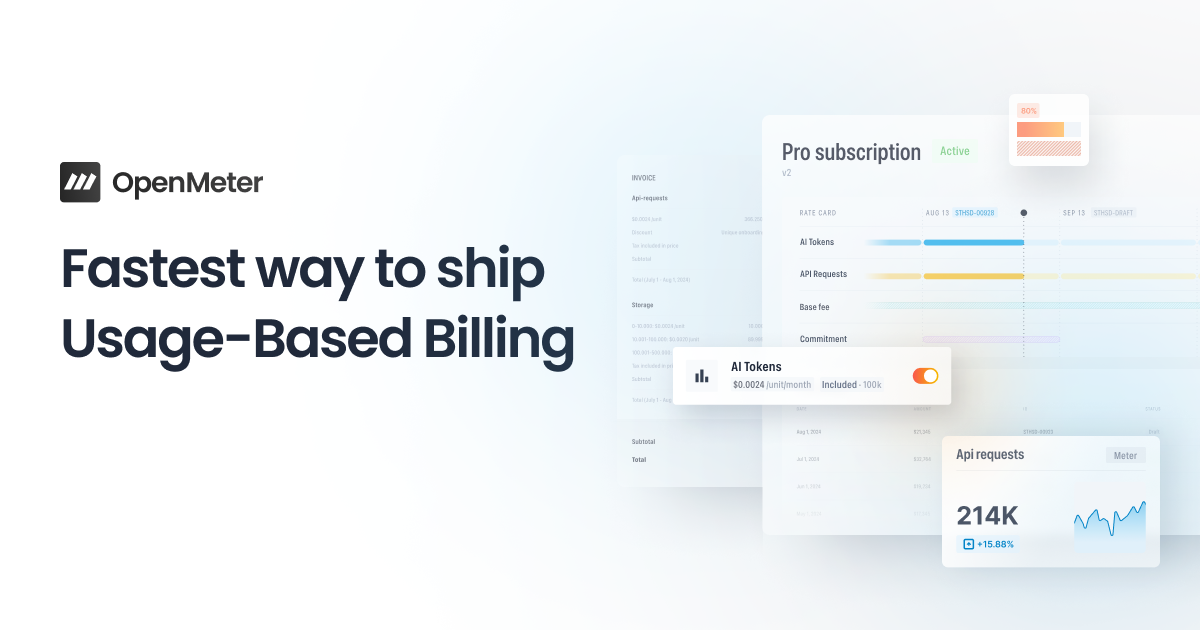
OpenMeter is an open-source billing and metering platform for usage-based products. It helps teams turn events, logs, and metrics into billable usage so they can launch metered products faster and support custom pricing arrangements without hardcoding billing logic into application code.
The public site presents OpenMeter as available in Managed Cloud and also as open source on GitHub under the Apache 2.0 license. The product pages and docs emphasize real-time usage metering, product catalog management, billing workflows, and usage controls such as limits, notifications, quotas, and low-latency enforcement.
Track events, logs, and metrics as billable usage, with real-time aggregation that can handle high-volume event streams.
Define pricing structures around plans, credits, usage-based pricing, commitments, add-ons, and entitlements without hardcoding those rules into the app.
Apply limits, notifications, and quotas to control usage, including low-latency enforcement and usage gating on the edge.
Turn metered usage into billing workflows, with support for self-service usage-based billing and invoicing-oriented flows.
Expose usage and revenue signals to sales and revenue teams, including growth and churn insights surfaced in CRM and customer tools.
Provide developer-oriented APIs, SDKs, and docs for sending events, querying meters, and building against the platform.
Measure AI or API consumption in real time, then turn those usage events into billable records and invoices.
Change pricing structure quickly by adjusting plans, credits, entitlements, add-ons, or commitments instead of hardcoding billing logic.
Let customers monitor their usage and receive limits, quotas, or notifications that help control spend before usage grows too high.
Give sales teams a way to provision custom deals and tailored packages without engineering rework.
Surface usage, growth, and churn insights in CRM or customer data tools so revenue teams can act on expansion opportunities.
OpenMeter is built for usage-based billing and metering. The docs and product pages show a setup flow that starts with signing up for OpenMeter Cloud, creating a meter, creating an API key, sending usage events, querying usage, and then setting up billing.
Yes. The pricing page says OpenMeter Cloud now ships as Kong Metering & Billing, and the docs also describe both Managed Cloud and self-hosted deployment options.
The source shows support for usage-based pricing, plans, credits, entitlements, limits, add-ons, discounts, commitments, and invoicing workflows. It is designed to let teams change pricing without hardcoding those rules into product code.
The website highlights SDKs for popular languages such as Node.js, Python, and Go, and the docs list SDKs and quickstarts alongside OpenTelemetry, LangChain, Kubernetes, and other collectors.
The product pages emphasize real-time metering, low-latency limit enforcement, usage gating on the edge, and revenue insights in CRM and customer data tools. The public pages do not provide a full inventory of every supported destination or connector.