
Three-part model stack
Uses three model types together: a layout- and language-agnostic encoder, a single-language ContextLM, and a layout-specific decoder for higher accuracy.

FUTO Swipe is a swipe-typing research release with a dataset, models, and C++ decoding library for turning swipe paths into word predictions.
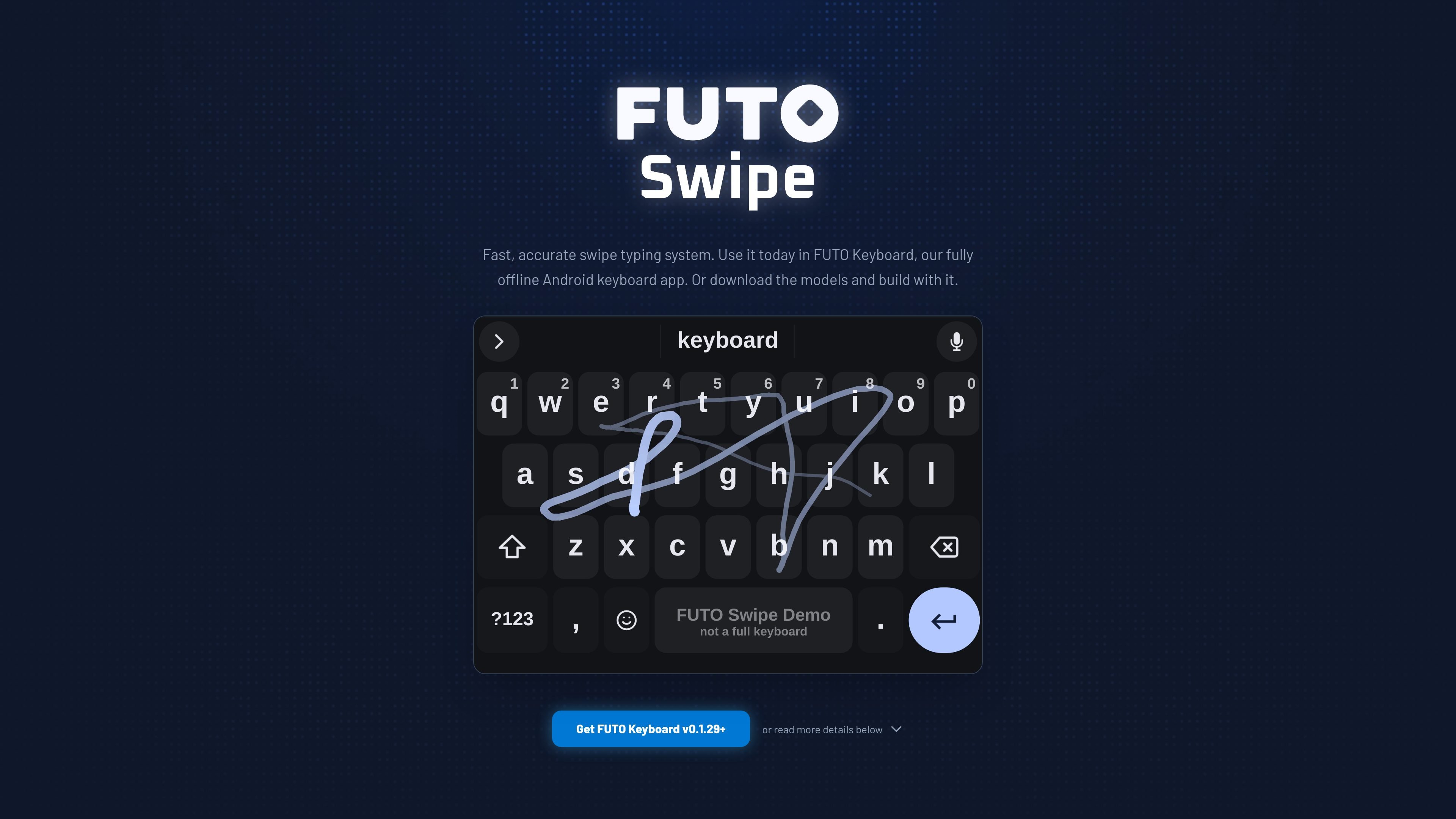
FUTO Swipe is a swipe-typing research and model release focused on turning drawn keyboard paths into word predictions. The project combines a released dataset, trained models, and a decoding library so swipe input can be evaluated and used in inference workflows.
The site describes a model stack with three parts: a universal encoder, a single-language ContextLM, and a layout-specific decoder. Together with dictionary-constrained beam search, these components aim to improve swipe prediction quality while keeping the models small enough to run on low-end devices.
The project grew out of a dataset collection effort on swipe.futo.org in August 2024. That effort produced more than 1 million swipes, and a cleaned dataset of 1 million swipes was released in March 2025 under the MIT license on HuggingFace.
FUTO Swipe also releases swipe-library, a C++ library for inference, decoding, and beam search. The site positions it as the missing piece needed to move from swipe traces to ranked candidate words.
Uses three model types together: a layout- and language-agnostic encoder, a single-language ContextLM, and a layout-specific decoder for higher accuracy.
The encoder provides general swipe prediction across layouts and languages, while the decoder is trained for a specific layout and language to capture keyboard-specific behavior.
ContextLM uses preceding sentence context to suppress word sequences that do not make sense, and it only needs text data for training.
A dictionary-constrained beam search scores candidate words from swipe paths, which is necessary because raw model outputs are not enough on their own.
The release includes swipe-library, a C++ library that handles inference, decoding, and beam search from swipe paths to word predictions.
The site reports a released dataset of 1 million English QWERTY swipes under the MIT license, used to train and evaluate the models.
Use the released dataset and model descriptions to study swipe-typing systems, compare approaches, or reproduce evaluation on a controlled English QWERTY corpus.
Use the encoder, ContextLM, and decoder together when building or testing a swipe-to-word pipeline that needs candidate ranking from raw gesture paths.
Use swipe-library when you need the decoding and beam-search layer around model outputs, rather than only a raw model that emits scores.
Use the released resources to understand how much context, layout knowledge, and layout-specific training contribute to prediction quality.
Use the small-footprint model stack when targeting devices or environments where milliseconds-scale inference and low compute use matter.
The source describes Swipe as a swipe-typing system built from a released swipe dataset, trained models, and a C++ swipe-library for decoding paths into word predictions.
The page says the released decoder is currently available only for QWERTY English, because decoder training requires swipe-typing data for a specific layout and language.
The site says the dataset was released under the MIT license and is available on HuggingFace.
The models are described as small enough to run on low-end devices in milliseconds, and the site says the full stack uses a dictionary-constrained beam search to produce candidate words.
The page does not list a consumer app, SDK, or hosted API; it presents the models and swipe-library as released resources for swipe-to-word prediction workflows.