
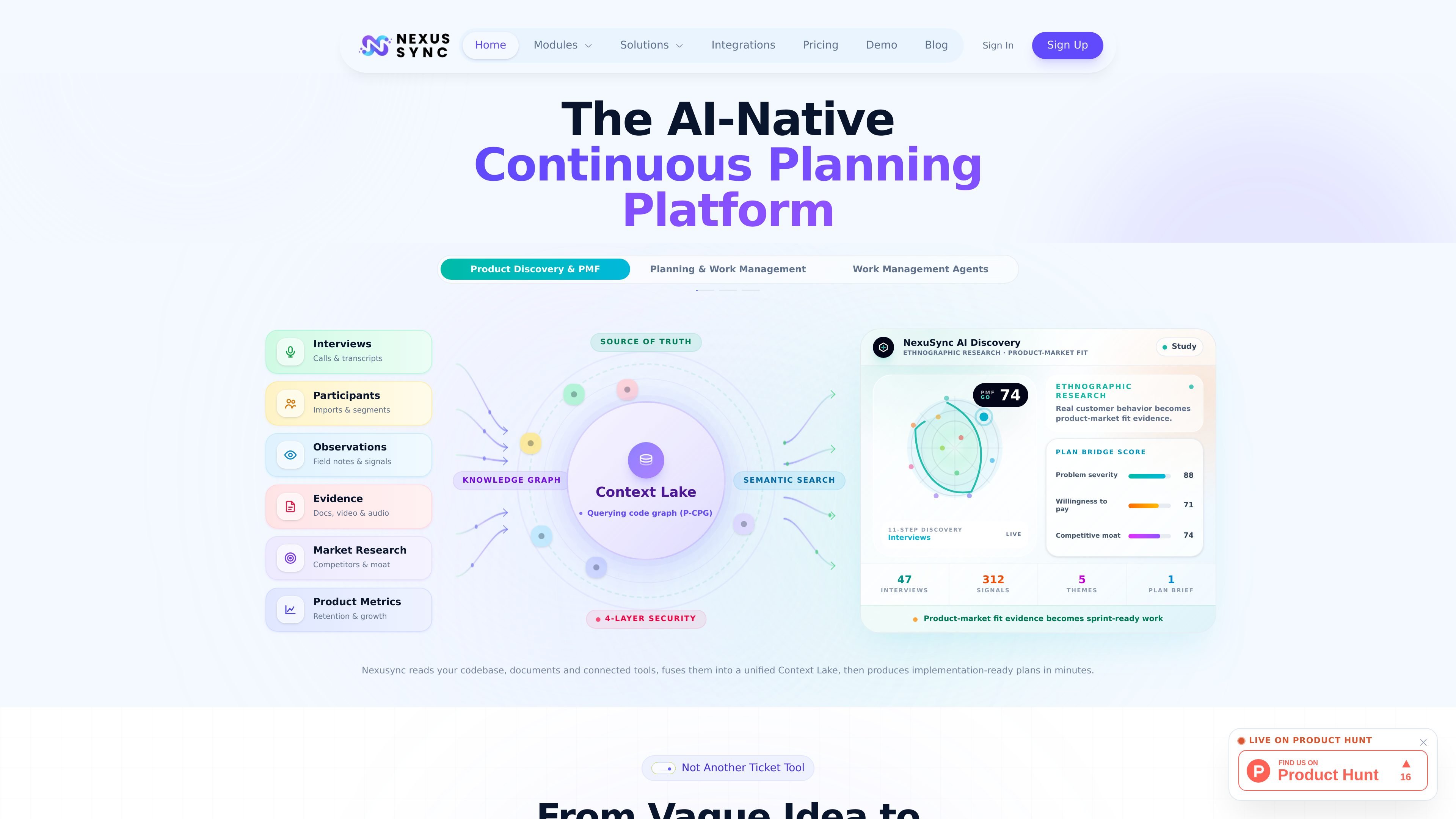
Customer research workspace
Organize study participants, interviews, observations, documents, recordings, and extracted evidence in one research workflow.

AI planning that connects customer research, code context, and structured engineering work.
NexuSync is an AI-native planning and work management platform for product and engineering teams. It connects customer interviews and research evidence with documents, code relationships, and project context, then generates structured delivery plans. Teams can move from discovery studies and product-market-fit assessments into themes, epics, stories, and tasks with estimates, dependencies, owners, and acceptance criteria.
Organize study participants, interviews, observations, documents, recordings, and extracted evidence in one research workflow.
Classify interview quotes into signal types, group evidence into themes, and create product-market-fit assessment reports. The workflow includes MVP signal scoring and the Sean Ellis survey method.
Combine documents, code relationships, glossary terms, URLs, and connected-tool context to create structured engineering plans.
Turn research signals, themes, and hypotheses into a brief with target users and acceptance criteria, then generate themes, epics, and stories.
Paid tiers include AI note-taker minutes. Team tiers add autonomous agents; their monthly credits, seats, and agent-run limits depend on the plan.
Combine interview evidence, product metrics, and market research to assess customer needs before planning a build.
Convert a research brief into engineering work with acceptance criteria and dependencies.
Use structured plans, ownership, estimates, and approval gates to organize work across discovery and delivery.
Yes. Free costs $0 and includes 250,000 AI credits per month, one seat, one workspace, one project, and three generated plans per month.
Individual Pro is $19 per user per month. Team Pro is $99 per team per month, and Team Pro Max is $199 per team per month; each team plan includes up to eight users.
Individual Pro includes 1 million AI credits and 300 note-taker minutes per month. Team Pro includes 2.5 million credits and 1,200 minutes; Team Pro Max includes 5 million credits and 1,500 minutes, with unlimited projects and workspaces.
Plans can include themes, epics, stories, and tasks, with estimates, dependencies, owners, and acceptance criteria derived from the planning context.
Traffic data is for reference only.

fragment.fit
Fragment is a structured context layer for product teams, builders, and AI agents. It connects customer conversations, product information, and company knowledge to support evidence-based discovery, prioritization, and build-ready specifications.

meridiona.com
Meridian is an engineering intelligence workspace that helps engineering leaders and teams understand delivery health, execution context, risks, and decisions. It connects project signals and team updates into a shared delivery view without replacing the project tracker.

linear.app
Linear is a product development platform for planning, building, and monitoring work in one workspace, with issue tracking, project planning, AI-assisted coding, code review, and product operations.

quickbase.com
Quickbase is a low-code platform for managing complex projects, workflows, resources, and field operations. It connects business data and systems so teams can build tailored apps, automate handoffs, and monitor work in one environment.

notchup.com
AI engineering management software for capacity planning, delivery visibility, and workforce decisions.