
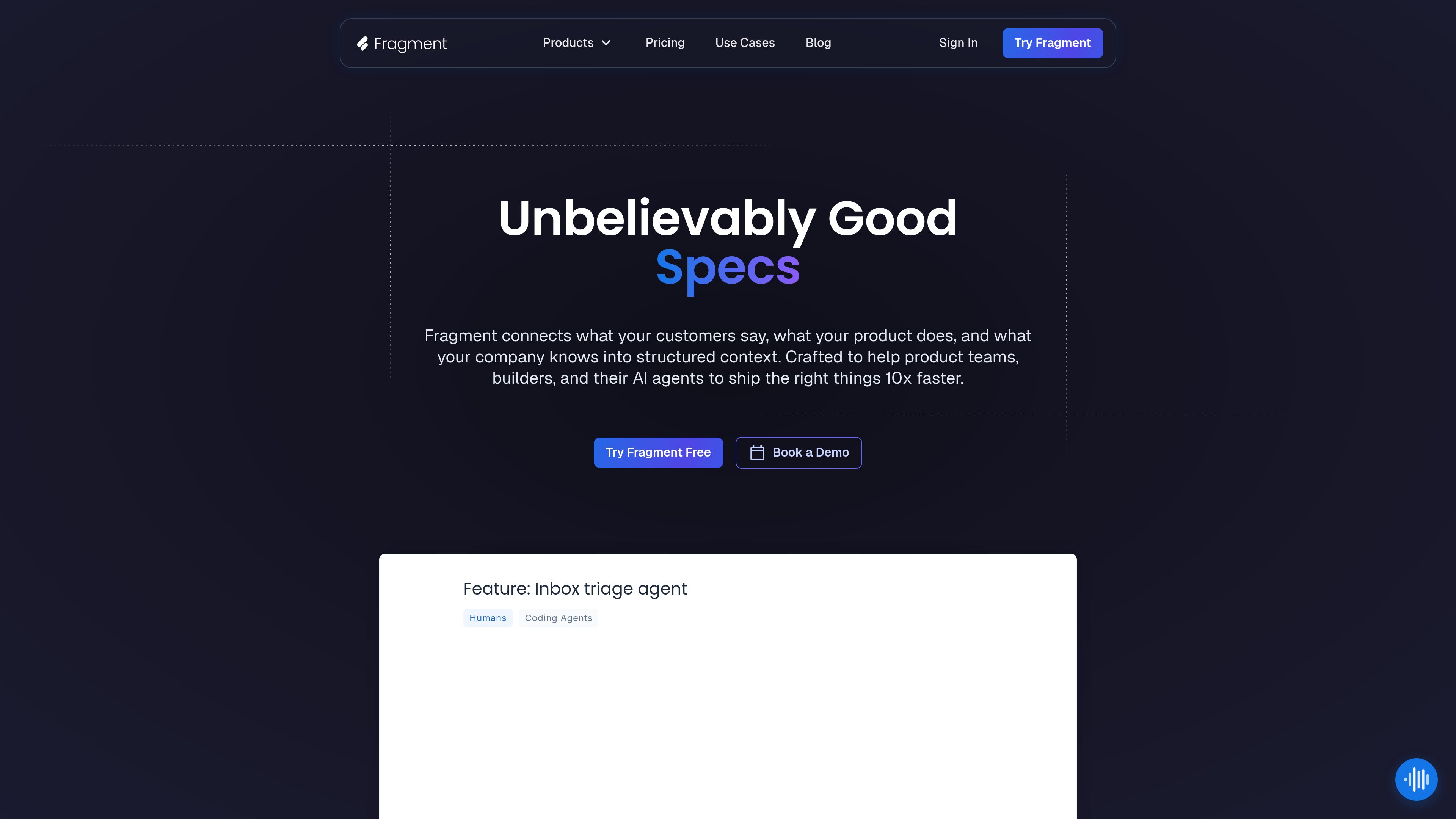
Evidence-grounded specification drafting
Start with a business goal, question, or rough idea. Fragment checks the idea against customer needs, product reality, company context, and available evidence, then helps produce a build-ready specification.

Fragment is a structured context layer for product teams, builders, and AI agents. It connects customer conversations, product information, and company knowledge to support evidence-based discovery, prioritization, and build-ready specifications.
Fragment is a structured context layer for product teams, builders, and AI agents. It connects customer conversations, product information, and company knowledge so teams can investigate needs, evaluate ideas, prioritize work, and create specifications from a shared body of evidence.
The product combines continuous feedback analysis with tools for research and product planning. It can process calls, messages, uploads, and connected sources, then organize findings into themes, reports, personas, Jobs to Be Done, and answers to product or customer questions. Its aim is to keep context current instead of leaving teams to search across transcripts, Slack threads, and outdated documents.
Fragment also supports AI-assisted development through Fragment MCP. Claude Code, Cursor, and Codex can query the product, customer, and company context within their workflows. Its Squad Notetaker creates typed records from internal meetings and customer calls, making decisions, action items, pains, objections, and other meeting outputs available as structured, sourced objects.
Start with a business goal, question, or rough idea. Fragment checks the idea against customer needs, product reality, company context, and available evidence, then helps produce a build-ready specification.
New calls, messages, and uploads are analyzed automatically to identify feedback, recurring themes, and priorities without requiring teams to maintain a taxonomy or manually tag every item.
Fragment can generate Voice of Customer reports, customer personas, Jobs to Be Done, and synthesized answers to questions about customer needs, product experience, and company goals.
Squad Notetaker distinguishes internal sessions from customer conversations. Internal meetings can yield decisions, action items, risks, and takeaways; customer calls can yield pains, needs, objections, issues, praise, and aspirations.
Claude Code, Cursor, and Codex can query Fragment through MCP. Agents receive sourced context and typed meeting objects instead of having to repeatedly re-read and extract information from raw transcripts.
Paste a product requirements document and check its customer-related claims against real conversations. Fragment can identify which claims are supported and surface relevant pains the document did not address.
Analyze customer and user research across calls to identify recurring needs, objections, and workarounds. Product managers and researchers can use the synthesized findings to support prioritization and roadmap discussions.
Research conversations associated with a particular role and produce a Jobs-to-be-Done persona whose jobs, pains, and workarounds are tied back to the language used in the calls.
Use Squad Notetaker for sprint planning, retrospectives, technical design, or customer calls. Teams can ask Claude or Cursor for decisions, owners, risks, or customer evidence instead of searching through full meeting transcripts.
Fragment is intended for product managers, product leaders, researchers, founders, builders, product marketers, and AI-assisted development workflows. These users can use it for discovery, roadmap evidence, research synthesis, customer language, specifications, and product questions.
The listed native integrations are Gong, Zoom with Fragment’s AI notetaker, Google Drive, Fireflies, and Zapier. Users can also upload transcripts, analytics exports, survey results, PRDs, documents, spreadsheets, images, audio, and video.
Fragment connects to Claude Code, Cursor, and Codex through MCP. The agents can query customer, product, and company context, including structured meeting records, within their existing workflows.
The site says there is no required manual tagging, taxonomy maintenance, manual entry, or model training. Fragment analyzes new calls, messages, and uploads automatically and incorporates the findings into themes and company context.
Yes. The Free plan includes 4 hours of meeting analysis per month, unlimited notebooks, 10 research messages, a 30-day history, uploads, Google Drive integration, and community support. Pro and Team plans provide higher usage limits and additional integrations.
Traffic data is for reference only.

nexusync.io
AI planning that connects customer research, code context, and structured engineering work.

productboard.com
Productboard is an AI-powered product management platform helping teams turn customer signals into priorities, build roadmaps, and move from strategy to delivery.

quickbase.com
Quickbase is a low-code platform for managing complex projects, workflows, resources, and field operations. It connects business data and systems so teams can build tailored apps, automate handoffs, and monitor work in one environment.

offloop.org
Offloop is a shared workspace for small teams and AI agents to run recurring work with visible context, ownership, approvals, and handoffs. It turns agent results into reusable workflows inside team Channels.
runevr.com
runevr is a collaborative workspace for creative teams, bringing boards, live media review, chat, drive, calls, recordings, and AI agents together in one project room. Keep work, feedback, and approvals in context from brief to delivery.

meridiona.com
Meridian is an engineering intelligence workspace that helps engineering leaders and teams understand delivery health, execution context, risks, and decisions. It connects project signals and team updates into a shared delivery view without replacing the project tracker.