
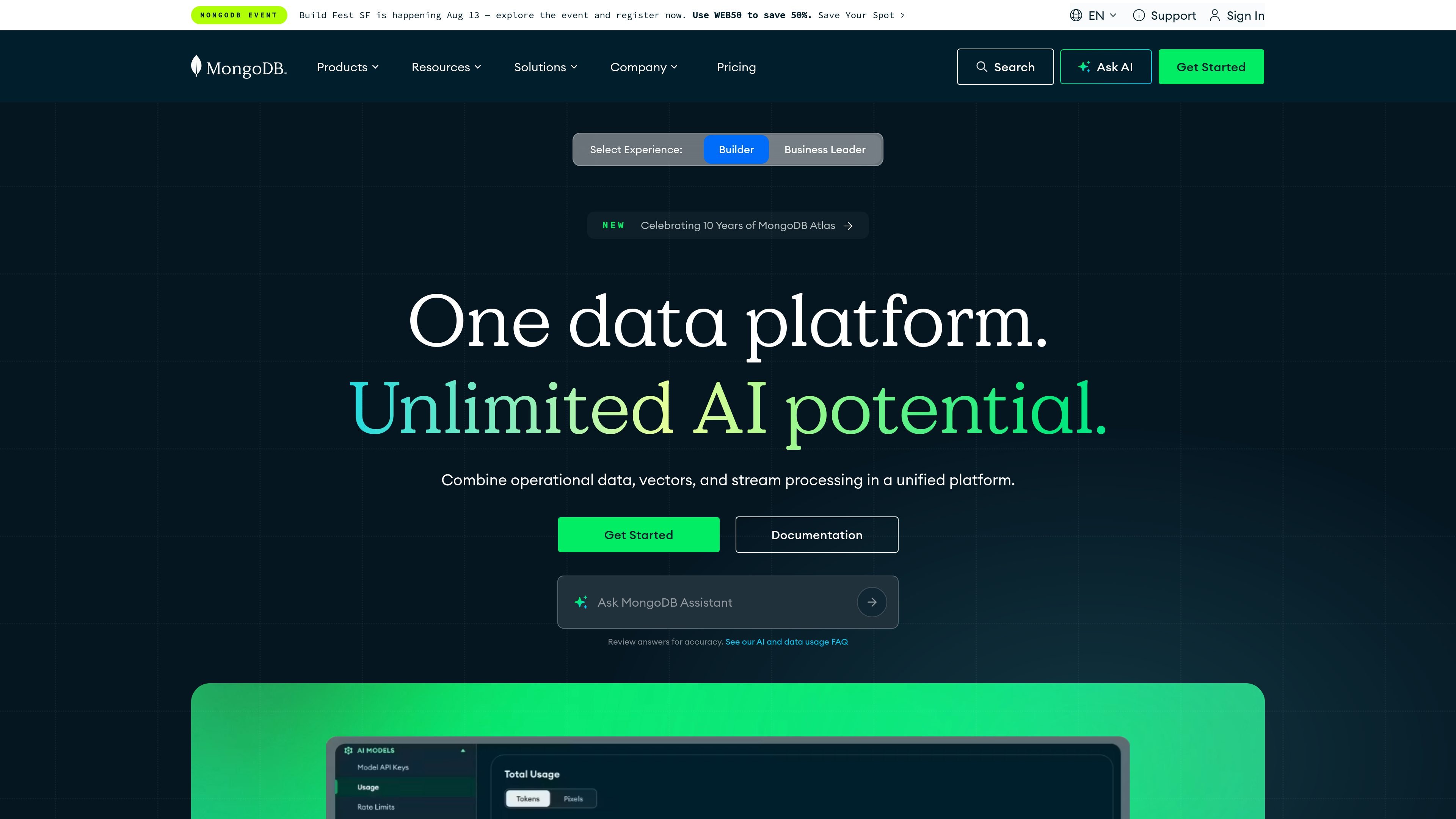
Unified data platform
MongoDB Atlas combines operational data, vectors, and streaming data in one platform, so teams do not have to stitch together separate systems for database, search, and sync workflows.

MongoDB is a modern data platform powered by MongoDB Atlas for application development and production workloads.
MongoDB is a modern data platform built around MongoDB Atlas, its managed database service for application development and production workloads. The site positions Atlas as an AI-ready platform that combines operational data, vector data, and streaming data in a single system.
The product spans managed cloud deployments, search, vector search, stream processing, transactional data access, analytics, graph and geospatial support, and enterprise/self-managed options. Pricing is published for Atlas tiers such as Free, Flex, and Dedicated, while MongoDB also offers MongoDB Enterprise Advanced and support services for teams that want self-managed or private-cloud deployment.
MongoDB Atlas combines operational data, vectors, and streaming data in one platform, so teams do not have to stitch together separate systems for database, search, and sync workflows.
Atlas includes native support for operational, transactional, analytical, graph, geospatial, text search, vector search, and stream processing workloads, letting teams address multiple application patterns from one service.
Vector Search keeps vector data in Atlas with operational data and supports semantic search, recommendation engines, anomaly detection, and conversational AI use cases.
Stream Processing is built for near real-time event-driven applications and can work with sources such as Apache Kafka using familiar MongoDB Aggregation Pipeline stages.
The platform supports query patterns ranging from simple lookups to complex processing pipelines, including secondary indexing, joins, and multi-document ACID transactions.
MongoDB Atlas is offered on AWS, Azure, and Google Cloud, with pricing pages for free, Flex, Dedicated, and enterprise deployment options.
Use MongoDB Atlas as the core data platform for applications that need operational data access, flexible querying, and production scaling without managing separate systems for each workload.
Build semantic search, recommendation engines, Q&A systems, anomaly detection, and other generative AI features with vector data stored alongside operational data in Atlas.
Process Kafka or other high-velocity event streams in near real time for applications that need to react quickly to changing data and trigger downstream actions.
Use MongoDB Atlas for workloads that need multi-document ACID transactions, secondary indexing, joins, and a single query API for both simple lookups and complex processing pipelines.
Support analytics, graph analysis, geospatial workflows, and integrated search from the same platform when teams need one system for multiple application-driven data tasks.
MongoDB Atlas is available on AWS, Azure, and Google Cloud. The pricing page also shows a free-forever M0 tier for learning and exploring, plus Flex and Dedicated deployment options for development and production use.
MongoDB Atlas combines operational data, vector data, and streaming data in a unified platform. The site highlights search, vector search, stream processing, transactional, analytical, graph, and geospatial capabilities as part of the platform.
The Atlas Stream Processing page says it is designed for scalable event-driven applications that react in near real time and can work with high-velocity streams from sources like Apache Kafka using MongoDB Aggregation Pipeline stages.
MongoDB Vector Search stores vector data alongside operational data in Atlas and supports semantic search, recommendation engines, anomaly detection, conversational AI, and hybrid queries with metadata, graph lookups, aggregation, geospatial search, and lexical search.
The pricing page shows self-managed and enterprise options in addition to Atlas, including MongoDB Enterprise Advanced and support-related add-ons. The site also points to documentation and learning resources for setup and training.
Traffic data is for reference only.

vespa.ai
Vespa is an AI search platform for building search, retrieval-augmented generation, recommendation, personalization, and agent applications over text, vectors, tensors, and structured data. It is designed for developer teams that need configurable ranking and distributed operation at production scale.

supabase.com
Supabase is a Postgres development platform for building applications with a database, authentication, APIs, realtime features, serverless functions, storage, and vector support. It helps developers move from application code to a managed backend through a dashboard, client libraries, CLI, and generated APIs.

upstash.com
Upstash Vector is a serverless vector database for storing and querying embeddings and metadata in AI and machine-learning applications. It supports dense, sparse, and hybrid indexes through a REST API and SDKs for Python, TypeScript, Go, and PHP.

powabase.ai
Backend platform for AI apps with Postgres, auth, storage, realtime, retrieval, and agents

weaviate.io
Weaviate is a vector database for building AI-native applications, including retrieval-augmented generation systems. It helps developers store and retrieve vector data, connect applications to language models, and deploy the database in a managed, self-hosted, or private-cloud environment.

spice.ai
Open-source SQL query and hybrid search engine for data-intensive apps and AI agents, with zero ETL.