MindsHub logo

MindsHub

Claim

MindsHub is a platform for open-source AI agents centered on Cowork, a workspace for delegating whole tasks and collecting finished artifacts. It combines model routing, data connections, and open-source agent harnesses without requiring provider API keys to start.

MindsHub preview

Platform overview

MindsHub is a platform for open-source AI agents centered on Cowork, a unified workspace for delegating whole tasks and collecting finished work. Instead of using a chat interface as the final output, it is designed to produce shareable artifacts such as documents, dashboards, apps, reports, and code.

The product combines an agent workspace, a model router, and a credentials vault. MindsHub says this lets you connect your data and tools, choose models from Anthropic, OpenAI, Google, and open-source providers, and run open-source agent harnesses such as Anton and Hermes without managing per-provider API keys. It also supports memory, skills, scheduled tasks, and published artifacts for team handoff and reuse.

Core capabilities

Task completion workspace

Brief a whole task in Cowork and the agent returns finished work instead of a chat transcript. MindsHub frames this around documents, dashboards, reports, apps, and code that you can keep in the workspace or publish by link.

Data and tool connections

Connect systems through a secure vault so credentials stay scoped per connection. MindsHub lists BigQuery, Postgres, Gmail, Drive, HubSpot, Notion, and Linear as supported systems in the connectors directory.

Model routing without provider keys

Use the pre-wired Model Router to choose planning and coding models from a dropdown without per-provider setup. MindsHub says you can switch among frontier models from Anthropic, OpenAI, and Google, or open models such as DeepSeek, Qwen, and Kimi.

Interchangeable agent harnesses

Swap between open-source agent harnesses inside the same workspace. MindsHub says Anton and Hermes are available today, with the workspace, data, and artifacts staying in place when you change harnesses.

Publishable artifacts and sharing

Turn agent output into reusable artifacts rather than a temporary chat log. MindsHub says results can live in the workspace, be published to a live URL, and be shared with a team by link.

Persistent memory and scheduling

Keep recurring work moving with memory, skills, and scheduled runs. MindsHub says Cowork can remember schemas and preferences, store reusable skills, and run daily briefings, weekly summaries, or recurring audits on a cadence.

Practical use cases

  • Delegating end-to-end work

    Use Cowork when you want an agent to take a larger piece of work and return a finished deliverable instead of a back-and-forth transcript. The product is built around documents, dashboards, reports, apps, and code that can be kept in the workspace or published.

  • Recurring research and operations

    Use the platform for recurring internal work such as daily briefings, weekly summaries, or audit-style tasks. MindsHub says scheduled work lets Cowork run on a cadence, while memory and skills help it reuse prior context and procedures.

  • Working across connected systems

    Use the connector vault when the work depends on business systems like BigQuery, Postgres, Gmail, Drive, HubSpot, Notion, or Linear. The agent can use scoped credentials at runtime without seeing raw keys.

  • Choosing the right model per step

    Use the model router when different steps in one task need different model strengths, such as planning, coding, long context, or faster low-cost drafts. MindsHub says you can switch models from a dropdown and keep the same workspace and history.

  • Running an open-source agent your own way

    Use the standalone agent setup if you want to run an open-source agent with its native harness instead of inside Cowork. MindsHub says Anton and Hermes run in Cowork today, while OpenClaw, OpenClaw + GBrain, NanoClaw, and Hermes are available standalone.

Pros and Cons

Pros

  • Produces finished artifacts like documents, dashboards, apps, reports, and code.
  • Lets users start without provider API keys because the Model Router is pre-wired.
  • Supports open-source agent harnesses with Anton and Hermes available today.
  • Keeps data access scoped through a secure vault rather than exposing raw credentials.
  • Allows model and harness switching without rebuilding the workspace or losing history.
  • Includes scheduling, memory, and reusable skills for recurring work.

Cons

  • The product is in early access, and MindsHub says usage-based billing is coming later.
  • The source only confirms a limited set of agents and connectors today, so broader availability is still evolving.
  • Cowork is designed around task delegation and artifacts; it is not positioned as a simple chat-only assistant.

FAQ

What is MindsHub Cowork?

MindsHub Cowork is the unified workspace for open-source agents. You brief a whole task in plain language, connect data and tools, and get back finished work such as documents, dashboards, apps, or code.

How does pricing work?

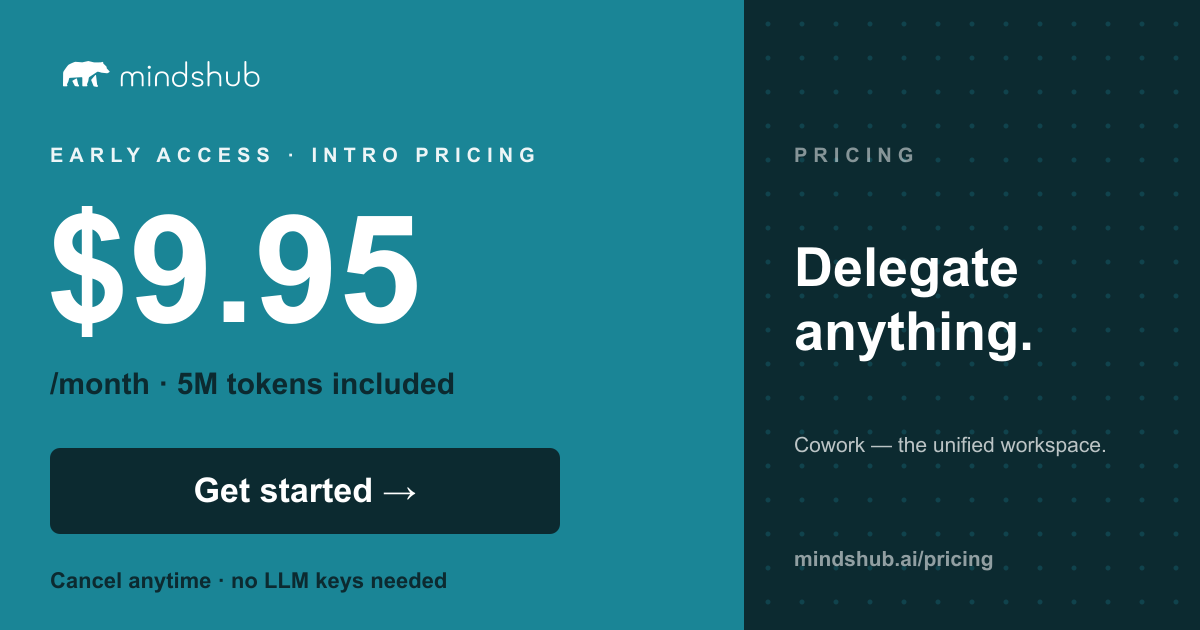
The pricing page shows a free Starter plan and a Pro plan at $9.95 per month. MindsHub also says its early-access pricing includes 5M tokens on the paid plan and is billed monthly with cancel anytime terms.

Do I need API keys to get started?

No. MindsHub says the Model Router is pre-wired, so you can start without setting up provider API keys. You can add your own LLM accounts later if you want direct provider control.

Which agents can I use?

Cowork runs on interchangeable open-source agent harnesses. Anton and Hermes are available today, and MindsHub says more are on the way.

What kinds of work can it connect to?

MindsHub describes Cowork as a workspace with scratchpads, projects, live artifacts, scheduled tasks, memories, skills, and connectors to systems like BigQuery, Postgres, Gmail, Drive, HubSpot, Notion, and Linear.

Quick Facts

Category
AI Agent Platform
Product
MindsHub
Workspace
Cowork
Source domain
mindsdb.com
Primary users
Teams and builders working with open-source agents
Notable workflow
Brief a task, route each step to a model, and collect finished artifacts