
No-code agent builder
Build AI agents without coding and use templates to get started faster. The site positions the builder for staff who want to create and personalize agents through a simple click-based workflow.

GPTBots.ai is an enterprise AI agent platform for no-code assistants for customer support, enterprise search, data insights, and sales workflows.
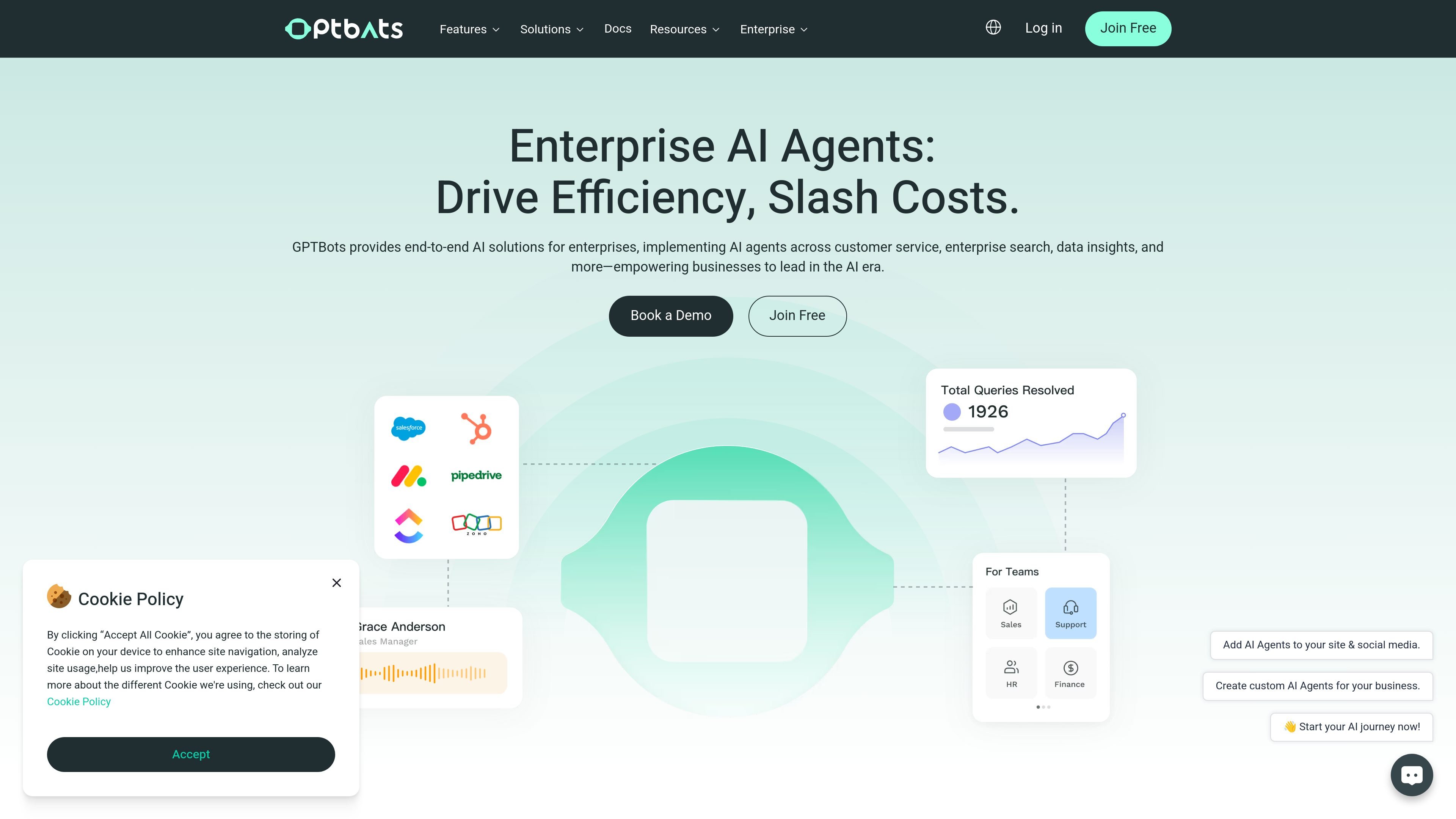
GPTBots.ai is an enterprise AI agent platform for building and deploying AI assistants across customer support, enterprise search, data insights, and related business workflows. The site presents it as an end-to-end solution that helps organizations automate repetitive work, surface information from internal systems, and deliver faster responses to employees and customers.
The product combines a no-code agent builder, knowledge base tooling, custom LLM support, and workflow features. Source pages also describe integrations with common business content sources and messaging platforms, along with enterprise-focused deployment options and security certifications.
Build AI agents without coding and use templates to get started faster. The site positions the builder for staff who want to create and personalize agents through a simple click-based workflow.
Create knowledge-aware agents that pull from enterprise sources such as documents, websites, Google Drive, databases, APIs, and other internal content. The enterprise search pages also describe structured and unstructured data support.
Switch between ChatGPT, DeepSeek, and other top AI models, letting teams choose the model that fits a given workflow. This supports more flexible agent behavior across use cases.
Use workflows and automation to create, train, and operationalize agents for business tasks. The source also describes data sync, query generation, and follow-up question suggestions in specific solution pages.
Distribute agent outputs across business tools and connect agents to platforms such as Discord, WhatsApp, Slack, and Zapier. This extends the product beyond a single chat interface.
Deploy with enterprise controls and security-oriented positioning, including RBAC on the enterprise search page and certifications such as ISO 27001, ISO 27701, and SOC 2 Type II on the main site.
Automate repetitive customer service questions, provide 24/7 responses, and route only the more complex cases to humans. The source highlights multilingual support and human-like tone adaptation for support workflows.
Make internal knowledge searchable across documents, databases, websites, and business apps. The enterprise search pages emphasize precise answers, follow-up query suggestions, and source-aware responses for employees.
Support sales teams by automating SDR tasks, syncing data to CRMs, and capturing leads from messaging channels. The homepage frames this as a lead-growth and conversion-efficiency use case.
Turn natural-language questions into data analysis and SQL-oriented outputs to help teams surface insights faster. The homepage presents this as a way to unlock data value and support business decisions.
Deploy an internal or customer-facing agent that works with existing business systems and content repositories. The product pages describe this as an enterprise implementation with deployment, monitoring, and ongoing optimization support.
GPTBots is designed to build enterprise AI agents for customer support, enterprise search, data insights, and related business workflows. The source pages describe it as an end-to-end AI solution for enterprises rather than a consumer chatbot app.
The source material shows GPTBots supports no-code agent building, knowledge base integration, custom LLM switching, workflows, and enterprise deployment support. It also highlights integration with business content sources and messaging platforms such as Google Drive, Notion, Discord, WhatsApp, Slack, and Zapier.
Yes. The customer support and enterprise search pages both state that GPTBots can be deployed with enterprise knowledge sources and integrated into existing systems, with support for secure cloud or on-premise hosting mentioned on the enterprise search page.
The pages mention a free pilot, free demo, free trial, and free start options in different calls to action, but they do not show a full pricing table or published plan structure in the provided source text.