
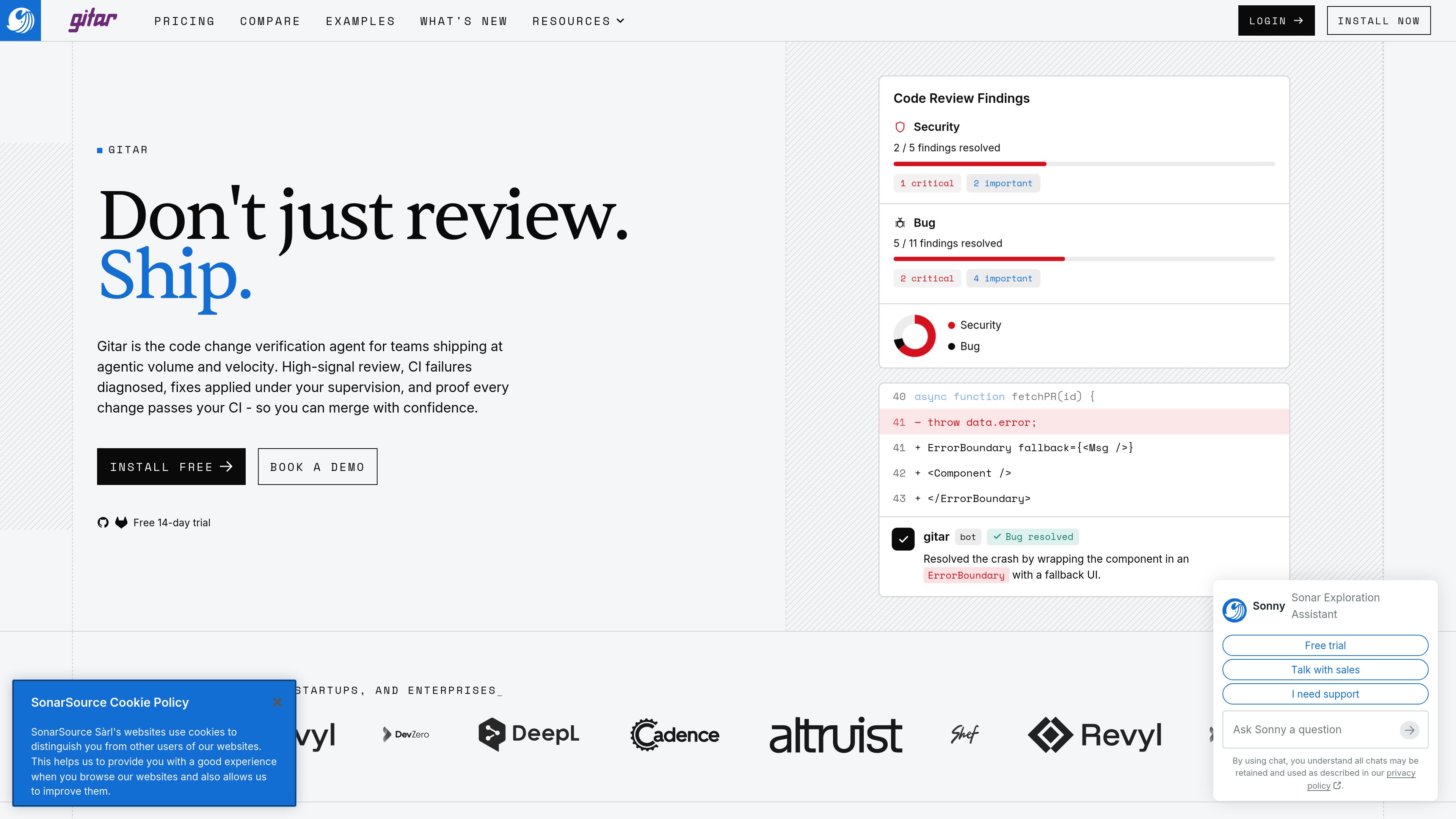
AI code review and PR summaries
Reviews pull-request changes for actionable issues, including functional bugs and security concerns, and produces automatic summaries with inline feedback where relevant.

Gitar is an AI-powered code review and pull request automation tool for teams that need to verify changes before merging. It reviews code, diagnoses CI failures, applies fixes under configurable rules, and checks that the pipeline passes.
Gitar is an AI-powered code review and change-verification tool for software teams. It reviews pull requests, summarizes changes, identifies issues, diagnoses CI failures, and helps teams verify that a change passes before it is merged.
Gitar reads the CI pipeline a team already uses rather than replacing it. It separates likely code-related failures from flaky tests and infrastructure noise, then uses the available context to identify root causes and suggest or apply fixes. Teams can define review, fix, approval, and merge-blocking rules in natural language and keep those rules in the repository alongside the code.
For teams that enable autonomous workflows, Gitar can iterate on a fix and commit only after CI passes. Analytics provide visibility into measures such as time to merge, review-cycle length, failure patterns, flake rates, and fix rates.
Reviews pull-request changes for actionable issues, including functional bugs and security concerns, and produces automatic summaries with inline feedback where relevant.
Reads pipeline results, de-duplicates failures, and distinguishes likely code breakage from flaky tests or infrastructure noise. The site lists support for GitHub Actions, GitLab Pipelines, CircleCI, Buildkite, and Bitrise across its plans.
Generates fixes for identified problems and can commit them to the working branch. Teams control which changes Gitar may make and which cases require escalation.
The autonomous fix workflow can iterate until CI passes and commit only on a green pipeline, providing a verified result rather than stopping at a review comment.
Review scope, fix permissions, merge blockers, and approval conditions can be expressed in natural language and stored as versioned rules in the repository.
Dashboards report process signals such as time to merge, review-cycle length, failure patterns, flake rates, and the amount of fix work handled by Gitar.
When several CI jobs fail after a change, teams can use Gitar to consolidate the failures, identify the underlying causes, and avoid treating every log entry as a separate problem.
Teams using coding agents can add an additional verification step that reviews changes, checks CI results, and helps close the gap between generated code and merge-ready code.
Engineering teams can allow Gitar to fix selected classes of issues while keeping escalation and merge-blocking decisions under repository-defined rules.
Platform and engineering teams can store natural-language review and merge policies with their code, then use analytics to examine review friction and CI failure patterns across repositories.
Qualifying open-source projects hosted on GitHub or GitLab can use the Pro feature set at no cost, subject to the stated public-repository and OSI-approved-license requirements.
No. Gitar reads the CI pipeline a team already runs and uses its jobs, results, and gates as part of code-change verification.
It can generate and apply fixes to a branch when that workflow is enabled. Teams define what Gitar may fix, what it must escalate, and what should block a merge.
The pricing information specifically names GitHub Actions and GitLab Pipelines for CI failure diagnosis on Core, and CircleCI, Buildkite, and Bitrise for advanced CI failure analysis on Pro.
The site states that Gitar does not retain code or data after processing and that data is deleted when an agent run completes. It also states that neither Gitar nor its LLM providers train on customer code or data. Enterprise customers can bring their own Anthropic API key.
The site lists a 14-day Pro trial with no credit card required. Qualifying open-source projects on public GitHub or GitLab repositories with an OSI-approved license can use Gitar at no cost.
Traffic data is for reference only.

kusho.ai
AI-native software maintenance for developers and QA teams, automating API testing, security scans, workflow validation, and test upkeep across CI/CD.

canyontechs.ai
CanyonTechs AI is an LLM-powered auto-remediation product that parses production logs, detects incidents, and delivers fixes as signed pull requests. It offers a workspace-based service with sign-up and login for individual and company users.

sre.ai
AI-native systems integrator for enterprise delivery, with Salesforce workflows and automated documentation, releases, monitoring, protection, and testing.

agentinel.habitwala.in
Agentinel is a local security layer for autonomous coding agents that checks install requests before execution and blocks suspicious npm packages with an offline OSV database and heuristics—without cloud calls.

www.coldtea.ai
Coldtea is an AI-powered software delivery environment for teams that want to manage QA, production monitoring, bug detection, task creation, and fixes in one place. It runs on your machine to catch regressions and production issues after code is written.

viberaven.dev
VibeRaven scans AI-built repos for production gaps and creates focused coding-agent prompts.