
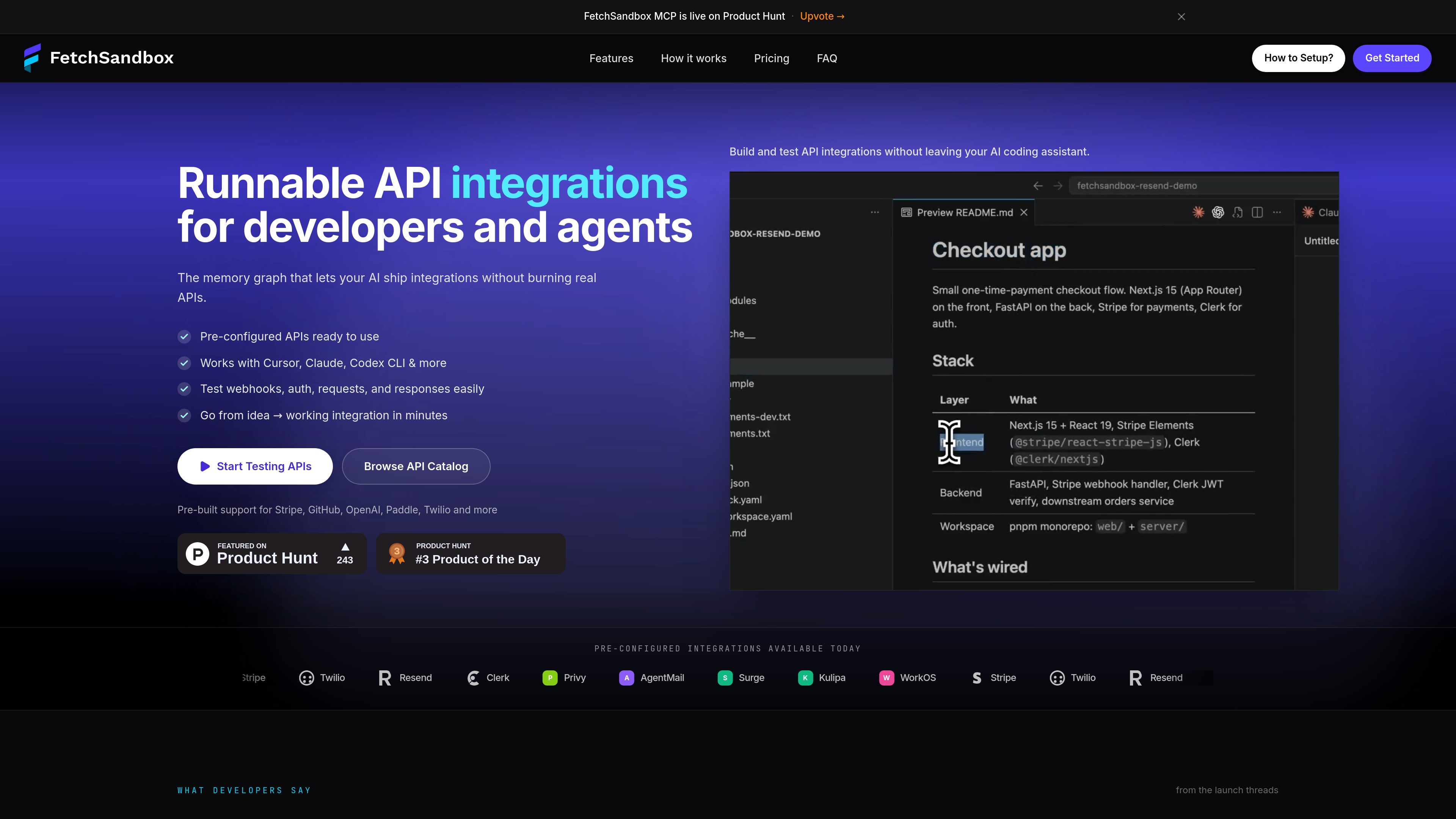
IDE and agent connection through MCP
One MCP configuration is presented as the way to connect FetchSandbox to supported coding assistants, keeping testing in the same environment where the integration is being written.

FetchSandbox is a developer tool for testing API integrations, webhooks, and stateful workflows inside AI coding environments. It helps developers and agent workflows validate integrations without real API keys or using up production quota.
FetchSandbox provides runnable API sandboxes for developers and AI agents that need to test integrations without leaving an IDE. It connects through MCP to coding tools such as Cursor, Claude Code, Cline, Windsurf, and Codex, then lets users exercise real integration flows against supported APIs or imported OpenAPI specs.
The product focuses on stateful behavior rather than simple mock responses. According to the site, sandboxes preserve state across requests, emit webhook events on real transitions, and let users replay events or scenarios to check handler logic, retries, idempotency, and other integration edge cases before production.
One MCP configuration is presented as the way to connect FetchSandbox to supported coding assistants, keeping testing in the same environment where the integration is being written.
The site lists bundled support for services such as Stripe, GitHub, Twilio, OpenAI, Paddle, Resend, Clerk, and others, so teams can start with an existing sandbox instead of building everything from scratch.
FetchSandbox is designed to preserve resources and state across requests, so a created object can be used in later steps of the same scenario rather than acting like a single-response stub.
Webhook-focused sandboxes fire events on state transitions and support replay, which is useful for testing delivery handling, retries, and idempotency logic.
The platform can generate a working sandbox from an OpenAPI 3.x spec, with the source also noting support for OpenAPI 3.0, 3.1, and Swagger 2.0 with auto-conversion.
Pricing includes a free tier, a Pro plan for private integrations and higher usage, and an Enterprise plan with controls such as SSO/SAML, audit logs, and private storage.
Use the webhook sandbox to validate signature checks, duplicate deliveries, retries, out-of-order events, and missing-event fallbacks before a production deployment.
When an agent writes an integration inside Cursor, Claude Code, or another supported tool, FetchSandbox can be used to confirm that the workflow still works after the first successful response.
Teams can work against a pre-bundled provider sandbox, such as Stripe or GitHub, to exercise requests, state changes, and event callbacks without using real provider credentials.
If a team already has an API specification, they can upload it and use the generated sandbox to test request/response behavior and stateful workflows derived from the spec.
Because scenarios can preserve state and replay events, the product is suited to debugging regressions or rebuilding the steps that led to a failing handler or workflow.
The pricing page says no: you can pick an API and run it in an isolated sandbox without real keys, OAuth, partner onboarding, or touching production data.
A run is one complete integration scenario, not just a single API call. The site describes it as an end-to-end sequence that can include calls, preserved state, and webhook delivery.
Yes. The OpenAPI mock server page says you can upload an OpenAPI 3.x spec and generate a working sandbox from it.
The site names Cursor, Claude Code, Cline, Windsurf, Codex, VS Code, Claude Desktop, and Continue.dev in its installation and home-page material.
Yes. The pricing page lists a free plan and says no card is required, with paid plans available for private integrations, higher limits, and team controls.
Traffic data is for reference only.

deepeval.com
DeepEval is an open-source LLM evaluation framework for testing and benchmarking AI applications. It helps developers run pytest-native evaluations, score outputs and agent traces, and iterate on systems across text, image, audio, and voice workflows.

noveum.ai
NovaSynth is a pre-production testing platform for AI agents that uses synthetic users across real SIP phone calls, LiveKit audio, and chat. It helps teams rehearse multi-turn interactions, surface failures, and validate fixes before releasing agents to customers.

www.promptfoo.dev
Promptfoo is an AI security and testing platform for evaluating LLM applications, agents, models, and workflows. It helps developers and security teams find vulnerabilities, validate guardrails, map findings to security frameworks, and track remediation through development and deployment.
www.mcpjam.com
MCPJam is a testing and evaluation platform for MCP servers. It helps developers inspect servers locally, run user and model-based tests, and add behavior checks to CI/CD workflows.

testsprite.com
Agentic end-to-end testing for developers, from code changes through CI and IDE workflows.

qagent.in
QAgent is an AI agent testing and quality assurance platform for developers and agile teams. It connects to an agent through a webhook or endpoint, runs automated test cases, and evaluates responses for groundedness, policy adherence, prompt compliance, and related quality dimensions.