
Full-model finetuning
Train Stable Diffusion 1.5 and SDXL models from images, with the homepage describing full-model finetuning rather than only LoRA training.
dreamlook.ai is a web-based Stable Diffusion platform for DreamBooth-style finetuning, image generation, LoRA extraction, and API-based training integration.
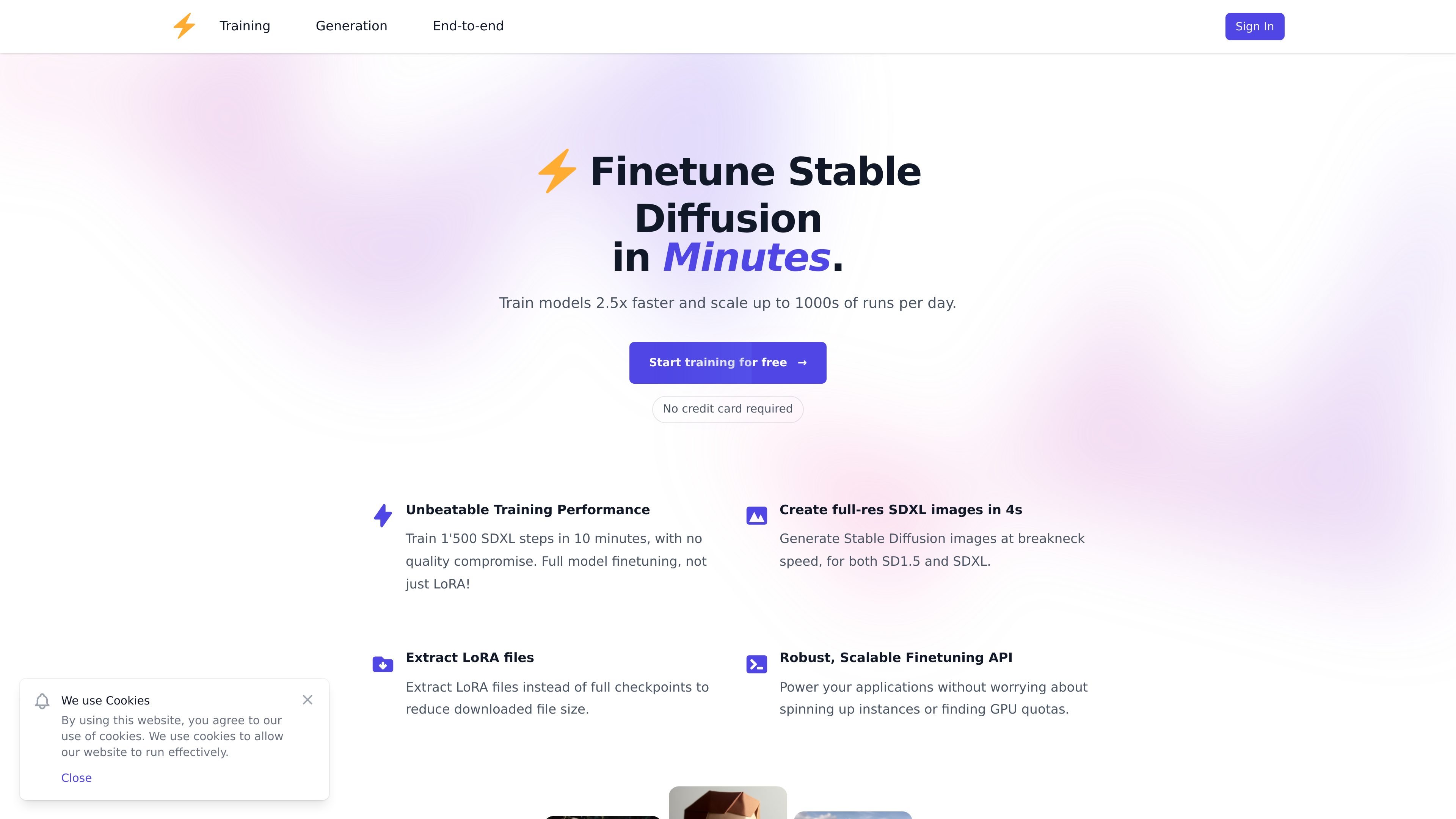
dreamlook.ai is a Stable Diffusion training and generation platform focused on DreamBooth-style workflows. It lets users finetune SD1.5 and SDXL models, generate images, and extract LoRA files from trained models.
The product is designed for fast turnaround and higher throughput. The homepage says it can train SDXL models in minutes, scale to thousands of runs per day, and provide an API for integrating training into applications without managing GPU infrastructure.
Train Stable Diffusion 1.5 and SDXL models from images, with the homepage describing full-model finetuning rather than only LoRA training.
Generate images for both Stable Diffusion 1.5 and SDXL, with the homepage calling out fast 1024×1024 image generation.
Extract LoRA files from trained models to reduce download size when you do not need a full checkpoint.
Use the API to integrate training and generation into applications, without managing GPU instances or quotas yourself.
Work with ControlNet on paid plans, and train from existing checkpoints on the Enthusiast, Pro, and Enterprise tiers.
Choose from multiple subscription tiers and token packages, with higher plans increasing queue priority, concurrency, storage duration, and team features.
Teams that need to finetune SD1.5 or SDXL models quickly for a specific subject, object, or style can use the platform to train models without building their own GPU pipeline.
Developers can connect training and generation flows to their product through the API instead of orchestrating instances and quotas manually.
Users who want to produce images from trained models can generate SD1.5 or SDXL outputs, including 1024×1024 image generation called out on the site.
Creators who only need a lighter-weight asset can extract LoRA files from trained models rather than downloading a full checkpoint.
Customers with higher-volume workloads can choose higher plans for more concurrency, higher token allowances, and longer model storage.
Yes. The site’s pricing page includes an API integration link, and the homepage says you can use the API to fast-track Stable Diffusion Dreambooth training in applications.
Yes. The homepage says trained models can be used for full-model finetuning, and the FAQ list specifically asks whether trained models can be used in AUTOMATIC1111 and on RunDiffusion or ThinkDiffusion, which indicates compatibility is supported or documented.
Yes. The pricing page lists both SD1.5 and SDXL training and generation, and the homepage highlights SDXL training and image generation.
Yes. The homepage explicitly says you can extract LoRA files, and the pricing page includes a separate limit for LoRA checkpoints per training job.
The site includes a privacy policy and terms of use, and the homepage FAQ asks what happens to uploaded images and trained models. The provided text does not include the answers, so the exact storage and retention behavior should be confirmed in the product documentation.