Dreamdata logo

Dreamdata

Claim

Dreamdata is a B2B attribution and activation platform that links journeys, campaigns, audiences, and conversions to revenue. Free plan available, with custom pricing for larger teams.

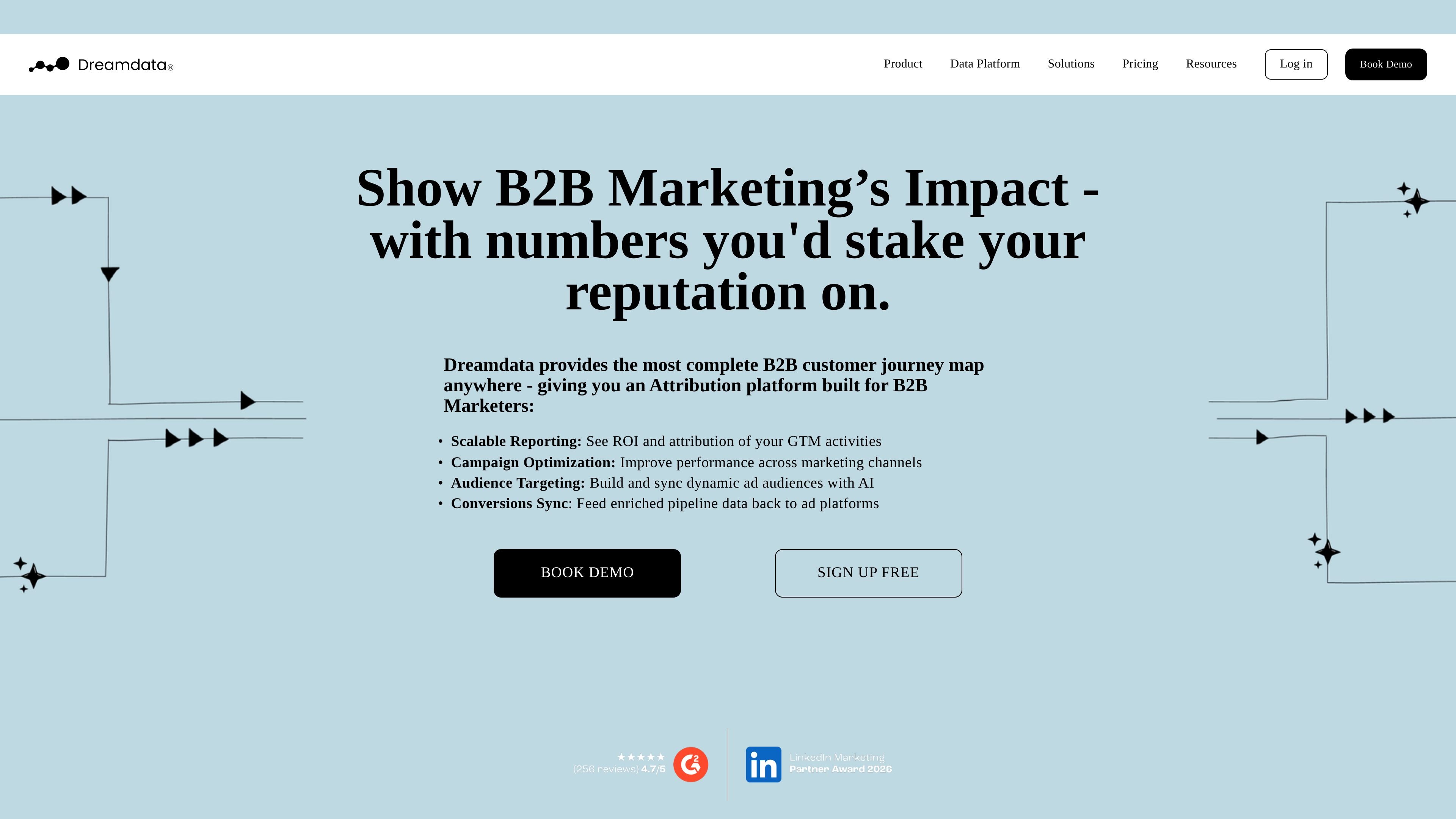
Dreamdata preview

Overview

Dreamdata is a B2B attribution and activation platform for marketers who need to connect marketing activity to revenue. It combines customer journey tracking, performance attribution, audience building, and conversion syncing in one product.

The site positions Dreamdata around a unified view of the B2B journey, including known, anonymous, and cookieless touches. It is designed for teams that want to measure what drives revenue, build precise audiences, and send pipeline or intent data back into ad platforms and internal workflows.


Core capabilities

Customer journey mapping

View interactive customer journey timelines that show known, anonymous, and cookieless touches from first touch through conversion. This helps teams trace revenue back to the source instead of relying on partial channel data.

Performance attribution

Measure revenue-generating performance across paid, social, and cross-channel activity with attribution views that break down results by source, campaign, revenue, deals, ROAS, and LTV.

Audience Hub

Build dynamic audiences from unlimited filters across web visits, ad clicks, pipeline stages, CRM properties, firmographic data, and intent signals, then sync them to major ad platforms.

Conversions sync

Feed offline conversions and pipeline data back to LinkedIn, Google Ads, Meta, and Microsoft Ads so campaign optimization can use revenue data instead of clicks alone.

Intent signals and alerts

Use AI signals and engagement data to spot in-market accounts, notify sales through Slack or Teams, and support targeting and follow-up across the GTM stack.

Unified GTM data model

Work from a unified data model that merges GTM sources and supports reporting, custom UTM mapping, custom data sources, multiple business units, and SSO/SAML on higher-tier plans.

Practical use cases

  • Review complete account journeys

    Use interactive journey timelines to inspect how accounts moved from first touch to conversion, including both identified and anonymous interactions. This is useful when marketing and revenue teams need a shared, source-backed view of account history.

  • Evaluate channel performance

    Measure the contribution of paid, organic social, and cross-channel campaigns by revenue, deals, ROAS, or LTV. Teams can use these views to decide where to invest budget and which campaigns to cut back.

  • Create and activate audiences

    Build audiences from page visits, ad engagement, pipeline stage, CRM fields, and intent signals, then sync them daily to LinkedIn, Google, Meta, or Microsoft Ads. This supports always-current targeting without manual uploads.

  • Optimize ad platforms with revenue data

    Send pipeline or conversion data back to ad platforms so bidding and targeting can optimize for revenue outcomes rather than clicks alone. This is especially relevant for teams running paid acquisition with offline conversion data.

  • Spot intent and coordinate follow-up

    Use engagement scores and AI intent signals to identify accounts that are showing buying interest, then notify sales in Slack or Teams for timely follow-up. This helps align marketing, SDRs, and account teams around active accounts.

Pros and Cons

Pros

  • Combines attribution, journey inspection, audience activation, and conversion syncs in one platform.
  • Supports both known and anonymous journey touches, including cookieless tracking mentioned on the site.
  • Lets teams build audiences with many filter types and sync them automatically to major ad platforms.
  • Includes free-start options and a no-credit-card start path for the free or trial flow.
  • Offers reporting, AI summaries, and customer journey views aimed at B2B marketing and GTM teams.

Cons

  • The public pages do not provide a complete, named integration catalog, so buyers may need to verify specific tool support.
  • Some advanced controls and services are reserved for higher-tier plans, and the source does not spell out the full pricing structure.
  • The product is broad in scope, which may require teams to choose which workflows they want to adopt first.

FAQ

Does Dreamdata require a credit card to start?

Dreamdata offers a free plan to get started, and larger teams can move to custom pricing. The pricing page also says you can try before you buy and that no credit card is required to start the free or trial flow.

What does Dreamdata do?

The source materials describe Dreamdata as a B2B attribution and activation platform for marketers. It is built to measure marketing impact, analyze customer journeys, build audiences, and sync conversions back to ad platforms.

What are the main workflows in Dreamdata?

The site highlights interactive customer journey timelines, performance attribution, Audience Hub for building and syncing audiences, AI signals, and offline conversion syncs to LinkedIn, Google, Meta, and Microsoft Ads.

Which tools can Dreamdata connect with?

The pages reference support for Slack and Teams notifications, CRM data, marketing automation systems, ad platforms, LinkedIn and G2 intent data, and GTM tech stack integrations. The source does not provide a full integration list.

Quick Facts

Category
B2B attribution and activation platform
Primary users
B2B marketers and GTM teams
Main workflows
Journey inspection, performance attribution, audience building, conversion sync
Pricing
Free plan available; custom pricing for larger teams
Start path
Free or trial flow without a credit card, per pricing page
Website
dreamdata.io