
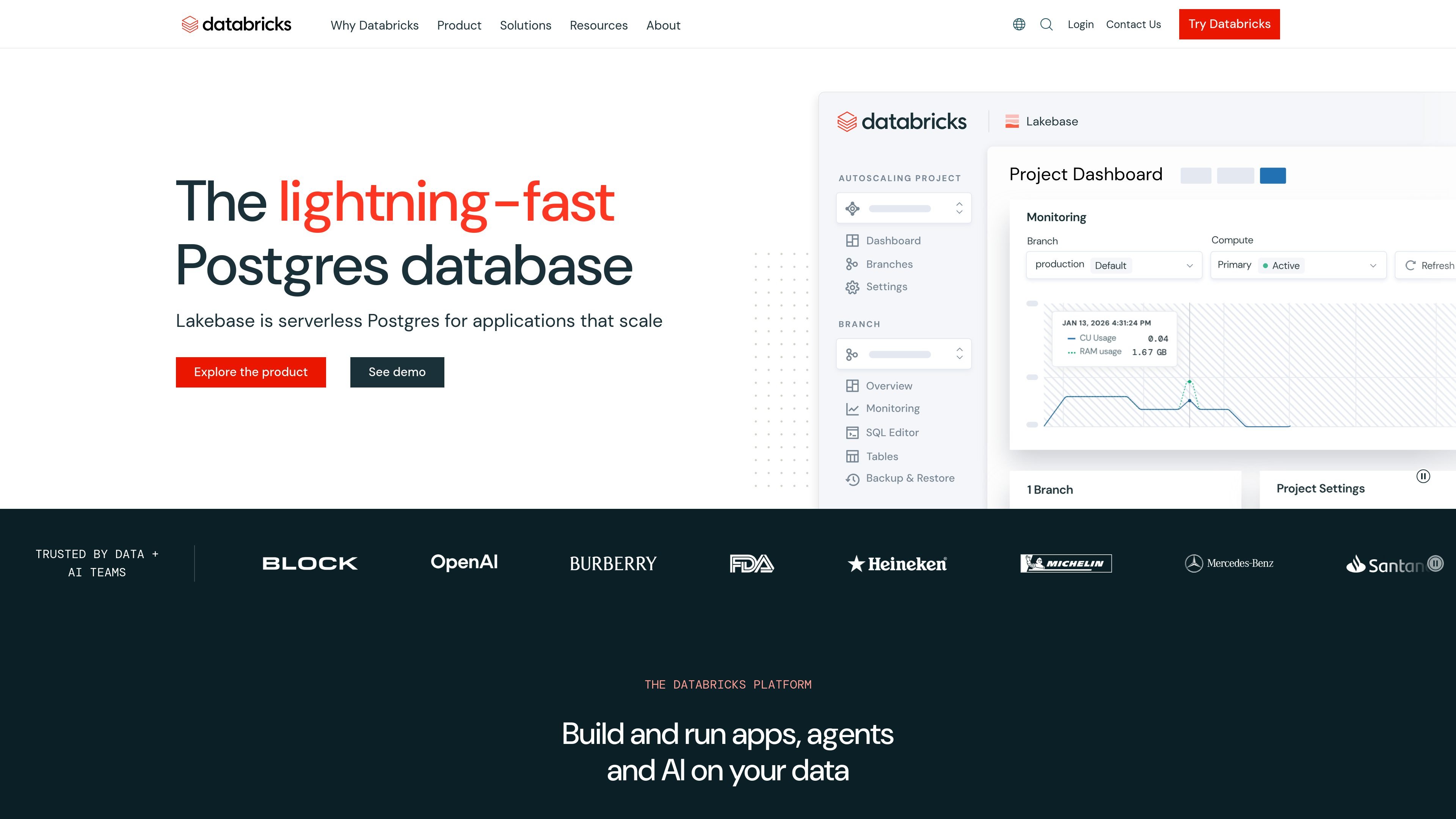
Unified data and AI platform
Databricks presents a single platform for data, analytics and AI so teams can work across databases, AI, business intelligence, governance, data warehousing and data engineering in one place.

Unified data, analytics, and AI platform for enterprises
Databricks is a unified platform for data, analytics and AI aimed at enterprise teams that need to build, govern and run modern data and AI workloads together. The homepage describes the platform as a way to build and run apps, agents and AI on your data, and the product pages frame it around data engineering, warehousing, governance, business intelligence and AI.
The site also separates out platform capabilities such as Lakebase, Agent Bricks, AI/BI, Unity Catalog, Lakehouse and Lakeflow. Across those products, Databricks emphasizes a data-centric approach: use trusted data as the foundation for analytics, AI applications and operational workloads, while keeping governance and discovery in the same environment.
Databricks presents a single platform for data, analytics and AI so teams can work across databases, AI, business intelligence, governance, data warehousing and data engineering in one place.
Lakebase is described as a serverless Postgres database for applications that scale, positioned as a transactional layer that ties together data, AI and governance.
Agent Bricks is built for production-ready AI agents grounded in your data and described as a way to build agents that continuously improve quality and accuracy.
AI/BI combines natural-language dashboard creation and conversational analytics, with Genie called out as part of the experience for exploring data and finding insights.
Unity Catalog centralizes discovery, governance and security for data, models, agents, apps and MCPs, with lineage, classification and policy controls across clouds and regions.
Lakeflow is positioned for reliable ETL, ingest, transformation and orchestration for batch and streaming pipelines at scale.
Use the platform to unify data warehousing, governance and AI work on a single foundation, rather than maintaining separate systems for each workload.
Use Unity Catalog to manage discovery, permissions, lineage and shared context for tables, dashboards, models and AI assets across clouds and regions.
Use Lakeflow to ingest, transform and orchestrate batch or streaming pipelines when you need reliable ETL at scale.
Use AI/BI and Genie to let business users create dashboards and ask questions in natural language, which can reduce dependence on custom reporting workflows.
Use Lakebase and Agent Bricks when building production applications or AI agents that need a transactional data layer and data-grounded behavior.
Databricks is designed as a unified platform for data, analytics and AI. The site describes it as a way to build and run apps, agents and AI on your data, with products such as Lakebase, Agent Bricks, AI/BI, Unity Catalog, Lakehouse and Lakeflow.
The pricing page says Databricks uses a pay-as-you-go approach with no up-front costs, charging only for the products you use at per-second granularity.
The source material shows Databricks supporting work across its platform products and across clouds, but it does not provide a full public list of third-party integrations on the pages reviewed.
Unity Catalog is presented as the governance layer for data, models, agents, apps and dashboards. It is intended for teams that need discovery, access control, lineage and monitoring across those assets.
The homepage positions Databricks for enterprises and notes that more than 20,000 customers use it, including over 60% of the Fortune 500. The site also offers a free trial and a request-a-quote path.
Traffic data is for reference only.

datarc.cn
Enterprise AI data insights through natural-language queries

peliqan.io
All-in-one data platform for ELT/ETL, BI, and AI access

outerbase.com
Query, edit, visualize, and organize SQL and NoSQL data with AI assistance.

databox.com
Databox connects 130+ data sources for AI-powered dashboards, reports, and performance insights.

pandas-ai.com
PandasAI is an AI business intelligence dashboard for no-code data questions, charts, dashboards, and analysis.

rose.ai
Rose is an agentic platform for discovering, analyzing, and visualizing financial data.