
Multilingual TTS with native code-mixing
Chariot generates voice in English, Hindi, and Hinglish from one model, including natural code-mixing rather than switching between systems.

Chariot is an AI text-to-speech product for developers building voice apps in English, Hindi, and Hinglish. Low-latency streaming, REST API, and a free plan with 10,000 credits.
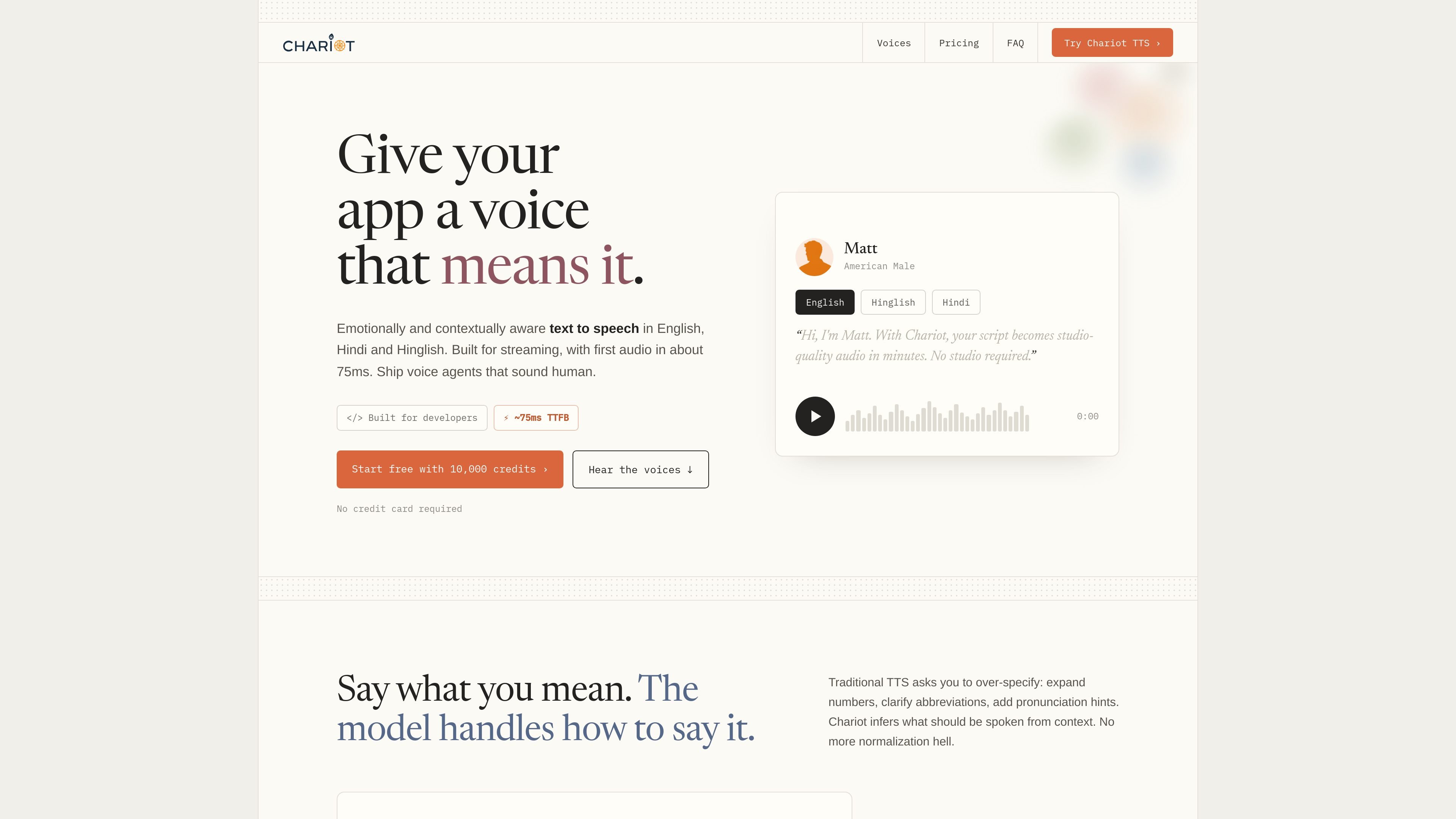
Chariot is an AI text-to-speech product for developers building voice experiences in English, Hindi, and Hinglish. It is positioned around emotionally and contextually aware speech, with one model intended to handle both what is said and how it should sound.
The product page emphasizes real-time use cases: first audio arrives in about 75 milliseconds, audio can stream while it is being generated, and a WebSocket mode is available for sentence-by-sentence agent interaction. The site also shows a REST endpoint for finished WAV output and a streaming endpoint for raw PCM.
Chariot presents itself as a developer-built speech system with twelve studio voices, commercial usage available from the Starter plan, and India-based processing with full data residency according to the site. The pricing page shows a Free plan with 10,000 credits and no credit card required.
Chariot generates voice in English, Hindi, and Hinglish from one model, including natural code-mixing rather than switching between systems.
The product is tuned to infer how text should be spoken, so it can handle numbers, abbreviations, pronunciation hints, pacing, and context without heavy manual normalization.
The page says first audio arrives in about 75 milliseconds and that audio streams as it is generated, which makes it suitable for live applications.
Developers can generate a finished WAV file through REST, stream raw 16-bit PCM, or keep a WebSocket open for live, sentence-level agent responses.
Chariot exposes twelve studio voices, with filters shown for gender and accent, including Indian, British, and American accents.
The pricing page offers a Free plan with 10,000 credits and no credit card requirement, and higher tiers with increasing credits and concurrency limits.
Use Chariot when a product needs spoken responses that feel immediate, such as voice agents or conversational assistants that should start talking after a short delay rather than waiting for a full render.
Use the streaming or WebSocket modes when building IVR-style flows or other live systems where sentence-by-sentence output is more useful than a completed audio file.
Use the model when your input text includes Indian language mixing, abbreviations, numbers, or other phrasing that would normally require manual normalization before synthesis.
Use the API when you need a downloadable WAV file for produced audio assets, such as published clips or pre-rendered voice output in an app workflow.
Use the pricing tiers when you are testing a prototype first, then scaling to higher request concurrency and commercial use after validation.
Chariot supports English, Hindi, and Hinglish from a single model. The source says more languages are on the way, but does not name them.
The product page says first audio arrives in about 75 milliseconds, and streaming audio begins as it is generated. It also offers a WebSocket mode for sentence-by-sentence agent responses.
The site says commercial usage rights are included from the Starter plan, so generated voice can be used in products and published content. The source mentions YouTube, ads, and podcasts as examples.
Yes. The pricing page shows a Free plan with 10,000 credits and no credit card required, plus access to all twelve studio voices.
Chariot says audio and text are processed in India, with full India data residency and DPDP compliance. The site states that nothing you send leaves the country.
Traffic data is for reference only.
| Apr | 3496 |
|---|---|
| May | 2068 |
| Jun | 1620 |