
Cross-merchant product search
Search products across merchants and return ranked results with pricing, imagery, and a direct purchase link. The catalog page says a query can fan out across the network when no merchant is specified.

CartAI is an agentic commerce platform for product search, payment authorization, and checkout on live merchant sites via API, MCP server, or hosted cart.
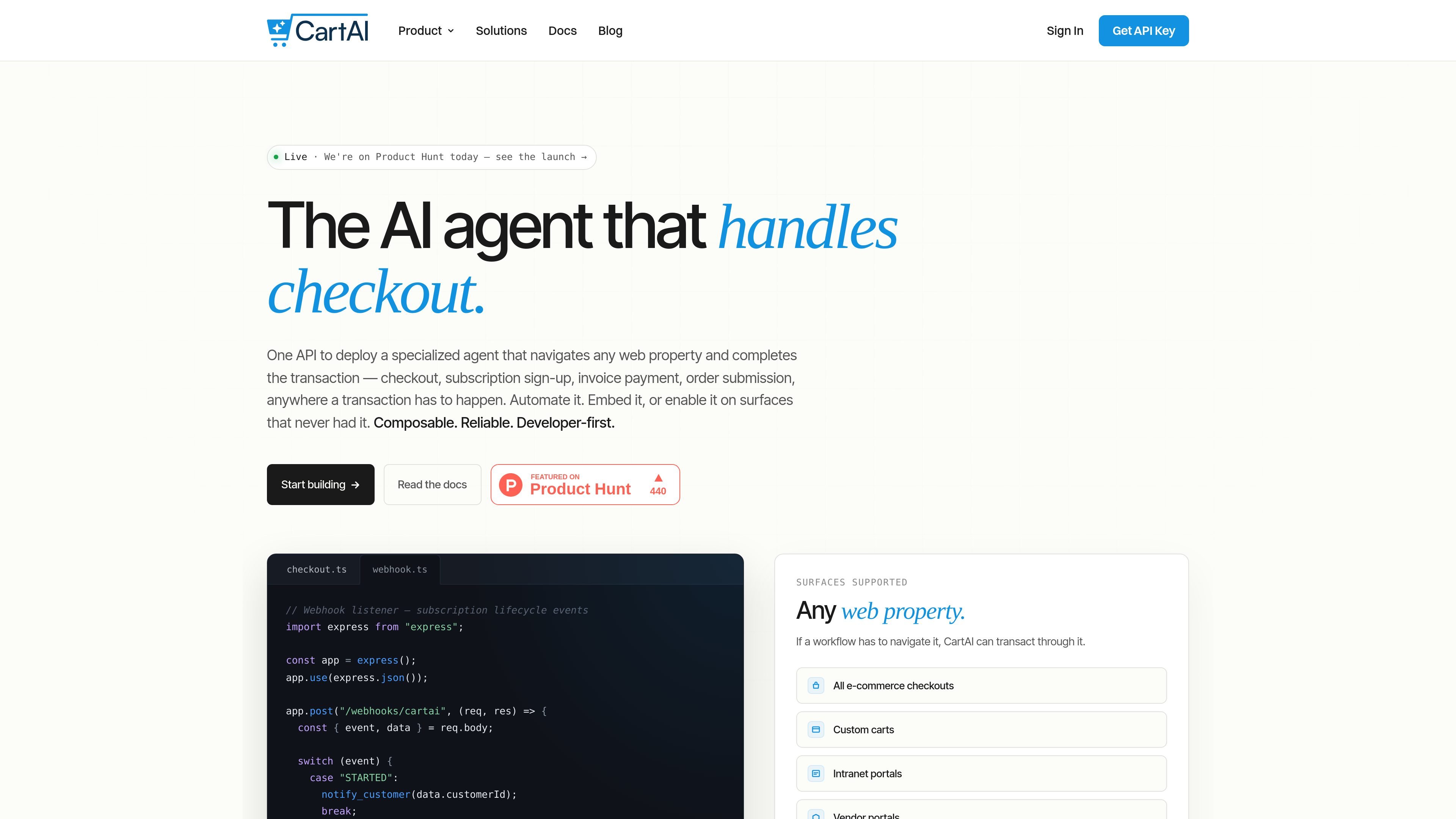
CartAI is an agentic commerce platform built to handle transactions on the web. Its homepage describes it as a specialized AI agent that navigates web properties and completes actions such as checkout, subscription sign-up, invoice payment, and order submission.
The product pages break the offering into a catalog layer, checkout execution, hosted payments, and monetization tools. The workflow is designed for developers: create or inspect a product, estimate the cost, authorize payment through a hosted session, then submit a checkout task and listen for webhook updates until the order is confirmed.
Search products across merchants and return ranked results with pricing, imagery, and a direct purchase link. The catalog page says a query can fan out across the network when no merchant is specified.
Inspect a product URL to extract variants, stock state, and per-variant pricing. The details endpoint is described as useful for building pickers from dimensions before showing a buy button.
Estimate subtotal, shipping, and tax before a cart exists. The checkout-estimates endpoint is read-only and returns a real total using merchant, destination, and item inputs.
Submit checkout tasks that run asynchronously on the merchant's live site and track the order through webhooks. The checkout flow supports cart, address, payment, and confirmation steps.
Create hosted payment sessions where the customer authorizes payment on a PCI-compliant UI and the sessionId is passed into checkout. The page says card data does not touch the backend.
Use an MCP server or hosted cart when you do not want to wire the API directly. The site says the same primitive underlies all three shipping modes.
Use CartAI when you need to turn a product URL or search query into purchasable options, with pricing and variant data available before checkout begins.
Use the checkout API for live merchant transactions where a user has already selected an item and you need the agent to complete cart, address, payment, and confirmation steps.
Use the payment-session flow when you want a hosted, PCI-compliant authorization step that keeps card data off your backend but still feeds a checkout task.
Use the MCP server if you are building in an MCP-capable environment and want the model to search products, estimate cost, and run checkout with tool access.
Use the hosted cart when you need a drop-in checkout UI for a surface that does not already have one and want variant, address, payment, and confirmation handling in one component.
CartAI provides an API and related products for agentic commerce. The homepage shows a checkout API, an MCP server, and a hosted cart, while the product pages document catalog search, checkout execution, hosted payment sessions, and monetization features.
The source shows an API-based workflow: create a payment session, pass the sessionId into a checkout task, and subscribe to webhook events for task progress and completion. The checkout flow runs asynchronously and returns state changes such as queued, started, in progress, placed, and completed.
CartAI's payment page states that hosted payment sessions can be embedded in an iframe or opened as a redirect, and that the card is tokenized inside CartAI's hosted UI so card data does not pass through the merchant backend. The page also notes support for Visa Intelligent Commerce and Mastercard Agent Pay, with American Express listed as coming soon.
The product pages show developer-oriented integration options including a direct API, an MCP server for MCP hosts such as Claude Desktop, Code, Cursor, and VS Code, and a hosted cart component. The homepage also shows webhook-based status tracking for execution events.
The source does not provide pricing details. The pricing URL shown in the collected sources returns a page-not-found response, so plan structure, free tiers, and sales process are not confirmed from the available evidence.