
Intent-driven tests as code
Describe a journey in plain English and blop turns it into a `.blop.ts` test that reads as intent rather than a selector script. The test lives in your repo and can be reviewed like other code.

blop is a QA agent that writes browser tests as code in your repo, runs them in CI, clusters repeated failures, and can open PRs to fix broken tests.
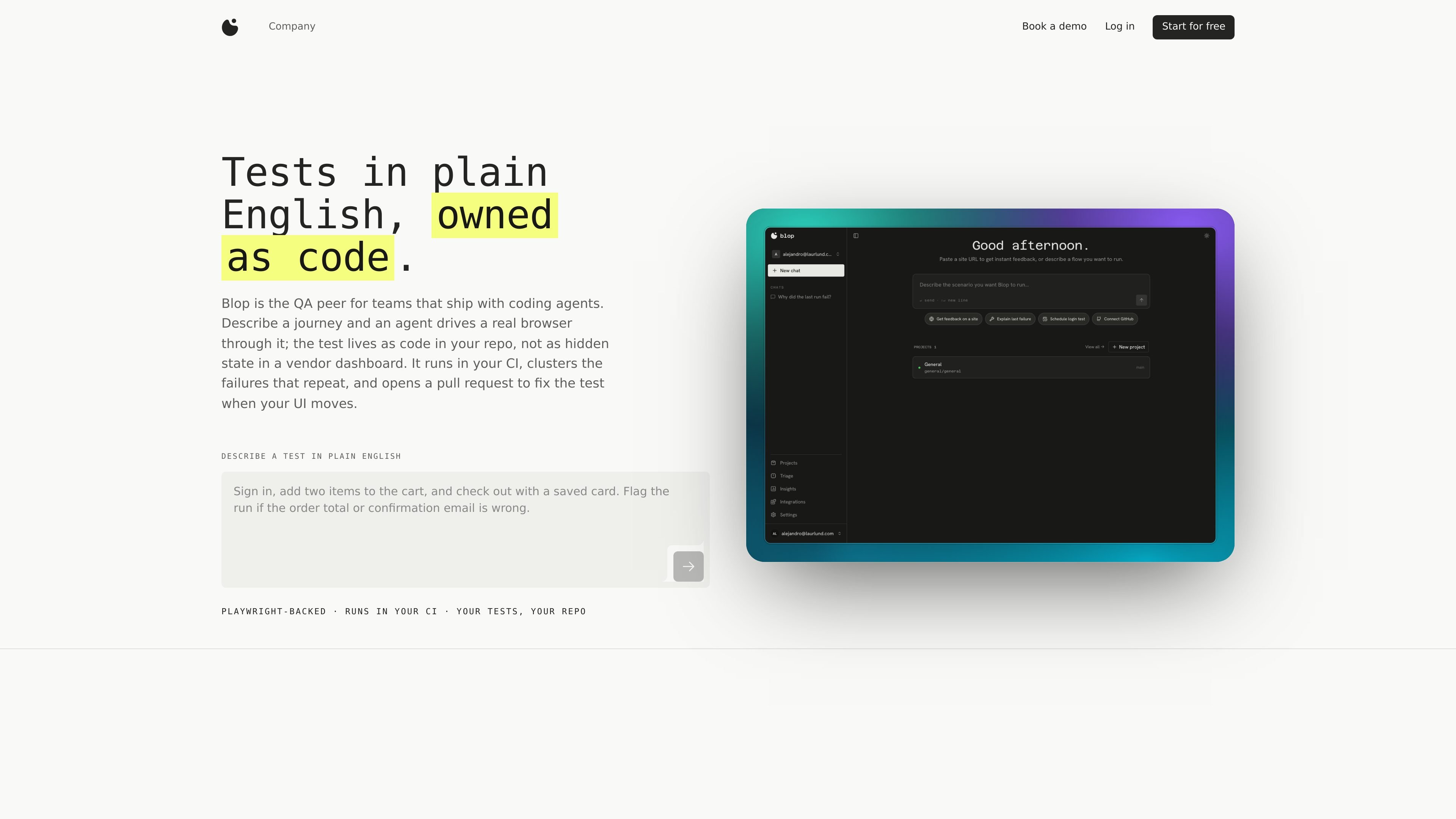
Blop is a QA agent for teams that want browser tests to live as code in their repository instead of in a vendor dashboard. You describe a journey in plain English, and the agent runs a real browser through it to create and maintain a test artifact you own.
The product runs those tests in your CI, posts structured results back to the pull request that triggered them, and clusters repeated failures so recurring breakages are easier to track. When UI changes break a test, Blop can open a pull request with a fix and verification step, keeping the workflow centered on reviewable diffs.
Describe a journey in plain English and blop turns it into a `.blop.ts` test that reads as intent rather than a selector script. The test lives in your repo and can be reviewed like other code.
The agent drives a real browser through the flow over Playwright, so the test outcome reflects an actual user path rather than a hidden dashboard state.
Blop runs tests in your CI using your existing GitHub Actions runners, so the workflow fits into the pipeline you already operate.
Repeated failures are grouped into clusters so the same broken selector or UI change does not appear as dozens of separate rows across runs.
When a failure is eligible, the agent can open a pull request that fixes the test and verifies it green before review. Auto-fix is described as early access.
Any test can also be scheduled as a recurring probe against production, with uptime, p95 duration, and journey completion shown as signals.
Teams can describe a checkout, signup, or other user journey in plain English and get a browser test that can be versioned and reviewed alongside product changes.
When the same selector breakage or UI regression shows up repeatedly, failure clustering turns many similar results into one issue to investigate.
If a UI change breaks a test, the agent can inspect the trace, console output, and diff, then open a pull request with a scoped repair and verification run.
Teams that already use GitHub Actions can run tests through their current CI runners instead of hosting a separate execution environment.
Any test can be scheduled as a recurring production probe to watch uptime, journey completion, and p95 duration for important user flows.
Tests live in your repository as `.blop.ts` files. They are version-controlled, code-reviewed, and editable or deletable by your team.
Yes. Every plan starts with a 7 day free trial, and the trial includes full access to the features in the plan you choose. No credit card is required to start.
Blop runs through your existing GitHub Actions runners, either cloud or self-hosted. The control plane does not execute tests itself.
Blop is Playwright-first today. The result payload is a versioned contract, and the site says adapters for other frameworks are planned next.
When a run fails, the agent inspects the failure, trace, and diff, then can open a pull request with a scoped fix and verification build. Auto-fix is in early access and nothing merges without approval.