
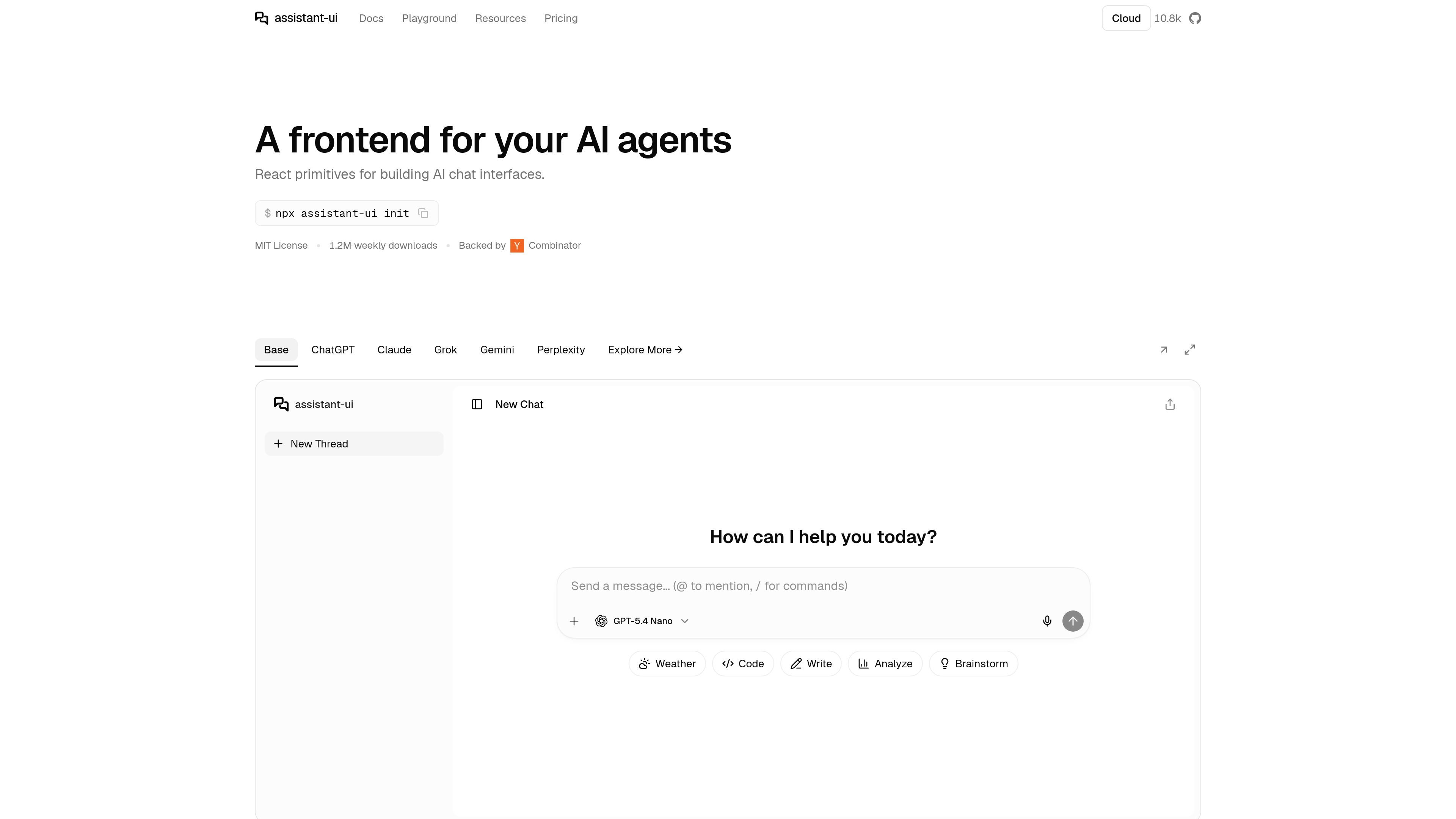
Chat UI components
Provides reusable React primitives for chat interfaces, including pre-built UI that can be customized instead of assembled from scratch.

Open-source React library for AI chats, copilots, and agents
assistant-ui is an open-source React library and runtime for building AI chat experiences. The product is aimed at developers who want to ship ChatGPT-style interfaces, copilots, and agent frontends in TypeScript with streaming, tools, and persistence.
The site presents it as a frontend for AI agents and emphasizes production-ready components, state management, and a quick-start CLI. It is designed to work across React-based frameworks and with several AI backends, while leaving the application’s model logic and backend architecture under the developer’s control.
Provides reusable React primitives for chat interfaces, including pre-built UI that can be customized instead of assembled from scratch.
Handles streaming responses, interruptions, retries, and multi-turn conversation state so the interface stays in sync with ongoing assistant output.
Targets responsive apps with optimized rendering and a minimal bundle size, which the site presents as part of its performance focus.
Supports React-based backends and frameworks, including Vercel AI SDK, LangChain, LangGraph, and custom LLM connections.
Includes tooling for persistence and thread management through Assistant Cloud, plus starter templates for different setup paths.
Build a ChatGPT-style interface inside a React app when you need polished chat UX, theming, and sensible defaults without designing every control yourself.
Add a conversational layer to support, product guidance, or internal tools while keeping your own backend, model provider, and application logic.
Create stateful agent experiences that need streaming output, interruptions, retries, and multi-turn context across longer interactions.
Start from a template such as cloud persistence, Clerk authentication, LangChain, or MCP when you want a guided setup path instead of a blank project.
Use Assistant Cloud when you want hosted persistence and thread management rather than building that backend yourself.
assistant-ui is a React library and runtime for building AI chat interfaces, so it fits when you want to add a ChatGPT-style conversation UI to an app rather than build the whole chat system from scratch.
The docs show a fast-start CLI flow with `npx assistant-ui@latest create`, and also mention installation and manual setup options for developers who want to wire it in themselves.
It is positioned for React-based apps and works with React-based frameworks. The source also says it can connect to Vercel AI SDK, direct LLM connections, LangChain, LangGraph, custom backends, and other React-based integrations.
The package list and docs show support for streaming responses, interruptions, retries, multi-turn conversations, persistence, thread management, and state management for chat interactions.
The pricing page shows a free open-source TypeScript/React library, a separate managed Assistant Cloud plan, and an Enterprise option with custom pricing, dedicated support, uptime SLA, and on-premises deployment.
Traffic data is for reference only.

www.persona-chat.dev
Persona is an open-source VanillaJS agent UI library for adding streaming AI chat to websites, with floating, docked, or fullscreen layouts, SSE support, and WebMCP page tools.

langdock.com
AI adoption platform with shared chat, agents, workflows, integrations, and API access

onorca.dev
Orca is an Agent Development Environment for shipping with coding agents, running parallel CLI agents in isolated worktrees with desktop and mobile companion workflows.

blopai.com
Blop writes browser tests as code, runs them in CI, clusters repeated failures, and opens pull requests to fix broken tests.

rlama.dev
Local AI platform for RAG systems and intelligent agents

kastra.ai
Kastra is authorization infrastructure for AI systems that checks prompts, tool calls, shell commands, API requests, and browser actions before execution. Enforce policy, maintain signed audit trails, and govern local and enterprise AI workflows.