
AI SAST for code review
Analyze source code with semantic AI SAST to identify security weaknesses in AI-generated and human-written code, including control flow, data flow, authorization behavior, dependencies, and insecure patterns before release.

AI-native application security for code, APIs, cloud, and AI
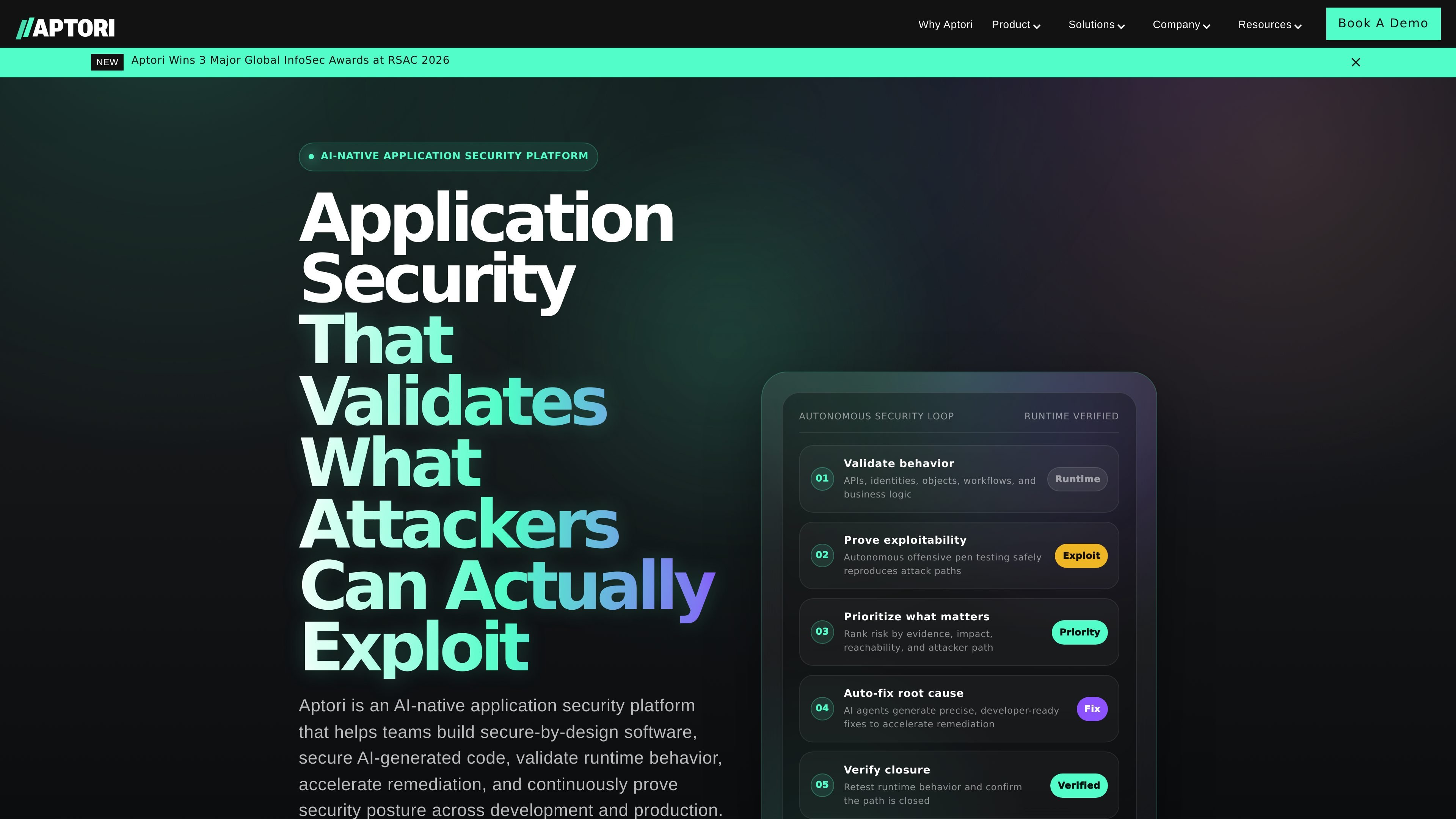
Aptori is an AI-native application security platform for code, APIs, cloud-native infrastructure, and AI systems. It combines AI SAST, runtime validation, autonomous pen testing, ASPM, and remediation into one operating model focused on proving what is exploitable rather than only reporting findings.
The product is built to help security and development teams work from runtime evidence. Aptori continuously validates applications and APIs, correlates signals across the security stack, and provides developer-ready guidance to accelerate remediation while supporting continuous compliance and secure-by-design software.
Analyze source code with semantic AI SAST to identify security weaknesses in AI-generated and human-written code, including control flow, data flow, authorization behavior, dependencies, and insecure patterns before release.
Validate APIs, identities, workflows, business logic, and Kubernetes exposure under runtime conditions so teams can separate theoretical findings from issues that are actually exploitable.
Run autonomous pen testing through AI Security Engineer agents that simulate attacker behavior, explore attack paths, and verify whether issues remain open after remediation.
Correlate findings across code, dependencies, APIs, runtime behavior, and third-party tools through the Security Data Lake and ASPM layer to reduce fragmentation and prioritize by real risk.
Connect triage to root cause analysis, developer-ready fixes, and verification steps so teams can move from finding to remediation with clearer ownership and evidence.
Support ongoing compliance and continuous vulnerability management by maintaining runtime evidence and security posture context across applications and cloud-native environments.
Use Aptori to review AI-generated or human-written code before it reaches production, with semantic analysis that looks at control flow, data flow, dependencies, and authorization behavior.
Use Aptori to validate APIs, identities, workflows, and business logic under runtime conditions, especially where authorization flaws or exploit paths are hard to prove with static tools.
Use Aptori to prioritize dependency, secrets, and SBOM findings by reachability, runtime exposure, and business impact so remediation work focuses on issues that matter most.
Use Aptori to test whether issues are truly fixed after remediation and keep validating that controls remain effective over time.
Aptori is an AI-native application security platform that combines AI SAST, API security testing, runtime validation, autonomous penetration testing, remediation, and compliance support in one operating model.
The source materials show a demo-led flow rather than published self-serve pricing. The pricing page currently returns a 404, and the site points visitors toward booking a demo.
Aptori is built for organizations that need security teams and developers to work from the same evidence. The company page says the platform is designed for CISOs and developers, with runtime truth, deterministic remediation, and unified signal correlation.
The platform uses semantic runtime validation, which models users, identities, APIs, objects, and workflows to validate real application behavior. It then connects findings to exploitability, remediation guidance, and verification.
Traffic data is for reference only.

kusho.ai
AI-native software maintenance for developers and QA teams, automating API testing, security scans, workflow validation, and test upkeep across CI/CD.

viberaven.dev
VibeRaven scans AI-built repos for production gaps and creates focused coding-agent prompts.

casco.com
Autonomous security testing for web apps, APIs, infrastructure, and AI systems

aviator.co
Developer workflow platform for shipping AI-generated code with PR routing, verification, merge automation, and release tracking.

blopai.com
Blop writes browser tests as code, runs them in CI, clusters repeated failures, and opens pull requests to fix broken tests.

kastra.ai
Kastra is authorization infrastructure for AI systems that checks prompts, tool calls, shell commands, API requests, and browser actions before execution. Enforce policy, maintain signed audit trails, and govern local and enterprise AI workflows.