
Table observability
Continuously watches for missing data, freshness problems, schema changes, and other table-level issues so teams can catch pipeline breakage early.

Anomalo is an enterprise data quality monitoring and data observability platform for monitoring data, investigating issues, and surfacing key changes with no-code setup and API configuration.
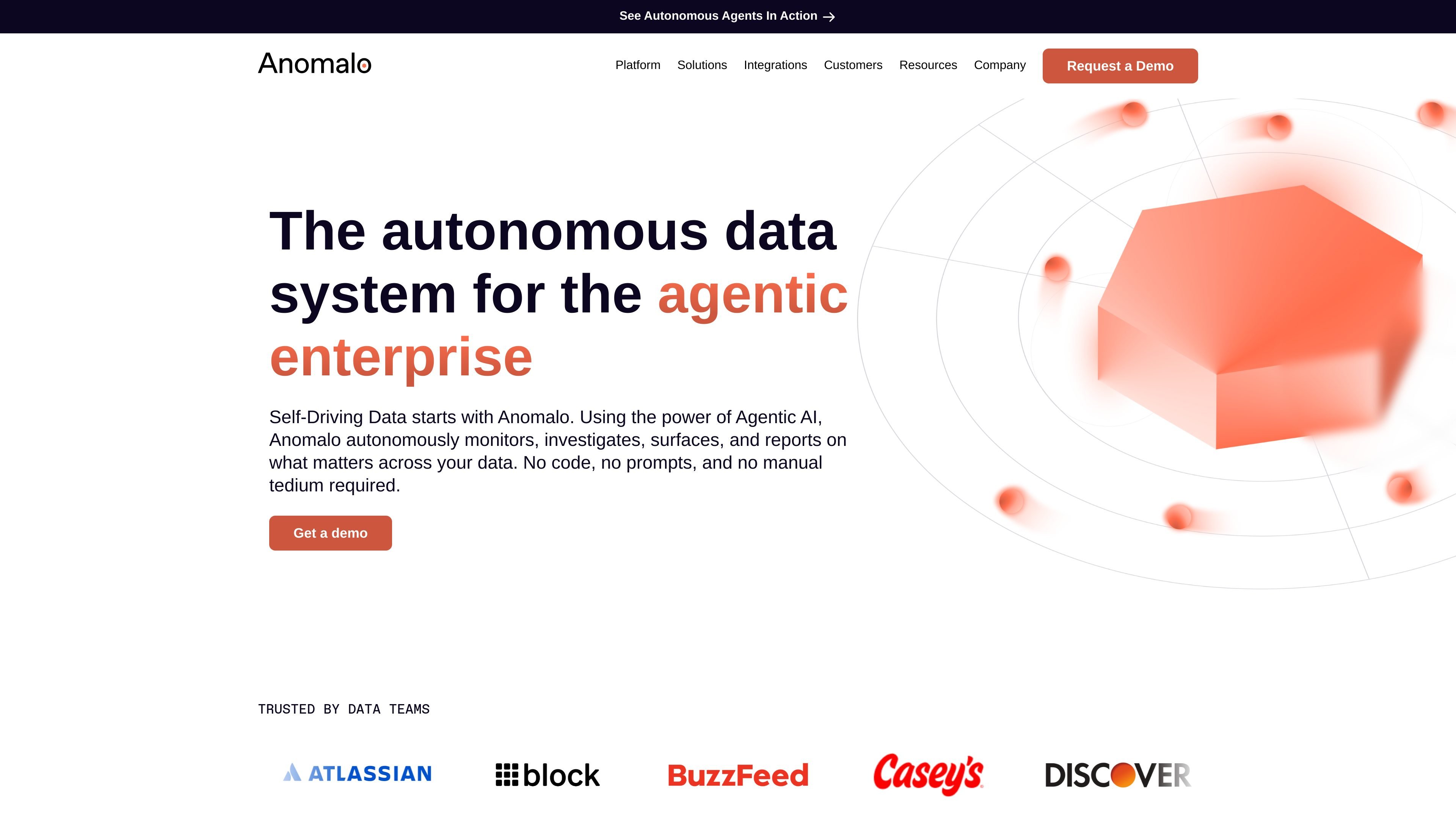
Anomalo is an enterprise data quality monitoring and data observability platform built around an agentic AI model. Its home page describes the product as an autonomous data system that monitors, investigates, surfaces, and reports on what matters across a company’s data, with no code and no manual tedium required.
The product pages frame Anomalo as an all-in-one platform for data teams that need continuous monitoring, faster issue investigation, and better trust in the data used for dashboards, reports, and AI workflows. The site also describes a suite of agents covering table observability, data quality, insights, documentation, conversational analytics, and related workflows, with some capabilities marked live and others coming soon.
Continuously watches for missing data, freshness problems, schema changes, and other table-level issues so teams can catch pipeline breakage early.
Uses unsupervised machine learning and no-code configuration to detect abnormal patterns, missing values, and inconsistent data without brittle hand-built rules.
Investigates issues with automatic root-cause analysis, visualizations, and contextual samples to help teams understand what changed and where it likely started.
Routes alerts intelligently, suppresses false positives, and supports ticketing and workflow integrations so the right people see the right issue.
Builds on data lineage context and catalog integrations so quality signals can be viewed in relation to upstream and downstream dependencies.
Supports natural-language interaction through AIDA for asking questions, creating visuals, and setting up monitoring or dashboards.
Monitor tables for freshness, schema, missing values, and other changes so pipeline issues are identified before they reach reports or downstream systems.
Investigate unexpected data changes with samples, visualizations, root-cause analysis, and lineage context to shorten time to resolution.
Set up validation checks, alert routing, and monitoring rules without building a large library of brittle hand-written checks.
Ask questions, create visualizations, and draft analyst-style findings through natural language using AIDA when teams need quick answers from their data.
Create documentation that combines catalog metadata, existing documentation, and relevant conversations so datasets are easier to understand and maintain.
Anomalo’s source pages describe it as an automated data quality monitoring and data observability platform for enterprise teams. It monitors data, investigates issues, surfaces noteworthy changes, and can support reporting and conversational analysis through its agent suite.
The product overview emphasizes no-code setup for many workflows, while also mentioning API-based configuration. The integrations page says it works with tools across the data stack, including warehouse, catalog, alerting, and orchestration systems.
The site’s product overview highlights table observability, anomaly detection, data validation, data governance, data observability, automated data lineage tools, unstructured data monitoring, and AIDA for conversational analytics.
The integrations page says Anomalo connects with data stack tools and partners such as Databricks, Snowflake, and Alation, and it can integrate with workflow orchestrators like dbt and Airflow. The page also groups integrations across data sourcing, catalogs, alerting, resolve, BI tools, and single sign-on.
The website does not publish pricing on the pricing URL; that page returns a not-found page. Based on the available evidence, pricing is not publicly listed on the captured pages and appears to be handled through demo or contact flows.