
Unified API Interface
Aiberm presents one consistent interface for multiple AI providers, with support for OpenAI, Claude, and Gemini formats so existing integrations can switch models with fewer code changes.

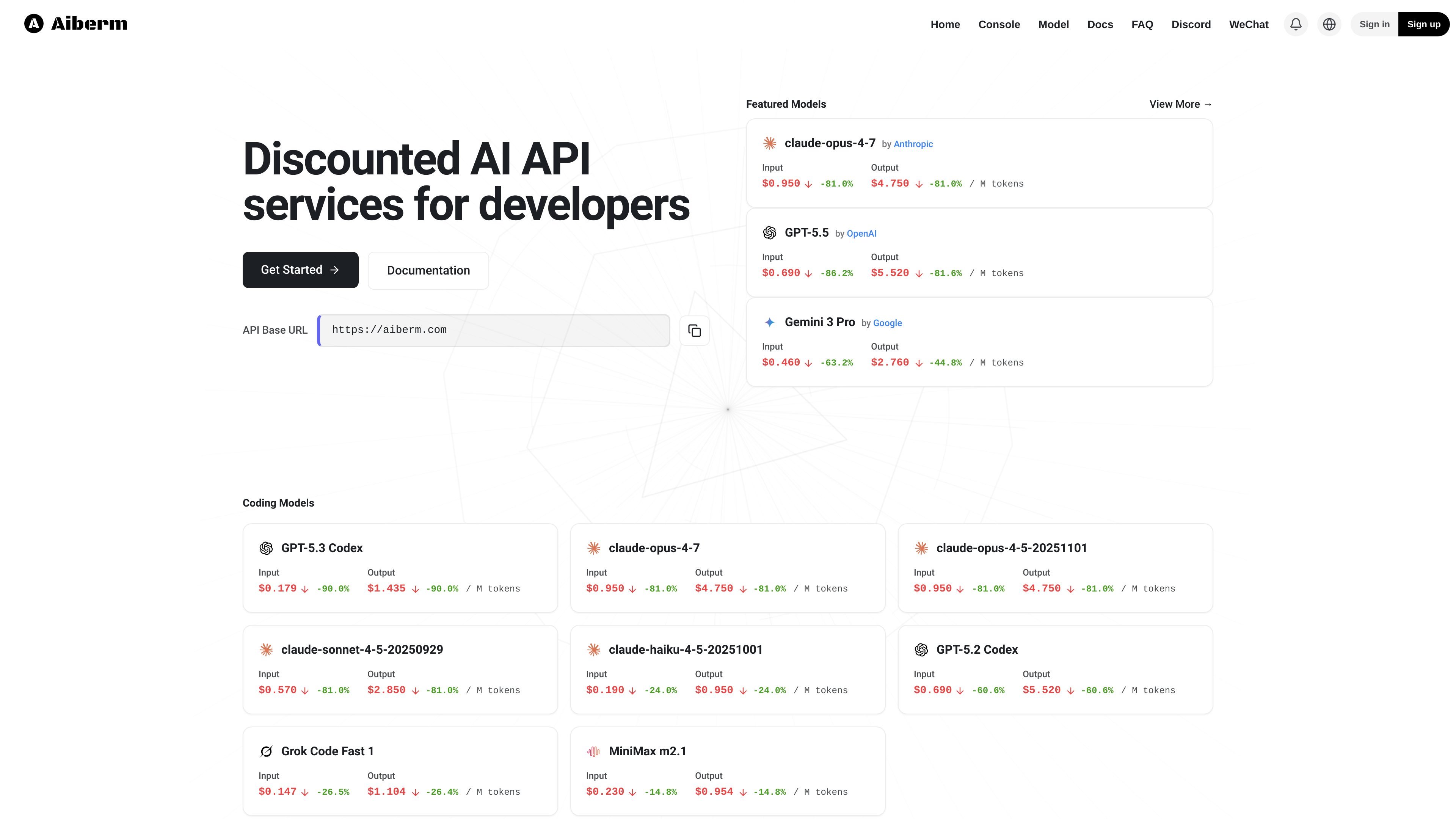
Aiberm is a unified AI API platform giving developers access to many models through one endpoint, with OpenAI-compatible integration and pay-as-you-go pricing.
Aiberm is a unified AI API platform for developers that aggregates multiple model providers behind one endpoint. The site says it supports 30+ AI models on the marketing pages and 113 available models on the pricing page, with OpenAI, Anthropic, Gemini, Moonshot, Zhipu AI, Qwen, DeepSeek, MiniMax, Spark Desk, and xAI represented in the catalog.
The product is built for developers who want to call AI models through the same API format instead of wiring each provider separately. The documentation shows an OpenAI-compatible workflow using https://aiberm.com/v1, and the platform also supports direct HTTP requests, streaming, and batch processing.
Aiberm’s public positioning emphasizes discounted pricing, pay-as-you-go billing, and production use. The home page highlights a 99.9% uptime SLA and automatic failover, while the pricing page shows model-by-model token pricing in USD and discount percentages for many models.
The about page says the service is operated by Geddle, Inc. and describes support for text generation, image generation, code generation, and multi-model access through a unified gateway.
Aiberm presents one consistent interface for multiple AI providers, with support for OpenAI, Claude, and Gemini formats so existing integrations can switch models with fewer code changes.
The platform advertises discounted pricing across its model catalog and a pay-as-you-go billing approach rather than subscriptions.
The docs show two integration paths: the OpenAI SDK with a changed base URL, or direct HTTP requests against the API endpoint.
Documentation mentions streaming and batch processing, and the quickstart points users to the detailed Chat Completions API guide for advanced usage.
The site states a 99.9% uptime SLA and automatic failover, positioning the service for production workloads.
Use Aiberm when you want to prototype or ship an app that can call different AI models through one endpoint, instead of maintaining provider-specific code for each vendor.
Use the platform when an existing OpenAI SDK-based project needs access to other model families without rewriting the whole client stack; the docs show changing only the base URL.
Choose it for workloads that benefit from model choice by task, such as routing coding, chat, or generation requests to different providers available in the catalog.
Use the documented streaming and batch support for applications that need incremental responses or higher-throughput request handling.
Adopt it for production services that need a published uptime target and automatic failover rather than a single-provider setup.
Aiberm provides a unified API and a quickstart that shows how to use the official OpenAI SDK by changing the `base_url` to `https://aiberm.com/v1`, or call the API directly with HTTP requests.
The documentation says Aiberm supports streaming and batch processing, and the quickstart points to detailed Chat Completions documentation for deeper API usage.
According to the FAQ, `claude-` prefixed models are offered at an 81% discount and are suited for coding scenarios, while `anthropic/` models are routed through AWS at about 28% off the official price.
Yes. The FAQ states that all Aiberm Claude models support prompt caching, and other models also support caching as well.
The FAQ lists self-service invoices through `https://meiguo.app/invoice`. It also notes that corporate bank transfer invoices are available by contacting the group admin, and that Chinese Fapiao rules may apply for non-corporate transfers.
Traffic data is for reference only.

aistudio.google.com
Google AI Studio is a browser-based development environment for experimenting with Google’s generative models and moving prompts into applications through the Gemini API. It supports developers building text, image, video, audio, and agent experiences.

docs.litellm.ai
LiteLLM lets teams call and manage 100+ LLMs through an OpenAI-compatible SDK or proxy, with request routing, spend tracking, and multi-provider access.

googleapis.github.io
A Python SDK for integrating Google’s generative models into applications through the Gemini Developer API and Gemini Enterprise Agent Platform APIs. It provides client libraries, typed request helpers, and synchronous or asynchronous workflows for developers building with Google’s generative AI services.
aimlapi.com
AIMLAPI provides one API and billing key for accessing a catalog of AI models for chat, reasoning, image, video, audio, voice, search, embeddings, code, and related tasks. It is intended for developers and teams that want to compare and use models from multiple providers through a common platform.

cloud.sambanova.ai
SambaNova Cloud is an AI inference platform that provides API access to open-source language and vision models. Developers can use its OpenAI-compatible API, playground, and model catalog to build and test AI-powered applications.

zenmux.ai
ZenMux is an enterprise LLM platform with one API for multiple models, automatic prompt routing, flexible pricing, cost visibility, and model-failure compensation.