
Multi-provider model catalog
Access models from providers such as OpenAI, Anthropic, Google, Alibaba Cloud, ByteDance, and others through a common platform and billing key.
AIMLAPI provides one API and billing key for accessing a catalog of AI models for chat, reasoning, image, video, audio, voice, search, embeddings, code, and related tasks. It is intended for developers and teams that want to compare and use models from multiple providers through a common platform.
AIMLAPI is a multi-model AI API platform that provides access to models from multiple providers through one account and API key. Its catalog includes chat, reasoning, image, video, audio, voice, search, code, embeddings, 3D generation, OCR, and safety or moderation capabilities.
The service helps developers compare models using information such as provider, modality, supported capabilities, context window, and token costs where listed. It also offers an MCP server for connecting compatible AI clients, while enterprise customers can request dedicated infrastructure, higher usage allowances, and managed support.
Access models from providers such as OpenAI, Anthropic, Google, Alibaba Cloud, ByteDance, and others through a common platform and billing key.
The catalog spans chat and reasoning, image, video, audio, voice, search, code, embeddings, 3D generation, OCR, and safety or moderation use cases.
The pricing and model directory can be filtered by modality, provider, capability, context length, and price, with model pages linking to documentation, API examples, and playground access.
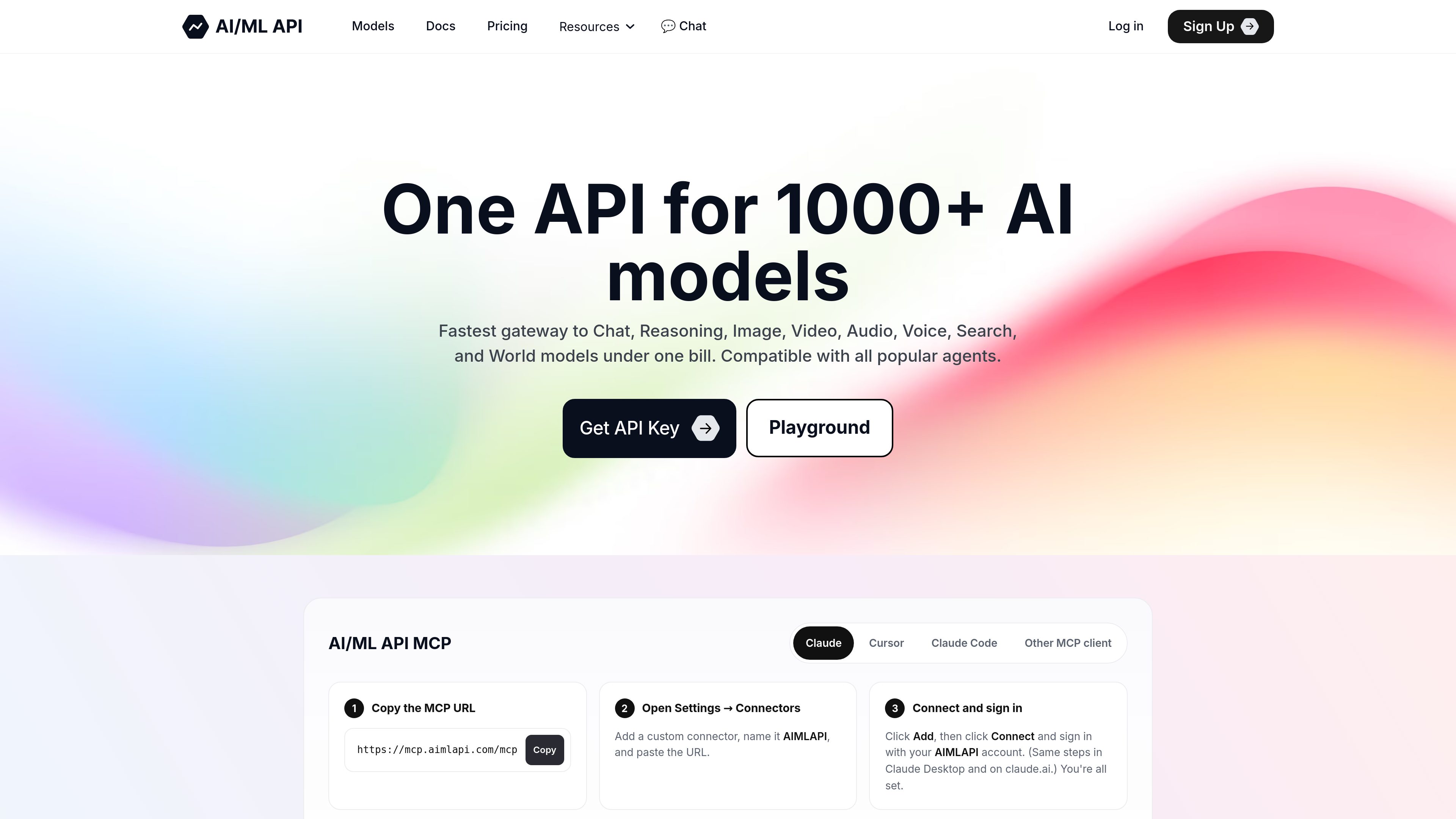
A documented MCP server supports Streamable HTTP connections for Claude, Cursor, Claude Code, and other MCP-compatible clients, with OAuth-based account login or API-key authentication examples.
The enterprise offering includes dedicated servers, priority features, unlimited RPM and TPM, a personal manager, and integration support for existing environments.
The enterprise page states that customer data is not used to train models and describes encryption for data in transit and at rest, along with real-time threat detection and cybersecurity defenses.
A development team can compare providers, modalities, capabilities, context windows, and listed token costs before choosing a model for a new application.
Teams building products that combine text with images, video, audio, voice, search, or embeddings can use one catalog and API entry point rather than arranging each capability separately.
Users of Claude, Cursor, Claude Code, or another MCP-compatible client can connect to the documented server and ask an agent to list models, run a chat completion, or check account balance.
Organizations with mission-critical or growing workloads can discuss dedicated servers, unlimited RPM and TPM, priority features, managed support, and tailored commercial terms with the enterprise team.
AIMLAPI provides a common API and billing key for a catalog of AI models from multiple providers. The catalog covers capabilities including chat, reasoning, image, video, audio, voice, search, code, embeddings, 3D generation, OCR, and safety or moderation.
The model and pricing directory provides filters for modality, provider, capability, context length, and price. Listings can include supported inputs and outputs, context size, input and output token costs, documentation, API examples, and playground links.
Yes. The site documents an MCP server using Streamable HTTP and provides connection instructions for Claude, Cursor, Claude Code, and other MCP-compatible clients. Authentication can use an account-based OAuth flow or an API key, depending on the connection method.
Yes. The enterprise offering describes dedicated servers, priority features, unlimited requests per minute and transactions per minute, a personal manager, integration support, encryption, and tailored pricing. The enterprise page states that pricing starts at $1,000 per month; terms should be confirmed with sales.
The pricing page describes a free playground tier, along with volume discounts and a single billing key across providers. The available information does not specify the tier's limits or a complete public plan structure.
Traffic data is for reference only.

cometapi.com
CometAPI is a unified, OpenAI-compatible API layer for accessing more than 500 text, image, video, and audio models through one key. It helps developers and teams compare models, centralize billing, and switch providers without maintaining separate vendor integrations.

eachlabs.ai
each::labs provides a single API for orchestrating more than 600 AI models, with routing, fallback handling, observability, and usage-based pricing. It is designed for teams building and operating production AI applications across video, image, audio, and text workflows.

piapi.ai
PiAPI is a unified platform for generating video, images, audio, 3D assets, and LLM outputs through a model catalog, playground, APIs, CLI, and MCP server. It is designed for developers, AI agents, and automation workflows that need access to multiple generative models.

docs.litellm.ai
LiteLLM lets teams call and manage 100+ LLMs through an OpenAI-compatible SDK or proxy, with request routing, spend tracking, and multi-provider access.

cloud.sambanova.ai
SambaNova Cloud is an AI inference platform that provides API access to open-source language and vision models. Developers can use its OpenAI-compatible API, playground, and model catalog to build and test AI-powered applications.

zenmux.ai
ZenMux is an enterprise LLM platform with one API for multiple models, automatic prompt routing, flexible pricing, cost visibility, and model-failure compensation.