
Root-cause analysis across code and infrastructure
Analyzes runtime behavior to identify issues at both the code and infrastructure levels, then points to a root cause instead of only surfacing an alert.

Digma is an agentic AI SRE platform that analyzes runtime and observability data to find root causes and suggest fixes for code and infrastructure issues.
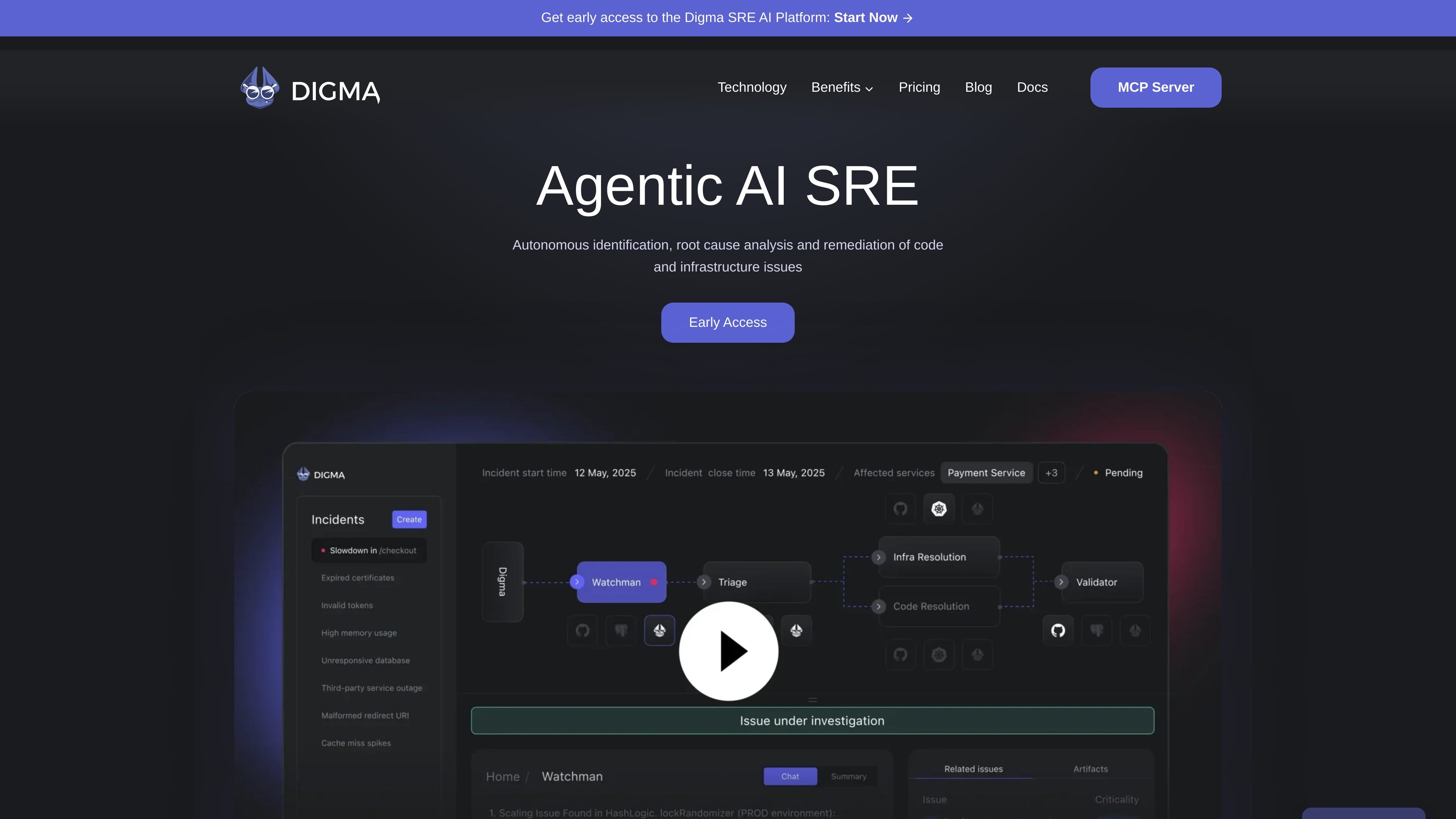
Digma is an agentic AI SRE platform that analyzes runtime and observability data to identify problems in code and infrastructure, pinpoint the root cause, and propose a remediation. The site positions it as a complementary layer to traditional APM tools, focused on finding issues earlier in the development cycle.
The product uses Dynamic Code Analysis to examine raw observability data, surface performance regressions, bottlenecks, scaling issues, and runtime errors, and help teams act before issues reach production. It also includes an MCP server that adds runtime context to AI-assisted code review, test generation, and fix suggestions.
Analyzes runtime behavior to identify issues at both the code and infrastructure levels, then points to a root cause instead of only surfacing an alert.
Proposes remediation such as pull requests or configuration changes, and the MCP server can help generate fixes from runtime context.
Connects to observability data and key sources such as PostgreSQL, GitHub, and Kubernetes to ground analysis in real system data.
Uses Dynamic Code Analysis to find issues earlier in pre-production and to prioritize problems by real impact before they escalate.
Provides an MCP server that enriches AI agents with runtime context for code review, test generation, and issue resolution.
Runs locally for individual developers and offers on-premises or private-cloud deployment options for teams.
Use Digma while developing locally to surface performance issues and regressions before code reaches shared environments.
Use the platform in pre-production to identify bottlenecks, scaling problems, and runtime errors tied to recent changes.
Use Digma’s MCP server during pull requests to highlight risky code, affected dependencies, and likely breakage before merge.
Use runtime context from observability data to generate or refine tests that reflect real traces, errors, and exceptions.
Use the AI agent to suggest fixes for slow database queries, API bottlenecks, and other costly inefficiencies in code paths.
Digma complements traditional APM tools rather than replacing them. The source says APMs typically detect issues in production, while Digma uses Dynamic Code Analysis to surface problems earlier in the development cycle.
Yes. The source says Digma analyzes every code change and highlights affected areas before a pull request is merged, so teams can see what may break before release.
No. The source says Digma works without code changes and is OTEL-compliant, so it can plug into existing observability data.
For teams, Digma can be deployed on-premises or in a private cloud. The free developer plan runs completely locally on a laptop.
The source says Digma avoids public AI models that share data outside the organization, and that data stays local.