
Shared project archive
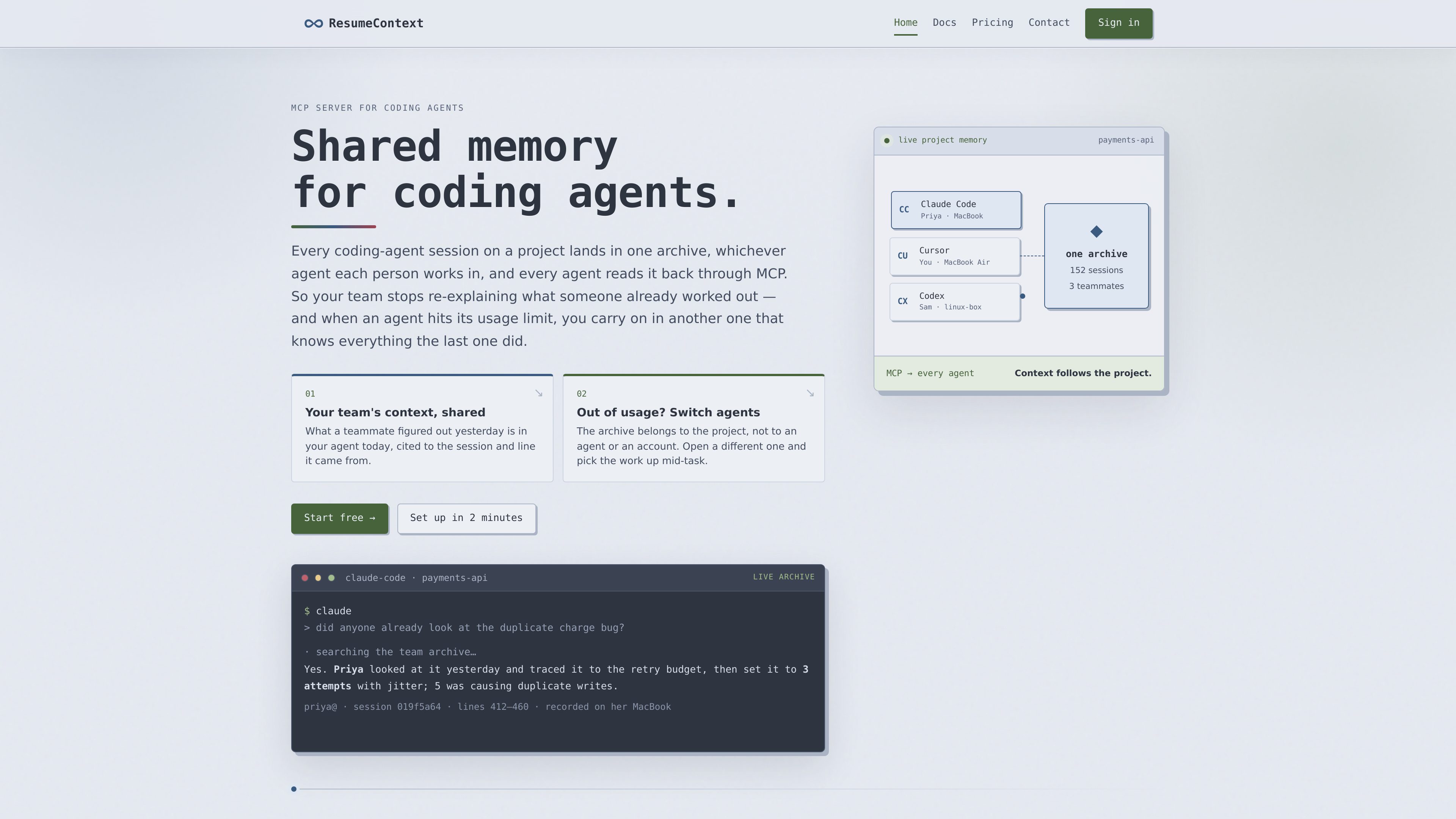
Sessions from team members are collected in one archive associated with a project, allowing agents to access prior project work.

ResumeContext è un servizio di memoria condivisa per i team di agenti di programmazione. Registra le sessioni in locale, le sincronizza con un archivio di progetto e lo rende accessibile agli agenti tramite MCP, così possono cercare il lavoro precedente e riprenderlo tra agenti, account o dispositivi.
ResumeContext is a shared memory service for coding-agent teams. A local daemon reads the session history that supported coding agents already write to disk, syncs those sessions to a shared project archive, and makes the archive available to agents through the Model Context Protocol (MCP). The product is designed to preserve project decisions, investigations, and unfinished work beyond an individual agent session.
Its main workflows are cross-agent continuity and shared team recall. An agent can search previous sessions and return answers with references to the originating session and line. Because the archive is associated with a project rather than a particular agent or account, a developer can switch tools, accounts, or machines without starting the task context over.
Sessions from team members are collected in one archive associated with a project, allowing agents to access prior project work.
The archive is provided back to coding agents as an MCP server, so users can query shared history from the agent session they are already using.
Responses can identify the source session and relevant line range, making it possible to trace an answer back to the recorded work.
A small daemon reads agent history from local disk and syncs it without requiring an installation inside the agent or changes to prompting.
The `resumecontext agents` command can list supported agents, inspect their history locations, and choose which agent histories to sync, including custom paths.
Months of sessions remain searchable, with the agent retrieving relevant passages instead of requiring all history to remain in the active context window.
Point another agent at the same project archive when the current tool reaches its limit, allowing work to continue without manually reconstructing the previous session.
A teammate can ask what another developer discovered about a bug and receive an answer grounded in the recorded investigation, including session and line references.
Project members can ask what changed, who is blocked, or whether work is overlapping, using the team’s recorded sessions instead of separate status updates.
The project archive supports continuity when work moves between agents, accounts, or machines, provided those environments are connected to the same project.
The product reads session history from supported coding agents. Its agent-management command can list supported agents, show their normal history directories, report whether history is present locally, and configure a custom history path where needed. The supplied documentation examples include Claude Code, Cursor, and Codex, but the complete supported-agent list should be checked in the current documentation.
No. ResumeContext reads the history agents already write to disk and returns the shared archive through MCP. The documentation states that nothing is installed into the agent and prompting does not need to change.
The quickstart describes a setup of about two minutes: install the CLI, sign in, run `resumecontext init` in the project directory, and connect the coding agent. After setup, it syncs automatically. The setup is performed on each machine that will contribute or read project history.
History is stored on ResumeContext’s servers within the project it was synced to and is readable by members of that project. The pricing page states that agent access is read-only and enforced by a database role without access to other data.
A teammate can be removed from the project page, and their access ends immediately. Sessions they already recorded remain in the archive and retain attribution to that teammate.
I dati sul traffico sono solo a scopo di riferimento.

murmell.com
Murmell è una tela accessibile dal browser per eseguire agenti di programmazione AI in sandbox cloud condivise. Permette agli sviluppatori di coordinare Claude Code, Codex, Kimi e OpenCode su un unico progetto, senza configurazioni locali né conflitti tra file.

weaveos.com
Weave Router è un router intelligente di modelli per agenti di programmazione. Valuta le attività di coding e instrada le richieste verso modelli aperti o chiusi, consentendo agli sviluppatori di mantenere i flussi di lavoro degli agenti esistenti e gestire velocità, qualità e spesa per i modelli.

www.maximem.ai
Maximem Synap è una piattaforma di memoria agentica e gestione del contesto per agenti AI. Registra le conversazioni, crea memorie strutturate e circoscritte e recupera contesto conciso tramite SDK, API, MCP e adattatori nativi per 23 framework di agenti.
nodeterm.dev
nodeterm è un gestore di terminali basato su nodi che esegue agenti di programmazione come nodi attivi su una tela infinita. È pensato per chi vuole organizzare in modo spaziale terminali, sessioni degli agenti ed elementi correlati dell’area di lavoro su macOS o Linux.

www.reflexio.ai
Reflexio è una piattaforma di apprendimento per agenti AI che trasforma i risultati delle interazioni e le correzioni degli utenti in indicazioni comportamentali recuperabili. Gli sviluppatori possono collegare un ciclo di riflessione, valutazione e recupero agli agenti esistenti tramite API ospitate, un SDK Python, REST o una CLI e un backend locali.

superqode.dev
SuperQode è un livello harness open source per agenti di programmazione che consente di scoprire, creare, eseguire, valutare e ottimizzare harness per agenti da un unico terminale. Supporta l’interoperabilità tra A2A, ACP, MCP e UHP, così i team possono continuare a usare gli agenti di programmazione e i modelli che già hanno.