
Interaction publishing
Send user-agent conversations, session information, agent versions, metadata, and retrieved learnings to Reflexio so the system can analyze completed turns.

Reflexio è una piattaforma di apprendimento per agenti AI che trasforma i risultati delle interazioni e le correzioni degli utenti in indicazioni comportamentali recuperabili. Gli sviluppatori possono collegare un ciclo di riflessione, valutazione e recupero agli agenti esistenti tramite API ospitate, un SDK Python, REST o una CLI e un backend locali.
Reflexio is a behavioral learning platform for AI agents. Instead of only storing what users said, it captures interactions, corrections, and outcomes to identify how an agent should behave differently in similar situations. The resulting learnings can be retrieved before a later response and are intended to reduce repeated mistakes without retraining the underlying model.
The platform supports a loop in which an agent retrieves relevant profiles or playbooks, produces a response, and publishes the completed interaction back to Reflexio. Developers can use the hosted service, connect through Python or REST, or run the open-source local backend and CLI. Learnings can be reviewed, approved, rejected, revised, and evaluated against an un-augmented response.
Send user-agent conversations, session information, agent versions, metadata, and retrieved learnings to Reflexio so the system can analyze completed turns.
Search profiles and user or agent playbooks before an agent responds, then inject selected context into the model prompt. Retrieval can be filtered and limited for the application’s token budget.
Convert corrections, triggering conditions, and successful or failed outcomes into actionable signals about how the agent should act in future situations.
Compare a candidate response with an un-augmented control response and use the resulting evidence to revise learnings over time.
Inspect learned rules and their statuses, approve or reject them, and remove rejected learnings from retrieval. The API also includes profile, playbook, configuration, evaluation, and data-rights operations.
Connect through a Python SDK, REST API, CLI, or integration skill. The service can be managed by Reflexio, use customer model credentials or storage, or run in a customer AWS, GCP, or Azure account.
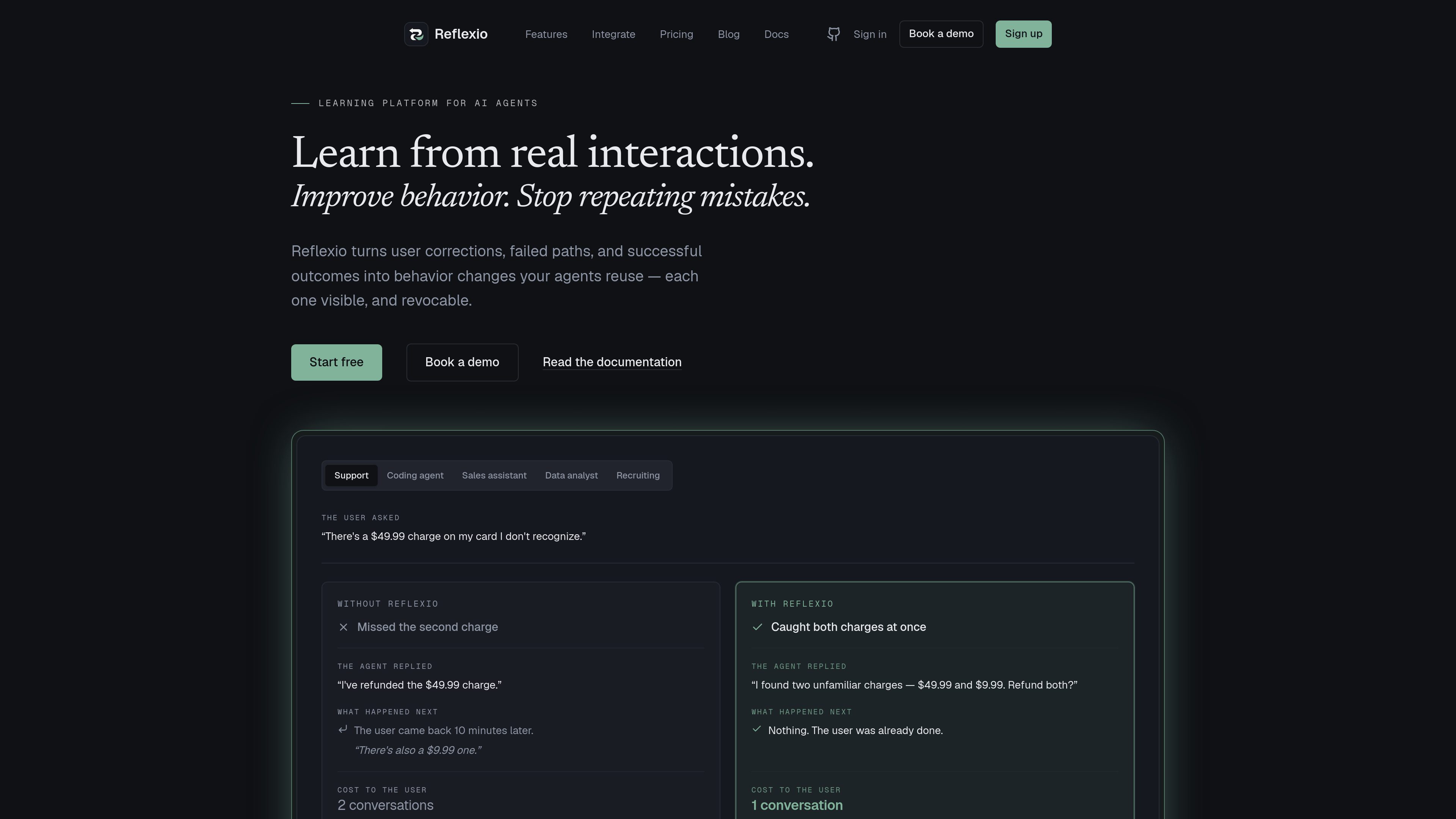
A support agent can learn to inspect the full window of recent charges before resolving one unfamiliar transaction, reducing the chance of asking the customer to return with a missed issue.
Developers can use business-specific extractors and playbooks to capture recurring coding feedback, such as how an agent should respond to a syntax or implementation error.
A sales agent can use retrieved profiles and learned playbooks to apply recurring interaction guidance when handling later conversations.
Teams can publish analyst-agent interactions and retrieve relevant learned behavior for subsequent analysis tasks, while retaining a reviewable learning record.
Teams that need local development or a customer-controlled environment can use the open-source CLI and local FastAPI backend, or discuss a BYOC deployment in their own cloud account.
The documented minimum loop retrieves profiles and playbooks before the agent responds, passes selected context to the LLM, and publishes the completed interaction afterward. The site says the SDK can wrap existing LLM calls without an agent rewrite.
No. The product describes a retrieve-and-publish learning loop rather than model retraining. Learned behavioral context is retrieved and injected at inference time.
The site documents a Python SDK, REST access, a CLI, and an integration skill for coding agents. The local open-source package includes the Python SDK, CLI, and local FastAPI server.
Yes. Learnings are presented as reviewable rules with statuses such as approved, pending, and rejected. The site states that rejecting a learning removes it from retrieval, and the API includes playbook and configuration management.
Reflexio offers a managed service, split arrangements using customer model credentials or storage, and BYOC/self-hosted deployment in AWS, GCP, or Azure. The documentation also describes a local open-source backend using SQLite by default.
I dati sul traffico sono solo a scopo di riferimento.

buildonto.dev
Onto aiuta i proprietari di siti web a rendere le pagine più facili da leggere per gli agenti AI, fornendo Markdown pulito allo stesso URL. Offre anche analisi delle visite degli agenti e un punteggio di leggibilità AIO. Gli sviluppatori possono recuperare ed elaborare contenuti web tramite la Read API o il server MCP.

weaveos.com
Weave Router è un router intelligente di modelli per agenti di programmazione. Valuta le attività di coding e instrada le richieste verso modelli aperti o chiusi, consentendo agli sviluppatori di mantenere i flussi di lavoro degli agenti esistenti e gestire velocità, qualità e spesa per i modelli.

www.monki.work
Task Monki è un’app desktop per gestire le attività degli agenti di codifica, dalla richiesta iniziale alla revisione e alla pull request. Supporta il monitoraggio delle attività, le anteprime locali, le revisioni indipendenti e la consegna tramite GitHub senza merge automatici.

agentql.com
Strumento per sviluppatori per estrarre e automatizzare dati web tramite query in linguaggio naturale, SDK Python e JavaScript e API REST.

murmell.com
Murmell è una tela accessibile dal browser per eseguire agenti di programmazione AI in sandbox cloud condivise. Permette agli sviluppatori di coordinare Claude Code, Codex, Kimi e OpenCode su un unico progetto, senza configurazioni locali né conflitti tra file.

resumecontext.com
ResumeContext è un servizio di memoria condivisa per i team di agenti di programmazione. Registra le sessioni in locale, le sincronizza con un archivio di progetto e lo rende accessibile agli agenti tramite MCP, così possono cercare il lavoro precedente e riprenderlo tra agenti, account o dispositivi.