
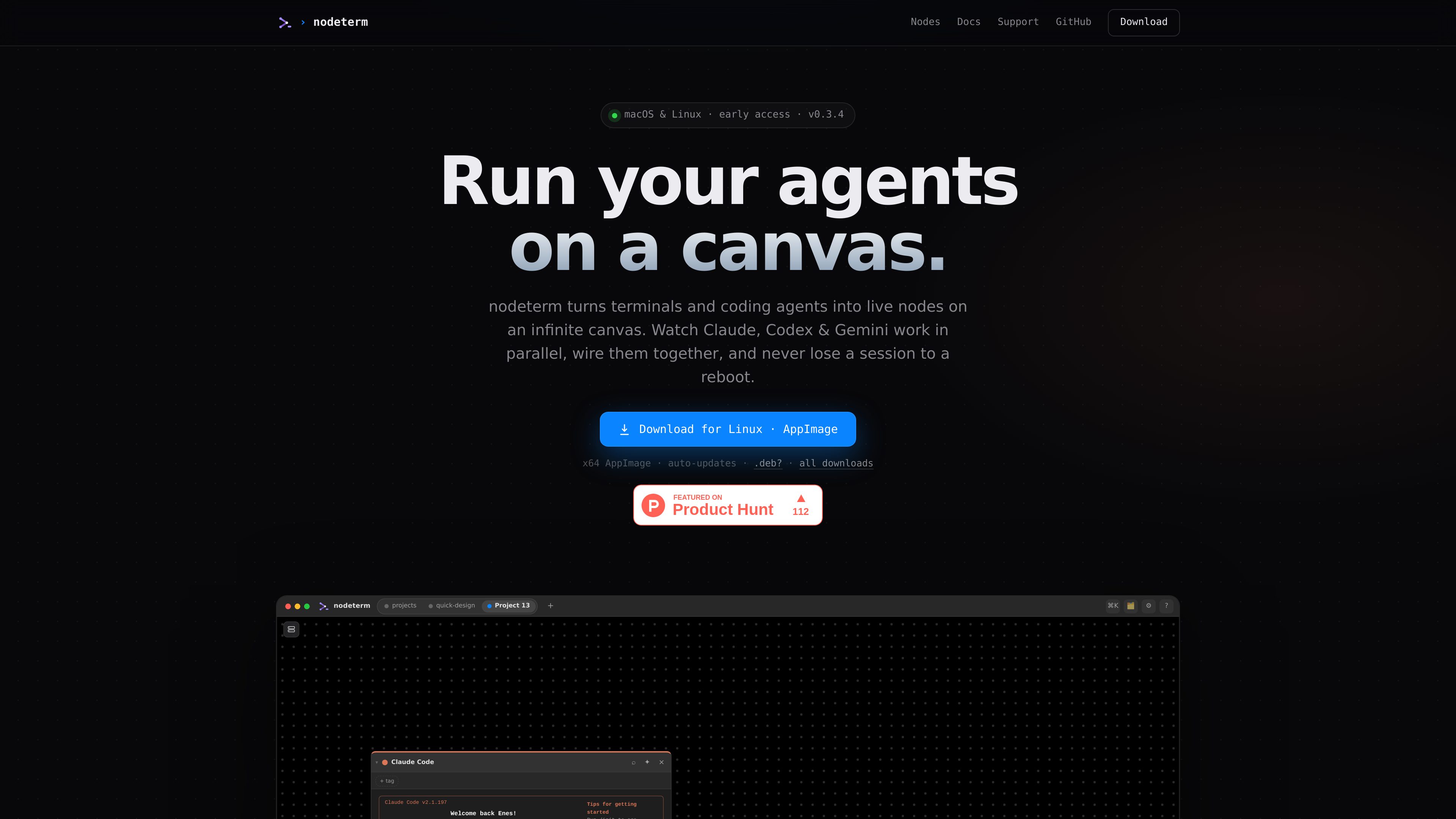
Infinite canvas layout
Pan and zoom across an open canvas to arrange terminals, agents, and related work items by project or task instead of by tab order.
nodeterm è un gestore di terminali basato su nodi che esegue agenti di programmazione come nodi attivi su una tela infinita. È pensato per chi vuole organizzare in modo spaziale terminali, sessioni degli agenti ed elementi correlati dell’area di lavoro su macOS o Linux.
nodeterm turns terminals and coding agents into live nodes on an infinite canvas. Instead of managing work in tabs, users place sessions spatially, zoom in and out, and keep related terminals, agents, and notes in view together.
The product is designed for persistent development workflows. Terminals run in tmux-backed sessions that can survive app quits and machine reboots, while agent nodes show live state such as RUNNING or NEEDS YOU, and can be wired together so one agent can read another's context.
Pan and zoom across an open canvas to arrange terminals, agents, and related work items by project or task instead of by tab order.
Run supported agent CLIs as visible nodes and watch their state change while they work, including badges for running sessions and sessions waiting for input.
Connect nodes with an edge so one Claude node can read another node's context on demand, making branching conversations easier to follow.
Keep terminal sessions alive inside tmux so processes and scrollback can return after closing the app or rebooting the machine.
Use sticky notes, group frames, a Monaco code editor, git diff views, and Claude chat nodes on the same canvas.
Use the macOS or Linux desktop app, a browser-based Server Edition on a headless Linux box, or an iOS companion for phone access.
Useful when you are running multiple coding agents across different projects and need to see which ones are busy, which ones are waiting, and which ones have spawned subagents.
Helpful for shell sessions, processes, and scrollback that need to survive quitting the app or restarting the computer without losing state.
Fits workflows where terminals, notes, code edits, diffs, and chat need to stay connected on one canvas rather than scattered across separate windows.
Supports workflows where one agent should continue from or inspect another agent's context, such as when splitting a task into related threads.
The iOS companion and relay-based session access make it possible to attach to an existing session from a phone when you are away from the computer.
nodeterm is a node-based terminal manager that presents terminals and coding agents as live nodes on an infinite canvas.
The source explicitly mentions Claude Code, Codex, Gemini, and opencode as supported agent CLIs.
Yes. The documentation says terminals run inside tmux sessions that outlive the app, and sessions can be restored after a machine reboot.
The desktop app is described as available on macOS and Linux. The docs also mention a Server Edition for headless Linux and an iOS companion.
No pricing details were accessible from the reviewed pages. The pricing URL returned a 404 page.
I dati sul traffico sono solo a scopo di riferimento.

omlx.ai
oMLX è un server di inferenza LLM nativo per macOS basato su MLX, che esegue localmente su Apple Silicon modelli compatibili linguistici, visione-linguaggio, embedding e reranker. Progettato per i flussi di lavoro con agenti di programmazione, funziona con Claude Code, OpenClaw, Cursor e client compatibili con OpenAI.

lmstudio.ai
LM Studio esegue LLM in privato su macOS, Windows e Linux, con API locali, SDK e flussi di lavoro MCP.

www.cosmicjs.com
Un marketplace per installare plugin dei fornitori sull’agente Cosmic responsabile di un’attività. È pensato per i team che utilizzano agenti Cosmic, strumenti MCP e flussi di lavoro correlati a contenuti o operazioni.

weaveos.com
Weave Router è un router intelligente di modelli per agenti di programmazione. Valuta le attività di coding e instrada le richieste verso modelli aperti o chiusi, consentendo agli sviluppatori di mantenere i flussi di lavoro degli agenti esistenti e gestire velocità, qualità e spesa per i modelli.

air.dev
JetBrains Air è un ambiente desktop per eseguire agenti di coding in parallelo, isolare le attività e rivedere le modifiche in un unico spazio di lavoro su macOS e Linux.

matrix-os.com
Matrix OS è un computer cloud e uno spazio di lavoro AI nel browser, che offre da qualsiasi dispositivo accesso a file, app, terminali, anteprime e flussi di lavoro degli agenti.