Flowise logo

Flowise

Rivendica

Flowise is an open-source platform for building AI agents and LLM workflows visually. It supports multi-agent orchestration, chat assistants, observability, and deployment on cloud or on-premises infrastructure.

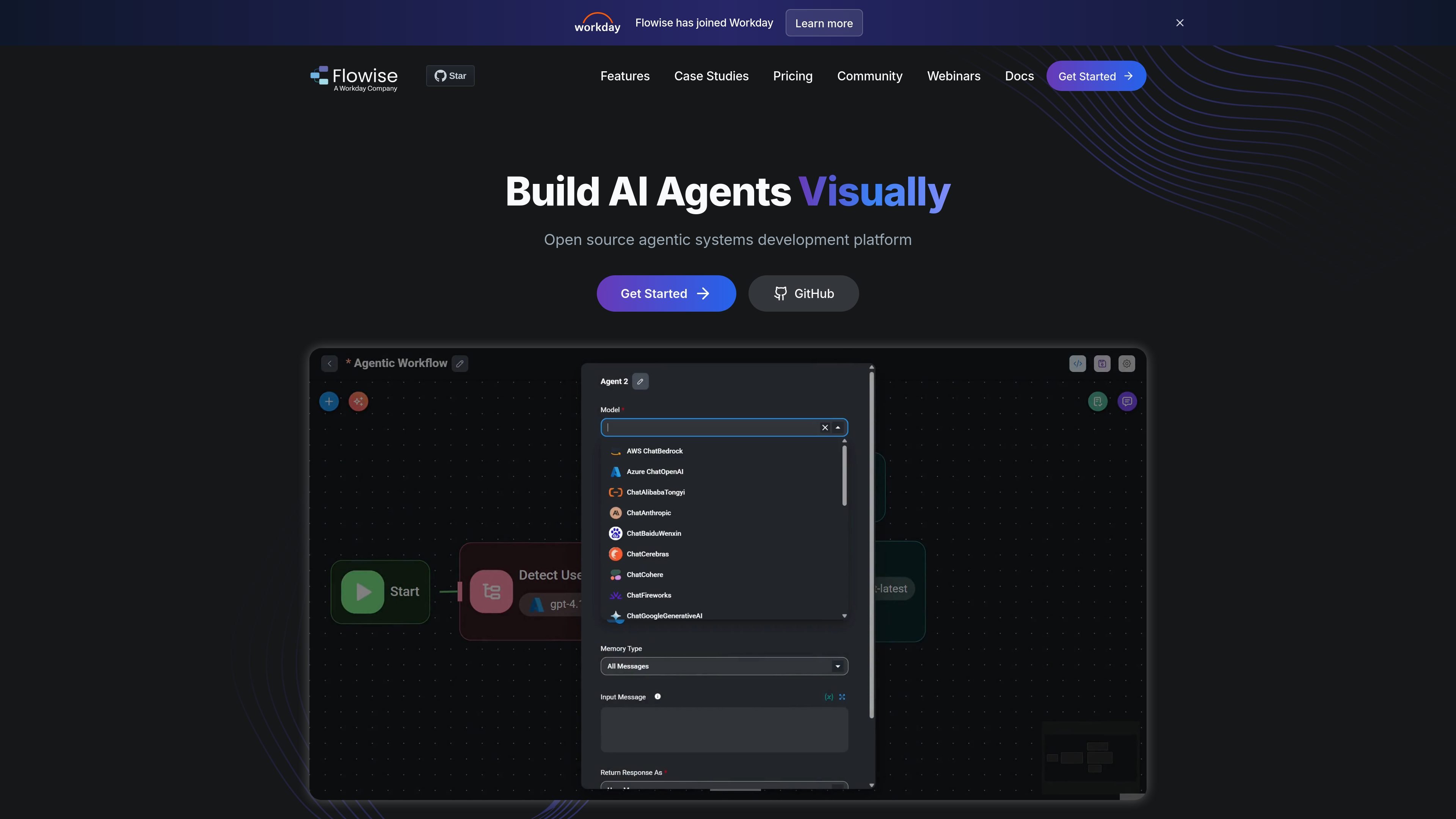
Flowise preview

Overview

Flowise is an open-source generative AI development platform for building AI agents, LLM orchestration, and related workflows. The homepage describes it as a visual system for creating agentic applications, from simple compositional flows to autonomous agents.

It is aimed at teams that want to assemble chat assistants, multi-agent systems, and retrieval-based experiences through modular building blocks rather than writing every workflow from scratch. The site also highlights developer integration through APIs, SDKs, and embedded chat, plus deployment support for cloud and on-premises environments.

Features

Agentflow for multi-agent orchestration

Build multi-agent systems with workflow orchestration spread across coordinated agents. The homepage pairs this with support for many input and data formats, including text, PDF, RTF, DOC, HTML, CSS, JS, JSON, XML, CSV, MD, and SQL.

Chatflow for chat assistants

Create single-agent chatbots and workflows that can call tools and retrieve knowledge from data sources through RAG.

Human-in-the-loop review

Add human review into agent workflows so tasks can be checked before they continue through the loop.

Execution tracing and observability

Inspect full execution traces and connect observability tooling such as Prometheus and OpenTelemetry.

Developer-facing integration options

Extend Flowise through APIs, embedded chat, and TypeScript and Python SDKs for use inside other products.

Enterprise deployment options

Run on cloud or on-premises infrastructure and scale horizontally using message queues and workers.

Use Cases

  • Multi-agent orchestration

    Assemble multi-agent systems where several agents coordinate on different parts of a workflow, with the visual builder providing the orchestration layer.

  • Chat assistants with retrieval

    Build chatbots and chat assistants that can call tools and retrieve answers from connected knowledge sources.

  • Human review workflows

    Add human review steps to workflows that need a person to approve, edit, or verify agent output before the process continues.

  • Product embedding and integration

    Integrate AI capabilities into an existing product through APIs, SDKs, or embedded chat rather than using Flowise only as a standalone app.

  • Operational deployment for teams

    Deploy AI applications in cloud or on-premises environments and scale them with workers and message queues when usage grows.

Pros and Cons

Pros

  • Open-source platform for visual AI agent and workflow building.
  • Supports both multi-agent orchestration and single-agent chatflows.
  • Includes human-in-the-loop review, execution traces, and observability hooks.
  • Offers API, SDK, and embedded chat integration paths.
  • Supports cloud and on-premises deployment with horizontal scaling options.

Cons

  • The public site does not provide a complete product documentation set in the collected source, so some implementation details remain unclear from these pages alone.
  • Pricing information is partially gated; the homepage shows example plan tiers, but the pricing page itself is sign-in only in the collected source.

FAQ

What is Flowise used for?

Flowise is an open-source platform for building AI agents and LLM workflows visually. The site positions it for users who want to create agentic systems, chatbots, and retrieval-based apps without starting from scratch.

What kinds of applications can be built with it?

The source shows Flowise supporting visual building of agentic systems, multi-agent workflows, single-agent chatflows, human-in-the-loop review, observability, APIs, SDKs, and embedded chat.

Can Flowise be deployed in different environments?

The site indicates support for cloud and on-premises deployment, with scaling via message queues and workers.

Is Flowise free?

The pricing page shows a sign-in flow and a free tier alongside paid plans, but the source does not include a public pricing table beyond the plan names and example limits shown on the homepage.

Does Flowise integrate with external applications?

The homepage highlights APIs, an embedded widget, and TypeScript and Python SDKs for extending Flowise into other applications.

Quick Facts

Category
Open-source generative AI development platform
Primary use
Building AI agents and LLM workflows visually
Deployment
Cloud and on-premises
Integration options
APIs, embedded widget, TypeScript SDK, Python SDK
Source domain
flowiseai.com
Pricing signal
Free tier plus paid plans shown on the homepage; pricing page is sign-in gated in the collected source