
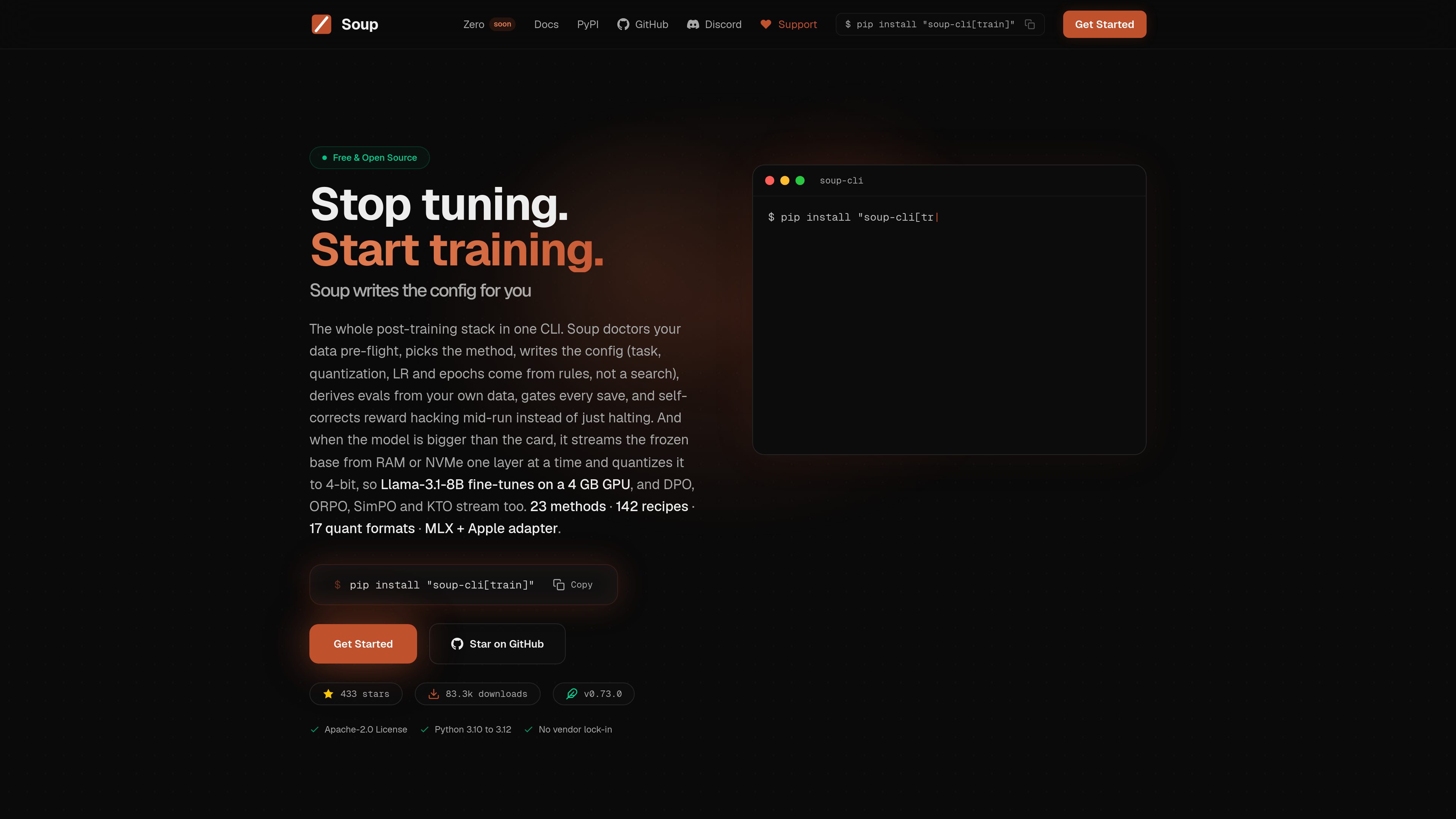
Config-driven training setup
`soup init` creates a `soup.yaml`, and the site states that Soup writes much of the training configuration automatically, including task, quantization, learning rate, and epochs when rules determine them.

Soup CLI est un outil en ligne de commande open source dédié au post-entraînement et aux workflows associés aux modèles : fine-tuning, entraînement par préférences, évaluation, fusion, déploiement et préparation des données. Il s’adresse aux personnes qui souhaitent gérer l’entraînement et la mise en production de modèles avec une seule CLI hors ligne, sur leur propre matériel ou du matériel emprunté.
Soup CLI is an offline, CLI-first toolkit for post-training language models and related workflows. It combines training setup, data preparation, evaluation, model merging, inference serving, export, and deployment commands in one interface.
Its core training workflow is designed to work from a config file generated by the tool, with rules that set many defaults automatically. The site emphasizes methods such as supervised fine-tuning and preference training, plus layer streaming so the frozen base model can stay in CPU RAM or NVMe instead of occupying full VRAM.
The product is positioned for users training on limited hardware, including cases where a model is too large to fit resident in GPU memory. The docs also show commands for migrating configs from other tools, browsing recipes, running eval gates, and pushing or deploying models to external runtimes.
`soup init` creates a `soup.yaml`, and the site states that Soup writes much of the training configuration automatically, including task, quantization, learning rate, and epochs when rules determine them.
Soup can stream the frozen base layer-by-layer from CPU RAM or NVMe into VRAM so only one layer is resident at a time, which the site says supports training models that do not fit on the card.
The training docs and home page mention support for supervised fine-tuning and preference methods including DPO, ORPO, SimPO, and KTO, with the training page stating 23 task values in the schema.
`soup train` supports `--gate` to run evaluation suites at epoch boundaries and halt on regression, and the home page says Soup derives evals from the user’s own data and gates saves on a ship/don’t-ship verdict.
`soup migrate` imports configs from tools like LLaMA-Factory, Axolotl, and Unsloth, while `soup recipes` lets users list, inspect, search, and copy from 142 ready-made recipes.
The reference includes commands for chat, serving, export, merge, push, evaluation, data validation, deduplication, generation, and dataset publishing, making the tool a broader model ops CLI rather than a training-only utility.
Use Soup when a base model is too large to load fully into VRAM and you need a streaming approach that keeps the frozen base in RAM or on NVMe.
Use it for DPO, ORPO, SimPO, or KTO runs where you want the reference model to come from the same streamed base rather than loading a second resident copy.
Use `soup migrate` to convert existing setups from LLaMA-Factory, Axolotl, or Unsloth into Soup YAML with minimal manual rewriting.
Use gating and checkpoint-related flags when you want runs to stop on eval regressions or automatically resume and push checkpoints during training.
Use Soup when you want a single workflow for data review, training, evaluation, adapter merging, deployment, and export to serving formats.
Soup CLI is a command-line tool for post-training workflows such as training, evaluation, merging, deployment, data preparation, and dataset handling.
Yes. The site says Soup can stream the frozen base from CPU RAM or NVMe layer by layer so the model does not have to stay resident in VRAM.
The site explicitly mentions SFT, DPO, ORPO, SimPO, and KTO, and the training docs describe 23 task values in the schema.
Yes. `soup migrate` is documented for importing configs from LLaMA-Factory, Axolotl, and Unsloth.
No. The CLI reference also documents chat, serving, export, merge, push, eval, and data commands.
Les données de trafic sont fournies à titre indicatif uniquement.
| mai | 0 |
|---|---|
| juin | 0 |
| juil. | 0 |
Les analyses de trafic ne sont pas encore disponibles.
Les analyses de trafic ne sont pas encore disponibles.

nuphos.ai
Nuphos est un espace de travail DevOps natif de l’IA pour les équipes d’ingénierie. Il fournit un environnement partagé où les agents d’IA peuvent apprendre l’infrastructure, analyser les incidents et exploiter les systèmes de production avec approbation humaine et traçabilité des audits.

middleware.io
Observabilité full-stack des logs, métriques, traces, infrastructures, applications et expérience utilisateur, avec OpsAI pour détecter les problèmes et faciliter leur résolution.

www.coldtea.ai
Coldtea est un environnement de livraison logicielle propulsé par l’IA pour les équipes qui souhaitent gérer au même endroit l’assurance qualité, la surveillance de la production, la détection des bugs, la création de tâches et les correctifs. Il s’exécute sur votre machine pour repérer les régressions et les problèmes de production après l’écriture du code.