
Intercepts tool calls at the boundary
Phinq observes agent tool calls before execution rather than relying on prompts or instructions the agent could ignore.

Phinq est une couche open source de gouvernance à l’exécution pour les agents IA. Elle intercepte leurs appels d’outils, les classe selon leur niveau de risque et suspend les actions les plus risquées pour obtenir une approbation humaine avant exécution.
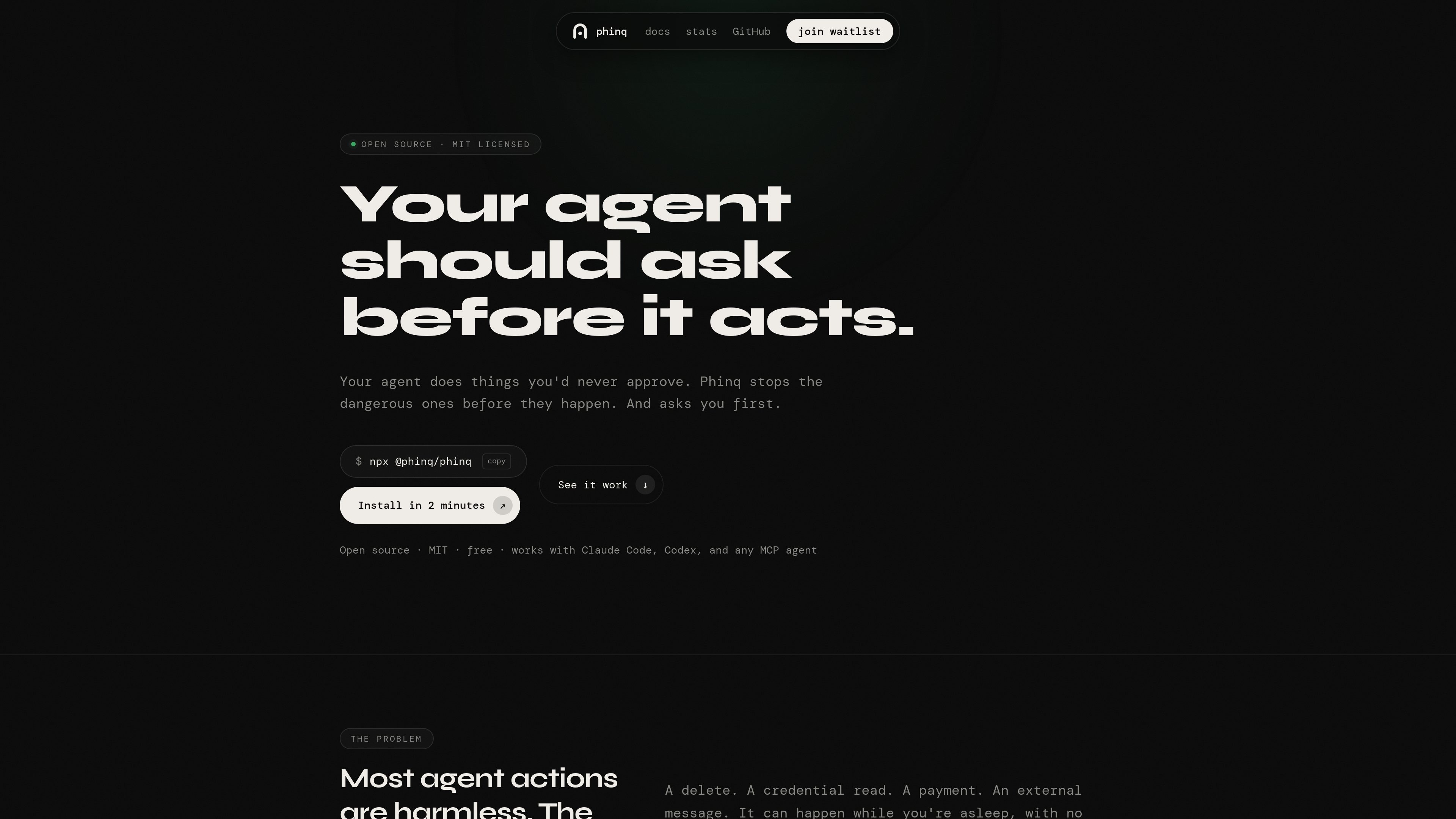
Phinq is an open source runtime governance layer for AI agents. It sits between an agent’s proposed tool call and the execution boundary, classifies the request by risk, and either allows it to pass or holds it for approval.
The product is meant to reduce damage from irreversible agent actions such as deletes, credential reads, payments, or external messages. It records each decision in an append-only, hash-chained audit log so teams can review what the agent attempted and how the request was resolved.
Phinq observes agent tool calls before execution rather than relying on prompts or instructions the agent could ignore.
The system evaluates the proposed action using the tool name, arguments, and session velocity, then returns an allow or hold decision.
Higher-risk actions are paused instead of forwarded until a human approves them through the configured channel.
If a held action is denied or times out, the action is blocked and never reaches the tool.
Every decision is written to an append-only JSONL log with SHA-256 chaining so later edits, reordering, or deletion can be detected.
Phinq can run as a proxy, an in-process SDK, or a plain HTTP gate, and the docs list compatibility with OpenAI-style, Anthropic Messages, Gemini, and MCP-based clients.
Use Phinq when an assistant may need to delete records, read credentials, send payments, or dispatch messages, but you want a human decision point before the action reaches the tool.
Teams can place Phinq at the proxy, SDK, or HTTP boundary instead of rewriting the agent workflow, which makes it suitable for systems already using compatible clients or MCP.
Phinq is useful when you need to review what an agent attempted, how it was classified, and whether it passed, held, approved, denied, or timed out.
The docs say the proxy starts in shadow mode by default, which lets teams classify and log traffic before enforcing holds in production.
Phinq is a runtime governance layer for AI agents that intercepts tool calls, classifies them by risk, and holds higher-risk actions for human approval before execution.
The docs say it evaluates the proposed tool call using the tool name, arguments, and session velocity, then returns allow or hold.
No. The documentation says the proxy starts in shadow mode by default, meaning it classifies and logs traffic first and only enforces HOLD decisions when enforcement is enabled.
The action becomes a pending approval instead of being forwarded. It can then be resolved through the configured channel; denied or timed-out holds are blocked.
Yes. The audit log is append-only JSONL and each entry is chained with SHA-256, so changing, reordering, or deleting entries breaks verification.
Les données de trafic sont fournies à titre indicatif uniquement.

panguard.ai
Panguard AI est une plateforme de sécurité open source pour les agents IA. Elle analyse les skills et les serveurs MCP avant leur exécution et protège les actions des agents à l’exécution, avec des contrôles auto-hébergés et des preuves de conformité signées pour les développeurs, fournisseurs d’IA et équipes réglementées.

kastra.ai
Kastra est une infrastructure d’autorisation pour les systèmes d’IA qui vérifie les prompts, appels d’outils, commandes shell, requêtes API et actions du navigateur avant leur exécution. Elle aide les équipes à appliquer les politiques, conserver des journaux d’audit signés et gouverner les workflows d’IA locaux et d’entreprise.

www.privent.ai
Privent est une couche de sécurité à l’exécution pour l’IA agentique, notamment les workflows n8n. Elle masque les données sensibles avant leur transmission aux modèles externes, conserve une trace des décisions de risque et surveille l’usage organisationnel de ChatGPT, Claude et Gemini.

arcade.dev
Arcade est un environnement d’exécution MCP pour les agents IA en production, qui associe autorisation des agents, outils fiables et gouvernance. Il aide les équipes à connecter les agents aux systèmes réels grâce à des déploiements flexibles et à des offres allant du gratuit à l’entreprise.

sim.ai
Sim est un espace de travail IA open source pour créer, déployer et gérer des agents IA, avec workflows visuels, Chat, accès API, intégrations et outils collaboratifs.

sparkco.ai
Sparkco : infrastructure open source pour agents IA, outils orientés terminal, workflows de marchés prédictifs et forfaits d’agents vocaux à l’usage avec crédit offert, SMS, transcriptions et intégrations.