K-Dense Web logo

K-Dense Web

Revendiquer

K-Dense Web is a fully hosted AI agent for research and analysis across science, engineering, healthcare, finance, and more, with code execution and database access.

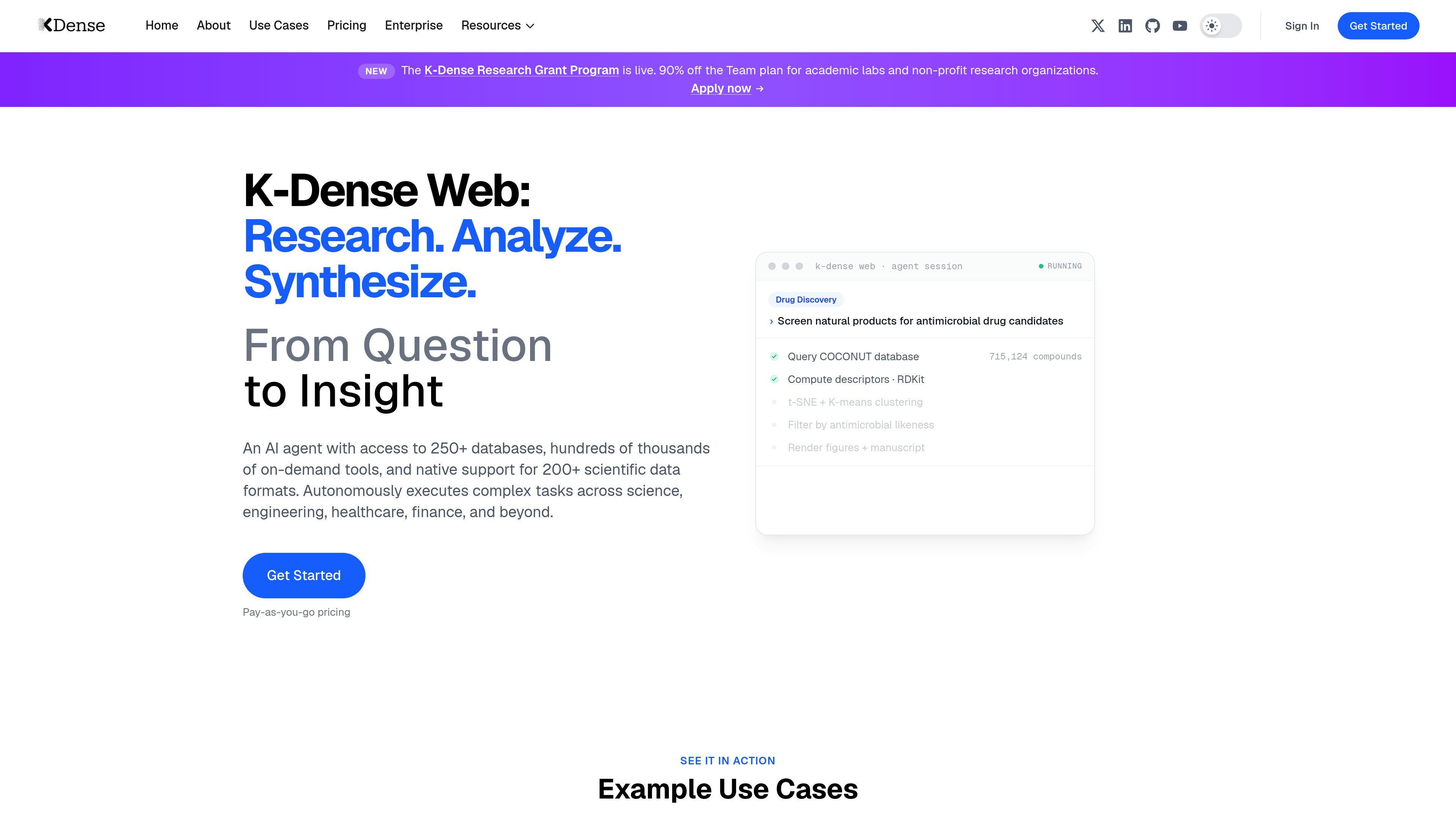
K-Dense Web preview

What K-Dense Web is and what it does

K-Dense Web is a fully hosted AI agent platform for research and other complex analytical work. It is positioned for tasks across science, engineering, healthcare, finance, and related fields, with a workflow that starts from a question or dataset and ends with analysis, figures, and publishable deliverables.

The product emphasizes real execution rather than chat-only interaction. According to the site, K-Dense Web writes and runs code, connects to databases, reads scientific instrument files, and supports more than 200 scientific data formats, 250+ databases, and on-demand tool generation from Python packages.

Its stated use cases include research sessions in science, finance and investment, engineering, health and climate, geopolitics and strategy, and synthetic biology. The pricing page shows self-serve Personal, Plus, and Team plans, plus a custom Enterprise plan for organizations that need private connectors, security controls, and dedicated support.


Platform capabilities

Database access

K-Dense Web connects to more than 250 databases, including scientific, clinical, financial, and chemical sources. The site specifically names PubMed, ChEMBL, UniProt, SEC EDGAR, and FRED, along with multi-database packages such as BioServices and BioPython.

On-demand tool execution

The platform writes and runs code on demand, so it is not limited to a fixed set of prebuilt actions. The site says this exposes capabilities from hundreds of thousands of tools generated from Python packages.

Python package support

K-Dense says it can use 500,000+ Python packages, with curated optimizations for common scientific and research libraries such as RDKit, Scanpy, scikit-learn, PyTorch, BioPython, and statsmodels.

Scientific data compatibility

Native format support covers more than 200 scientific data formats across domains such as genomics, medical imaging, mass spectrometry, astronomy, materials science, flow cytometry, and geospatial data.

Publish-ready outputs

The platform produces manuscript-ready papers, presentation slides, posters, PDF reports, interactive visualizations, schematics, and figures so outputs can be shared or published rather than copied from a notebook.

End-to-end task execution

The FAQ describes K-Dense as a workflow that ingests data or a goal, breaks work into multi-step analyses, and produces professional reports and visualizations on hosted cloud infrastructure.

Practical use cases

  • Research synthesis and reporting

    Run multi-step literature or database-driven research that needs querying, filtering, analysis, and a written output in one session. The site shows examples that move from a question to database queries, computed descriptors, clustering, and a PDF report.

  • Scientific data analysis

    Work with scientific data that arrives in domain-specific formats rather than clean spreadsheets. K-Dense says it can read formats across genomics, imaging, spectroscopy, materials science, and other fields, then carry the data into analysis and output generation.

  • Financial and market analysis

    Use the platform for financial, market, or investment research that combines public sources, code execution, and structured reporting. The site positions the product for finance and investment as well as broader competitive intelligence work.

  • Technical and applied domain work

    Analyze engineering, healthcare, or climate datasets where the job includes validation, modeling, and presentation-ready outputs. The homepage and FAQ both describe support for technical analysis and end-to-end task execution in these domains.

  • Team-based research workflows

    Share completed sessions with collaborators through public links, or use the Team plan when a group needs a shared credit pool and unlimited seats. The pricing page and FAQ both indicate team-oriented workflows are part of the product design.

Pros and Cons

Pros

  • Combines data access, code execution, and analysis in one hosted platform.
  • Supports a wide range of scientific file formats and common analytical packages.
  • Produces outputs intended for publication or presentation, not just intermediate code.
  • Offers self-serve pricing for individuals and shared-credit team usage for groups.
  • Includes a separate research grant program that discounts the Team plan for eligible academic and nonprofit organizations.

Cons

  • The site does not publish a complete list of supported integrations or data sources, so buyers with specialized systems may need to confirm fit.
  • Some workflow details are high level, especially around onboarding and how much setup is needed before a session can run.
  • Enterprise-only controls and custom deployment options are described separately from the web product, so organizations with strict requirements may need a higher-tier plan.

FAQ

How does K-Dense Web work?

K-Dense Web is a fully hosted AI agent platform. You can sign up, describe a goal or upload data, and the system breaks the task into steps, runs analyses, and returns reports and visualizations.

What is the difference between K-Dense Web and K-Dense Enterprise?

K-Dense Web is the self-service product for individuals and small teams. K-Dense Enterprise adds custom integrations, private data connectors, enterprise security options, custom UI/branding, team management, and dedicated support.

How is K-Dense Web priced?

The pricing page shows Personal as pay-as-you-go, Plus at $199 per month or $1,799 per year, Team at $499 per month or $4,499 per year, and Enterprise as custom pricing. The open-source Scientific Agent Skills and K-Dense BYOK are separate MIT-licensed options.

Can teams collaborate in K-Dense Web?

K-Dense supports sharing sessions via public links in K-Dense Web. Enterprise includes broader collaboration features such as shared workspaces, role-based access control, team management, usage analytics, and administrative controls.

What file formats does K-Dense support?

K-Dense says it supports common formats such as CSV, Excel, JSON, PDF, FASTA, FASTQ, PDB, and SDF, plus many scientific instrument and analysis formats. Enterprise customers can request custom data connectors for proprietary formats.

Quick Facts

Category
AI agent platform
Platform
Fully hosted cloud workspace
Primary users
Researchers, analysts, and technical teams
Source domain
k-dense.ai
Pricing
Paid plans with Personal, Plus, Team, and custom Enterprise options
Team usage
Supported through Team plan shared credits and unlimited seats