
Scoped workspaces and tenant boundaries
Create workspaces for customers, teams, projects, or agents, then attach integrations with aliases, connection strategy, and scoped permissions so each environment stays separated.

Weavz is a governed app access layer for AI agents and SaaS products, connecting apps with scoped credentials, approvals, files, state, and MCP access.
Weavz is a governed app access layer for AI agents and SaaS products. It sits between AI clients or backend workflows and third-party business apps, so teams can connect accounts, execute actions, receive events, and preserve scoped state without building every connector or approval flow themselves.
The product is centered on workspaces. Each workspace can mount integrations such as Slack, Gmail, HubSpot, Salesforce, or internal APIs, then expose approved tools to agents through MCP, SDKs, or direct action calls. The source describes Weavz as useful for chat-based assistants, copilots, automations, and embedded workflow products that need credentials, approvals, files, state, and audit in one controlled environment.
Create workspaces for customers, teams, projects, or agents, then attach integrations with aliases, connection strategy, and scoped permissions so each environment stays separated.
Expose app actions through hosted MCP servers and Code Mode or Tool Mode, allowing agents to discover typed APIs, run parallel calls, and execute multi-step workflows.
Use Human Gates and input partials to review sensitive actions, lock defaults, prefill fields, or hide preset values from tool schemas before execution.
Persist files and key-value state at workspace, user, or external-ID scope so agents can keep artifacts and checkpoints across runs.
Provision customers, workspaces, connect links, MCP servers, and scoped tokens through API, TypeScript SDK, Python SDK, CLI, or dashboard.
Connect approved accounts through hosted links and manage org- or workspace-scoped API keys for customer-facing automation.
Give a customer-facing AI feature access to the customer’s own connected apps while keeping credentials, state, and permissions isolated per workspace.
Connect ChatGPT, Claude, Cursor, or another MCP client to a governed workspace so the agent can act on approved business tools instead of raw credentials.
Create a workspace with files, state, Human Gates, and aliases for recurring tasks such as support follow-up, research, or internal operations.
Provision workspaces, end users, connect links, and scoped tokens from your backend when building an AI-native application.
Expose selected actions through MCP or direct APIs when you need a controlled integration surface for internal tools, coders, or agent frameworks.
Weavz is designed to be used through the dashboard, API/SDKs, MCP servers, CLI, or directly from supported AI clients. The docs describe a first-day flow that starts with creating a workspace, adding integrations and end users, setting partials or Human Gates, and then testing the flow in Playground.
The source lists Slack, GitHub, Google Sheets, Notion, Salesforce, Gmail, Google Calendar, HubSpot, Airtable, Asana, Jira, Dropbox, Shopify, Stripe, Zendesk, and many others. The homepage also says Weavz connects to 1,000+ apps, but the exact supported list is broader than the examples shown here.
Yes. The homepage and docs say Weavz supports ChatGPT, Claude, Cursor, Codex, Claude Code, VS Code, Cline, Gemini CLI, OpenCode, and other MCP-compatible clients, along with custom remote MCP clients.
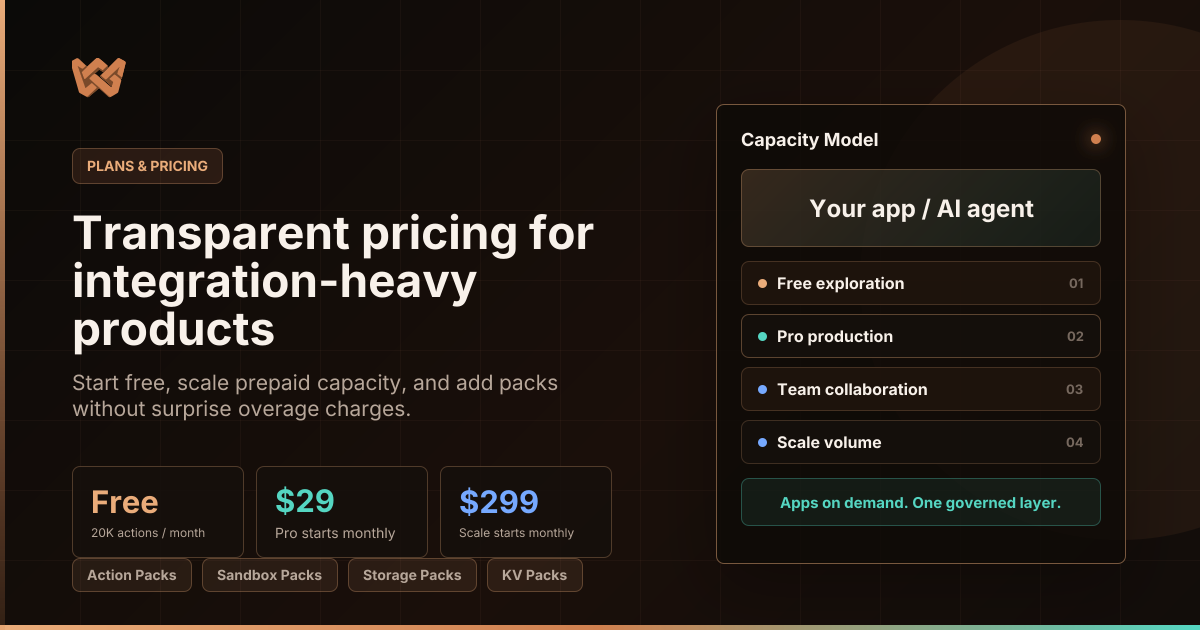
The pricing page shows a Free plan and paid plans for Pro, Team, and Scale, plus an Enterprise option with custom pricing and contract-based capacity. The Free plan is intended for exploring agents, actions, and state, while paid tiers increase capacity and included primitives.
Weavz is built around governed access: connections are scoped to organizations, workspaces, or end users, and Human Gates can pause sensitive API, SDK, MCP, Playground, or trigger actions until a reviewer approves them.