
Multi-step admissions process
Admissions include an application form, a remote video interview, and a possible admissions call before a decision is made.

Turing College is an online school for people who want to build practical tech skills through self-paced, project-based programs. It serves busy professionals, career switchers, and learners looking for job-ready or promotion-ready training in data, software, and AI topics.
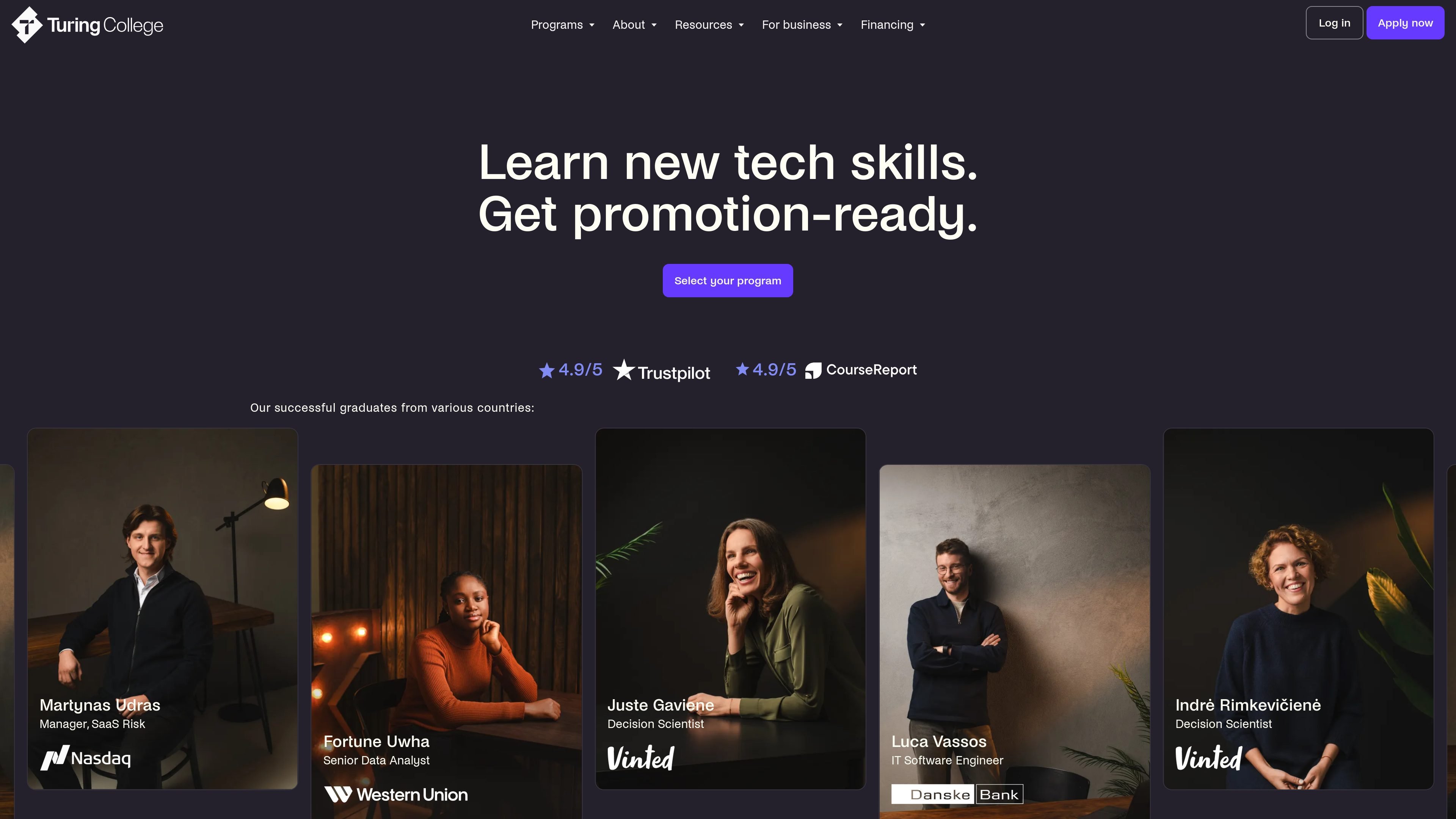
Turing College is an online school for people who want to build practical tech skills while studying around work and other responsibilities. Its programs cover areas such as data analytics, data science and AI, software and AI engineering, AI for business, AI engineering, AI ethics, and building with AI.
The learning model is built around short sprints, real projects, and feedback from senior professionals rather than lectures. Learners study online at their own pace, work in cohorts, and receive career support aimed at helping them become job-ready or promotion-ready.
Admissions include an application form, a remote video interview, and a possible admissions call before a decision is made.
Programs use short intensive sprints inspired by Agile methods, with 9 to 24 sprints depending on the program.
Learning is self-paced, with no lectures and pre-recorded material that students can access online whenever it fits their schedule.
Each sprint includes a practical project based on real-life industry work, and project reviews happen in two 1-on-1 assessments.
Students receive weekly feedback, support from senior professionals, and guidance from junior and senior team leads, plus career coaching.
The school groups learners into cohorts and uses community chat, stand-ups, and open sessions to keep peers connected.
A working professional can study on a flexible schedule, use pre-recorded materials, and fit learning around a job or family responsibilities.
Someone aiming for a new role in data, software, or AI can use the project-based curriculum, feedback, and career support to build a portfolio and prepare for interviews.
A learner who wants practical work samples can complete sprint projects that resemble real industry tasks and use the reviews to improve their output.
A person seeking progression in their current role can use the employer-adapted curriculum and structured support to gain skills relevant to promotion.
A learner who values peer input can join weekly stand-ups, open sessions, and community chat to stay accountable and learn with others.
Turing College uses a self-paced online format with no lectures. Learners work through curated material, weekly stand-ups, project reviews, and 1-on-1 feedback from senior professionals and other reviewers.
The site presents Turing College as an online school for people who want flexible study around work and life. It is designed for learners who want practical skills, project work, and career support rather than lecture-based classes.
Programs are organized into learning sprints. Depending on the program, there are 9 to 24 learning sprints, and each sprint ends with a practical project and review process before the next sprint begins.
The source states that students receive a certificate of completion after finishing a program. It does not list any formal degree or university credential.
The available sources do not show pricing details. The site does mention financing-related pages and a Germany-specific Bildungsgutschein path, but the pricing page itself is not available in the collected sources.